Dismissal during illness in Switzerland: protection periods

At a glance
After the probation period, your employer cannot dismiss you while you are ill or injured through no fault of your own: for 30 days in your first year of service, 90 days in the second to fifth, 180 days from the sixth. The whole pregnancy and the 16 weeks after the birth are protected too, as is the time around longer military or civilian service. Notice given during this time is void. If it came before, the notice period stops and resumes afterwards, usually running on to the next month end.
The rules fit into a few sentences. The hard part is the arithmetic: when does the period start, what counts as a new illness, and why can two weeks of flu keep you employed for a whole extra month? We work it through with examples using real dates, and use six Federal Supreme Court rulings to show how the courts apply the rules.
What a protection period is and who it protects
A protection period, also called a blocking period (in German Sperrfrist), is a time during which your employer cannot give you ordinary notice. The law calls this termination "at an inopportune juncture" and sets it out in Article 336c of the Code of Obligations. The idea behind it comes from the Federal Council's dispatch, which the Federal Supreme Court quoted again in 2024: someone who is ill is unlikely to find a new job, because no new employer knows how long the illness will last. The protection period is meant to stop your notice period from running during exactly that time.
The protection has three limits you should know. It only applies after the probation period. It only applies when the company gives notice, not when you resign. And it only covers ordinary dismissal with notice, not summary dismissal. More on that below.
Within these limits, the protection is mandatory. An employment contract or a collective employment contract cannot shorten the protection periods (Article 362 CO), only lengthen them. How long they last depends on the reason. The most common one is illness.
How long does the protection period last during illness or accident?
The longer you have been with the company, the longer you are protected. What counts is the year of service, meaning the time since your first working day at this company, not the calendar year.
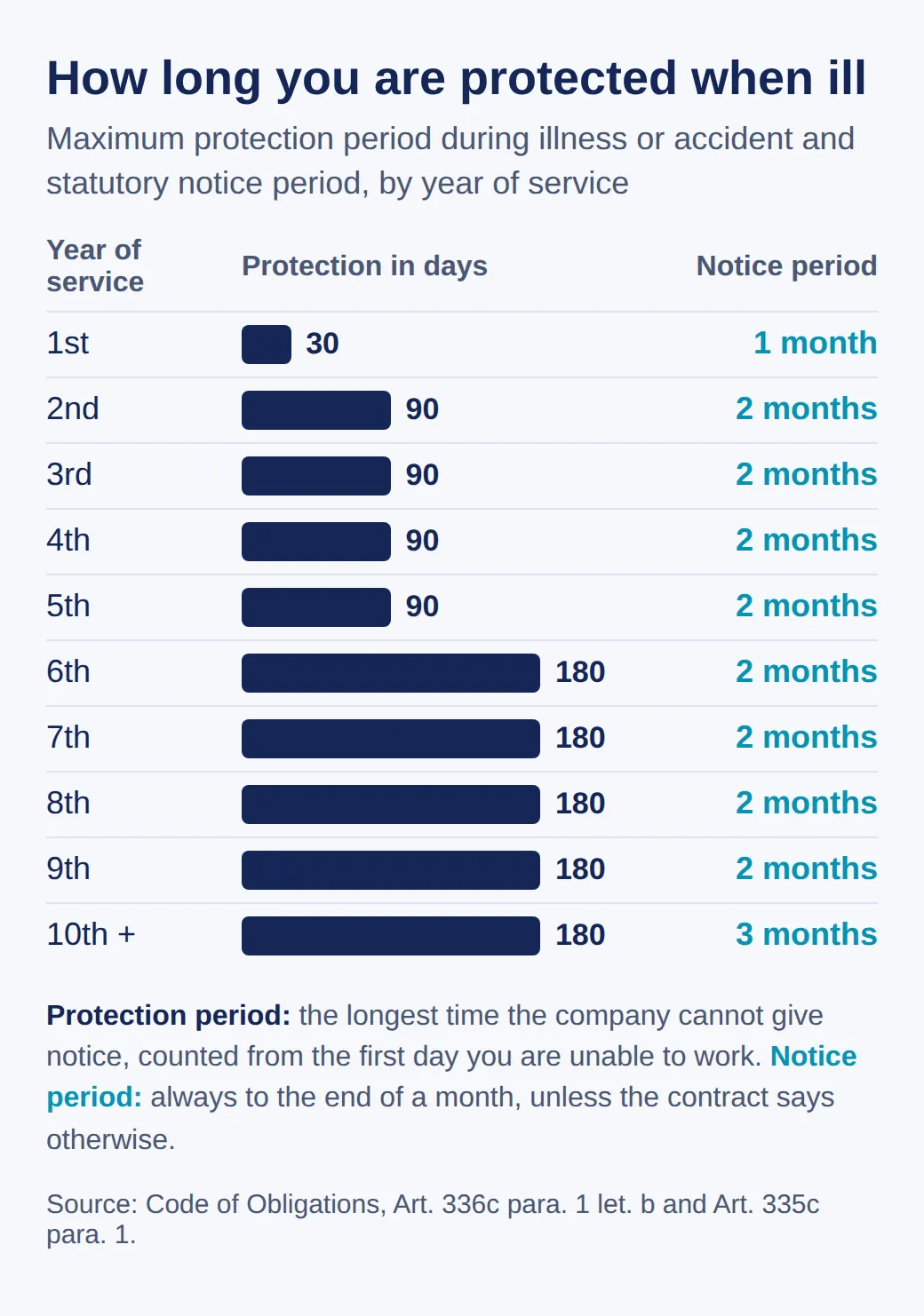
The days count from the first day you are unable to work, and they are calendar days, weekends included. The figures are maximums. If you are well again after two weeks, the protection ends after two weeks. It also applies if you are only partly unable to work, say at 50 percent: the law expressly says "partially or entirely". The Basel-Stadt Office of Economy and Labour works through an example in its guidance on protection periods (in German): ill from 14 June 2025 in the fourth year of service, and only 50 percent unable to work from 21 July. Even so, the company could not give notice until 12 September, when the 90 days were up.
Nor does it matter whether you knew you were ill. In 2002 the Federal Supreme Court declared void the dismissal of the general secretary of a sports federation based in Lausanne, who, without knowing it, had leukaemia when he received the letter (BGE 128 III 212, in French). According to that ruling, the only exception is an illness so minor that it does not stop you in any way from starting a new job.
What if your year of service changes during the illness?
Then the longer period applies, counted from the first day of illness. The Federal Supreme Court decided this in 2007 in the case of a metalworker from the canton of Vaud (BGE 133 III 517, in French). He had started on 5 May 2003, received notice on 7 April 2004 for 7 May, and fell ill on 24 April. The company wanted to grant him only 30 days of protection, because he had fallen ill while still in his first year of service. The court gave him 90 days, because the illness reached into his second year. The notice period was suspended from 24 April to 22 July, the remaining 13 days ran until 4 August, and because his contract set notice to end on the same day of a later month, the job ended on 7 August 2004.
Basel-Stadt calculates it the same way in its guidance: ill from 25 April 2025, moving into the sixth year of service on 12 July. From then on 180 days apply, minus the 78 that have already passed, so the protection runs until 21 October 2025. But what if the company gives notice during such a period anyway?
Notice given during illness is void
Notice you receive during a protection period is void. It has no effect, not even later. Once the protection period is over, the company has to give notice again, with the full notice period (Article 336c para. 2). If it does not, your employment simply continues.
Here is an example with our own figures. You are in your third year of service and signed off sick from 3 March 2026. On 20 March the notice arrives by post. It is void, because your 90-day protection period runs until 31 May. The company can give notice again on 1 June at the earliest, and with two months' notice to the end of a month, your job then ends on 31 August 2026 at the earliest.
What counts is the day you receive the notice, not the date on the letter. And once the protection period is over, the company may give notice even if you are still ill. Such a notice is valid in principle, as the employers' association Swissmem (in German) shows with several Federal Supreme Court rulings. Only a different illness or a new accident brings a new protection period, as we explain below. It is a different story if the notice came before you fell ill.
Ill during your notice period: how to calculate it
If you received notice before you fell ill, it remains valid. But the notice period is suspended while the protection period runs, and resumes afterwards. If the new end date does not fall on a termination date, usually the end of a month, it is extended to the next one (Article 336c para. 3).
What matters is where you count from. The notice period is counted backwards from the termination date, not forwards from the day the letter arrived. The Federal Supreme Court expressly confirmed this method in 2008 (BGE 134 III 354, in German). If notice is given for 30 June with two months' notice, the period runs from 1 May to 30 June, whether the letter came in March or in April. For you, this means that an illness which is over before the notice period starts shifts nothing, because the period was not yet running.
The following worked example shows why two weeks of flu can make such a difference. You are in your fourth year of service, receive notice on 28 April 2026 for 30 June, and are ill from 1 to 14 June.
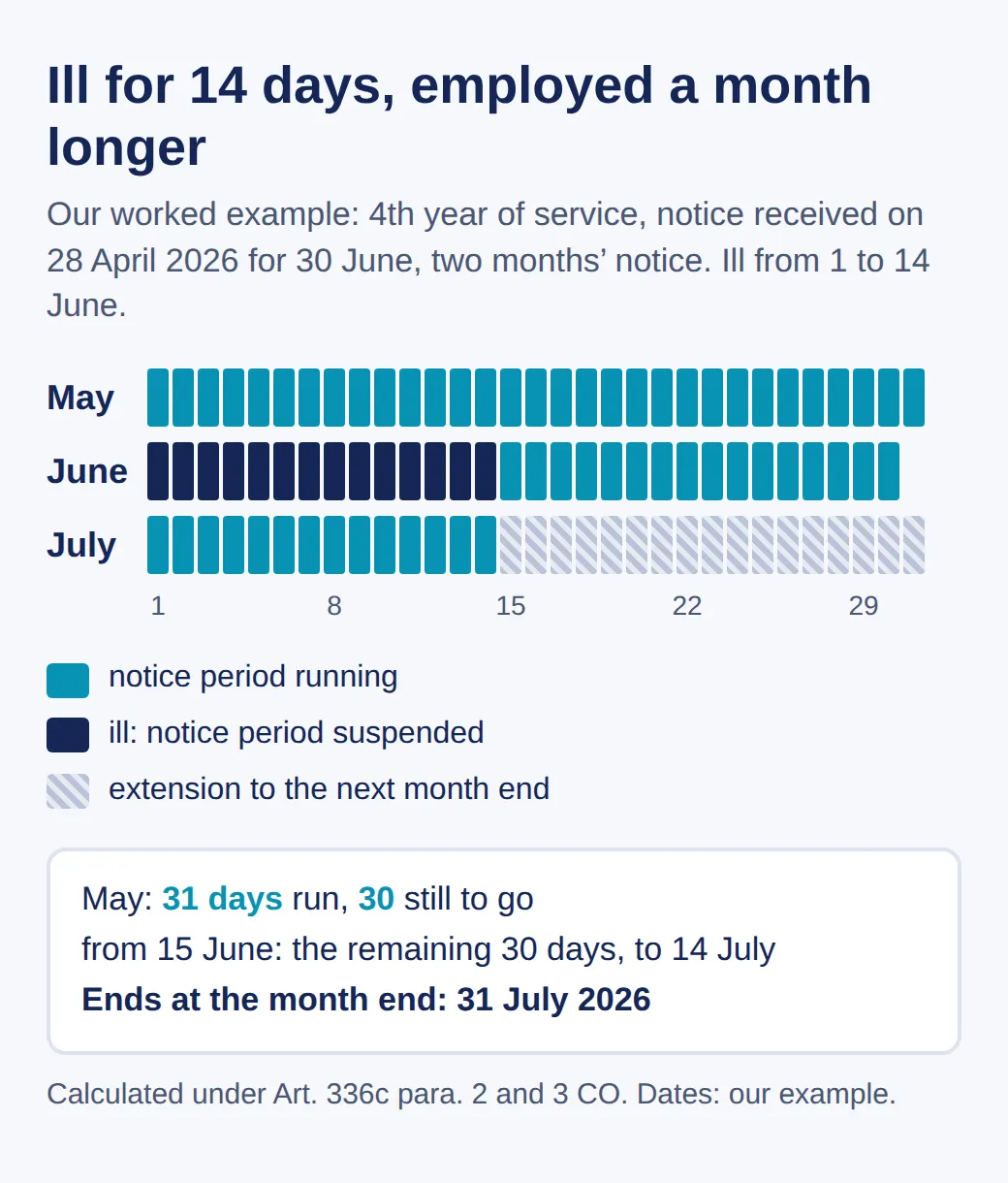
By the end of May, 31 of the 61 days of notice have run. From 15 June the remaining 30 run, until 14 July. Because the notice period has to end at the end of a month, your employment only ends on 31 July 2026. Fourteen days off sick, a month longer in the job, and paid for it once you are back at work.
The second example shows that the protection period is a cap, even if you are ill for longer. You started on 1 March 2026 and your probation is over, so you are in your first year of service. On 25 September you receive notice for 31 October, with one month's notice. From 10 October you are ill until mid-December. Your protection period lasts 30 days, until 8 November. From 1 to 9 October, 9 days of the notice period ran; the remaining 22 run from 9 November, even if you are still ill by then. They end on 30 November, the end of a month. So your job ends on 30 November 2026.
The 2008 Federal Supreme Court case, by the way, was not about illness but about a pregnancy, and the pause lasted more than a year. We come back to it further down. First, a question that comes up in almost every dispute: what happens when a second illness comes along?
A new illness brings a new protection period
Every different illness and every new accident triggers its own full protection period, even if one was already running. The Federal Supreme Court decided this in 1994 (BGE 120 II 124, in French). The case came from Geneva. A cashier who had been with the same company since 1973 had an accident on 1 November 1990 and could not work until the end of February 1991. On 9 March 1991 she had a second accident, unrelated to the first, and from July she worked at 50 percent. On 29 August the company gave her notice. Counted from the first accident, the 180 days were long over; counted from the second, only 173 days had passed. The notice was void, and the company had to pay her wages for December 1991 to February 1992.
Basel-Stadt also states this as a principle and gives an example from the second year of service. A first illness lasts from 4 January to 6 April 2025, the protection period runs until 3 April, and notice is possible from 4 April at the earliest. A second illness, from 20 May to 30 June, triggers a new protection period, during which the company again cannot give notice.
For your medical certificate, this means it pays to have it state clearly from when, and to what percentage, you are unable to work. Whether it is a new illness is often the deciding question in a dispute. Yet there are cases where even a valid certificate does not protect you.
When the protection period does not protect you
In some cases the protection period does not help you, even if you are ill. Basel-Stadt lists them in its guidance, and several come up often in everyday working life.
- During probation. Notice given during the probation period stays valid even if you are ill. However, the probation period is extended by the days you were ill (Article 335b para. 3). There is more on this in our article on the probation period.
- If you resign yourself or sign a termination agreement, that is, an agreement by which both sides end the employment.
- With a fixed-term contract that ends on the agreed date.
- With summary dismissal. But illness itself is never grounds for one. A court may never accept being prevented from working through no fault of your own as good cause (Article 337 para. 3).
The trickiest case is an incapacity for work that only concerns your workplace, for example a medical certificate because of a conflict with your manager, while you could work somewhere else. In ruling 1C_595/2023 of 26 March 2024, the Federal Supreme Court confirmed that no protection period applies in that case. It concerned an army instructor with an anxiety disorder and depression which, according to the medical reports, had been triggered by problems at his workplace. The ruling dealt with federal staff, but it relies expressly on the case law on Article 336c CO. According to Swissmem (in German), in practice it is the company that has to prove the illness only concerns the workplace.
A dismissal outside the protection period can still be unfair, for instance if the company caused the illness by failing to take the protective measures it should have. The Federal Supreme Court only accepts this in flagrant cases. That is a topic of its own, with its own deadlines, which we explain in our article on unfair dismissal. The longest protection the law offers, though, goes to pregnant women.
Pregnancy and maternity
Throughout your pregnancy and for the 16 weeks after the birth, the company cannot dismiss you. The protection starts on the first day of the pregnancy, not on the day you or the company find out about it. If it only turns out after the notice that you were already pregnant at the time, the notice becomes void retroactively, according to Basel-Stadt.
A case from Geneva shows how closely the courts look (BGE 136 III 562, in French). A counter assistant at a café-restaurant had agreed a three-month probation period and taken just over a month of unpaid leave in between. The company gave her notice on 29 January 2009, when she was already several months pregnant, arguing that her probation was not yet over because of the leave. The Federal Supreme Court disagreed: unpaid leave does not extend probation, hers had ended, and the notice was void.
If you were given notice before the pregnancy began, the same calculation applies as for illness, only the pause lasts much longer. In the 2008 case, a sales assistant with almost 14 years of service received notice on 2 August 2006 for the end of the year, with three months' notice.
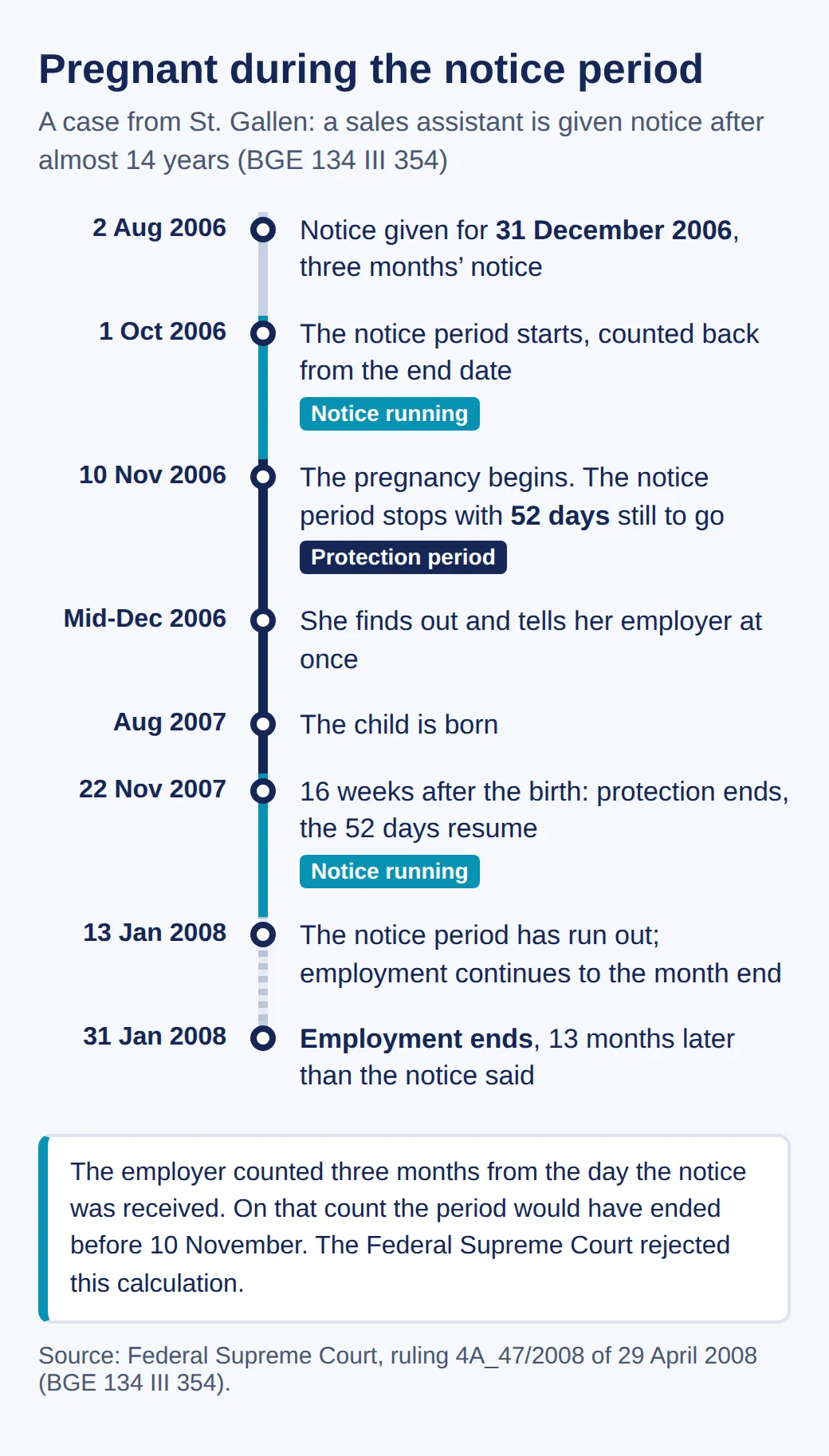
The pregnancy began on 10 November 2006, in the middle of the notice period, with 52 days still to go. After the birth in August 2007 the protection period ran until 22 November 2007, then the 52 days resumed and ran until 13 January 2008, and at the end of that month the job ended on 31 January 2008. The company wanted to count forwards from the day the notice was received. On that count the period would have run out before 10 November, and that is exactly the calculation the Federal Supreme Court rejected.
Around the birth, further protected periods apply, added to the law in 2021 and 2024:
| Situation | Protection under Article 336c CO |
|---|---|
| Newborn in hospital, maternity leave extended | until the extended leave ends |
| Two extra weeks of leave after the death of the other parent | from the first to the last day of leave taken, at most three months beyond the 16 weeks |
| Care leave for a seriously ill child | as long as you are entitled to it, at most six months |
| Leave for the other parent after the mother's death | while this leave is being taken |
For the regular leave of the other parent, usually the father, there is no protection period, but there is an extension: if the company gives notice and you are entitled to these two weeks but have not yet taken all of them, the notice period is extended by the days still outstanding (Article 335c para. 3).
Military service, civilian service and civil defence
While you are doing military service, civil defence service or civilian service, the company cannot dismiss you. If the service lasts more than eleven days, the four weeks before and after it are protected too. This means compulsory Swiss service, as Article 336c para. 1 let. a states.
Here is an example with our own dates. You serve from 7 to 25 September 2026, which is 19 days. That protects you from 10 August to 23 October 2026. A notice letter that arrives during this time is void. If it came earlier, the notice period is suspended during this time, just as with illness. For service of eleven days or less, the protection only applies during the service itself.
The same protection applies if you take part, with your employer's consent, in an aid project abroad ordered by a federal authority. In all these cases the calculation works as it does for illness, and the first step after receiving notice is the same too.
What to do when the notice arrives
Start by checking three dates: when you received the notice, when your incapacity for work, your pregnancy or your service began, and which year of service you were in at the time. Keep your medical certificates and the envelope or the Swiss Post collection receipt to hand. If the notice came during a protection period, it is void. Tell the company so, briefly and factually, and offer to work as soon as you are fit again:
Dear Ms [Name]
I received your notice of termination dated [date] on [date]. I have been unable to work due to illness since [date]; the medical certificate is enclosed. I am in my [e.g. third] year of service. The notice therefore fell within the protection period under Article 336c CO and is void. My employment continues. I will return to work as soon as I am fit to do so.
Kind regards [Name]
If the notice came before the protection period, work out the new end date as in the examples above and ask the company to confirm it in writing. Pay is a separate question: the protection period protects your job, not your income, and how long the company has to pay you during illness is explained in our article on sick pay. If you think the dismissal is unfair, you must lodge a written objection before the notice period ends (Article 336b). In a dispute, the conciliation authorities can help, and so can your union if you are a member.
Use the time you gain for your job search
The protection period buys you time, and that is what it is for: to get well and to look for a new job before the old one ends. Work out your new end date as soon as the situation is clear, and plan your applications around it. If you want to go back to work with a reduced workload after a long illness, you will find current openings in our overview of part-time jobs. And a good application dossier is best written while you are still employed.
Common questions
- Do I have to tell my employer I am pregnant to be protected from dismissal?
- No. The protection applies from the first day of the pregnancy, even if nobody knows about it yet. If it only turns out after the notice that you were already pregnant at the time, the notice becomes void retroactively. Still, tell the company quickly and in writing as soon as you know, so there is no dispute about the dates.
- Can my employment contract shorten the protection periods?
- No. Neither an individual contract nor a collective employment contract may depart from Article 336c CO to your disadvantage. Longer protection periods or extra grounds for protection are allowed, though. If your contract says something shorter, the law applies automatically.
- Do I still get paid during the protection period?
- That is a separate question with its own rules. The protection period protects your job, not your pay. Without daily sickness benefits insurance, the company only has to keep paying your salary for a limited time: in the Basel-Stadt example, two months in the second year of service, while the protection period lasts 90 days. So you can be protected from dismissal yet no longer be paid.
- Do the protection periods apply to federal employees?
- In principle yes, because the Federal Personnel Act refers to the Code of Obligations. For illness or accident, though, federal employees have their own, longer rule: after the probation period, the Confederation may give ordinary notice no earlier than the end of an incapacity for work lasting at least two years (Article 31b of the Federal Personnel Ordinance). Cantons and municipalities have their own personnel laws; the canton of Zurich, for example, refers to the Code of Obligations for the protection periods. If in doubt, ask your HR department.
More posts
All posts
Overtime pay in Switzerland: what the law really says
Overtime or extra time? When you are owed 25% on top, what your contract can cut, who decides on time off in lieu and when Swiss overtime claims expire.

Sick pay in Switzerland: Bern, Zurich and Basel scales
How long your salary is paid when you are ill in Switzerland: the Bern, Zurich and Basel scales, 80% sickness benefits and the medical certificate.

Swiss probation period: when it ends, what illness changes
Probation period in Switzerland: one to three months, seven days' notice, no protection while sick. How illness extends it and the rules for fixed-term jobs.