Unfair dismissal in Switzerland: deadlines and compensation

In one minute
A dismissal is abusive when the reason behind it is one the law forbids: because you asked for your pay or overtime, because of your origin, religion or union work, or because the company let a long-serving employee go with no regard for them at all. The dismissal still stands. But you can claim up to six months' salary in compensation, as long as you meet two deadlines.
A Federal Supreme Court ruling from June 2026 shows just how strict those deadlines are (4A_199/2026). A contract manager in Basel, with the same company since 2002, went to the conciliation authority to claim just over CHF 23,500 for overtime he had worked. The company dismissed him during that very hearing. He sued for CHF 53,670 and got nothing, because in court he had not shown that his written objection reached the company in time. In the end, no court ever looked at whether the dismissal was abusive. To make sure this does not happen to you, we go through the rules one at a time, with the rulings that show how courts apply them.
When is a dismissal abusive?
When it is given for a reason the law forbids. As a rule, either side in Switzerland can end an open-ended employment contract without giving a reason (Art. 335 CO). That freedom has limits, though, and the most important ones are in Article 336 of the Code of Obligations. The official English translation calls such a termination "unlawful"; in everyday usage it is an abusive or unfair dismissal. A dismissal by the employer is abusive in these cases:
| Prohibited reason | What it means |
|---|---|
| A personal attribute | Age, origin, religion, illness and the like, unless it relates to the job or seriously harms cooperation at work |
| A constitutional right | Your political views or your faith, for example, as long as exercising them does not breach a duty under your employment contract |
| Blocking a claim | The company dismisses you only so that a claim never arises, such as a bonus about to fall due |
| Retaliation for asserting your rights | You asked in good faith for pay, holidays, overtime or similar |
| Military, civilian or civil defence service | Or another legal duty you did not take on voluntarily |
| Trade union | Being a member, not being a member, or lawful union activity |
| Employee representation | You are an elected employee representative, and the company cannot prove just cause |
| Mass redundancy | The company did not consult the employee representatives or the staff beforehand |
The list is not exhaustive. The Federal Supreme Court recognises other cases if they are as serious as those in the law. It decided one such case in 2005 (BGE 131 III 535): a Geneva bank dismissed its deputy general manager, 52 years old and with the bank for over 26 years, after an employee had defrauded about thirty people of more than CHF 11 million. The bank could prove nothing against the manager himself. It had sacrificed him to protect its own image, and that is abusive.
Just as important is what does not count. Someone whose character poisons the working atmosphere cannot invoke the protection of personal attributes (BGE 136 III 513). And if you claim bullying, you have to prove it. An infringement of your personality rights that did not lead to the dismissal does not make it abusive (BGE 125 III 70).
Two things often get mixed up. A dismissal after the probation period during an illness, a pregnancy or military service falls within the protected periods (Art. 336c CO) and is then void, not merely abusive. And summary dismissal without good cause follows its own rules. This article is about ordinary dismissal with notice. Of all the reasons in the table, one ends up in court especially often: retaliation.
Retaliatory dismissal: when you stand up for your rights
A dismissal is abusive if the company punishes you for asserting claims under your employment. A lorry driver from Aargau, with a construction firm since 2008, had a lawyer ask the company in October 2019 whether it would waive the statute of limitations on possible claims for overtime pay. In November he was dismissed. The lawyer's letter came up in the dismissal meeting, the reasons in the dismissal letter stayed vague, and two other employees who had also made claims under the national collective agreement for the construction industry were let go as well.
The company argued that a letter merely hinting at claims was not yet asserting them. The Federal Supreme Court disagreed (4A_402/2023): anyone who asks for such a waiver shows that they believe they have a claim and are prepared to sue for it if need be. The driver was awarded CHF 24,786.60 in compensation, on top of CHF 26,035 in back pay for overtime.
Claims that later turn out to be unfounded are protected too, if you believed in them in good faith. Clearly unfounded demands, on the other hand, do not shield you from dismissal. And the link has to be shown, as a ruling from March 2026 makes clear (4A_388/2025). An in-house group lawyer insisted on a large bonus payment, the company wound up the bonus plan early and dismissed him just over two months later. The court saw that sequence of events as an indication. But with emails, a witness statement and his earlier demotion, the company was able to show that his relationship with the CEO had already broken down. So retaliation was not proven, and he got no compensation.
With retaliation, the question is what you did. With older employees, courts also ask how the company went about the dismissal.
Older employees: more consideration, but no ban on dismissal
If you have worked for the same employer for a long time and are close to retirement, you are entitled to special consideration. The leading case dates from 2005 (BGE 132 III 115). A heating fitter had worked for the same firm for 44 years without complaint and planned to retire in May 2003. Because of tension with a supervisor, the firm dismissed him a year earlier, put him on garden leave at once, and had neither talked to him nor looked for a gentler solution beforehand. The Federal Supreme Court awarded him the full six months' salary, just over CHF 35,000.
More recent rulings build on this. A baker in Geneva, born in 1958 and with the business since 2001, was dismissed in May 2020 without a reason, on the day his bakery reopened after the lockdown. Only after his objection did the company cite economic reasons and old warnings. Shortly before, it had hired a new worker for a second bakery where he had already worked. When he was signed off sick with severe depression, it told him to come to work. The result: three months' salary, CHF 15,000 (4A_617/2023).
A CNC turner in Ticino, 63 years old with almost 29 years at the same company, was dismissed in August 2020 because of a reorganisation. The company was drawing short-time work compensation, could not back up the economic difficulties it claimed, considered no alternative and gave him no warning. That cost it four months' salary, CHF 21,000 (4A_109/2024).
The same ruling also sums up the limits. Age alone does not make a dismissal abusive. There is no formal right to a meeting before you are dismissed, and the company does not always have to choose the mildest option. A restructuring that hits a well-paid management post can be lawful, and so can dismissing a long-serving employee who had been ill for over six months and could not say when she would be back. What counts is the overall picture. And it is up to you to paint that picture in court.
Who has to prove the dismissal was abusive?
You do, as the person who was dismissed. But the Federal Supreme Court does not demand watertight proof (BGE 130 III 699): if you present enough indications that the reason given is not the real one, the court may presume abuse. The company can then no longer stay silent and has to back up its own reason.
Your first tool is a simple request. The company must give the reasons for the dismissal in writing if you ask for them (Art. 335 para. 2 CO). The company is then held to those reasons. If a different reason appears later, as with the Geneva baker, that is an indication in itself. Also collect everything that shows how things unfolded: emails, the dates of meetings, your performance reviews and an interim reference if you have one. How to read a reference and when it binds the company is covered in our article on the wording of a Swiss reference letter.
You have it easier if you were disadvantaged because of your sex, including because of a pregnancy or your marital status. Then the Gender Equality Act applies, and discrimination is presumed as soon as you make it credible. Compensation there is also capped at six months' salary. There is one exception, though: if the company dismisses you without good cause after you complained internally about discrimination or went to the conciliation authority or a court, you can challenge the dismissal in court (Art. 10 GEA). Unlike under Article 336 CO, where the dismissal stands, the court can then overturn it and order that you be reinstated for the duration of the proceedings. The protection lasts for the proceedings and six months beyond, and the challenge must reach the court before your notice period ends.
In all other cases, it comes down to money. And you only get it if your first letter arrives in time.
The objection: one letter before your last day
You must object to the dismissal in writing to the company by the end of the notice period, or the claim is lost (Art. 336b CO). Once missed, this deadline cannot be extended or restored, and a contract cannot shorten it. The Zurich courts (page in German) sum up the requirements in a single sentence that names the two traps along the way: an original signature, and receipt by the employer.
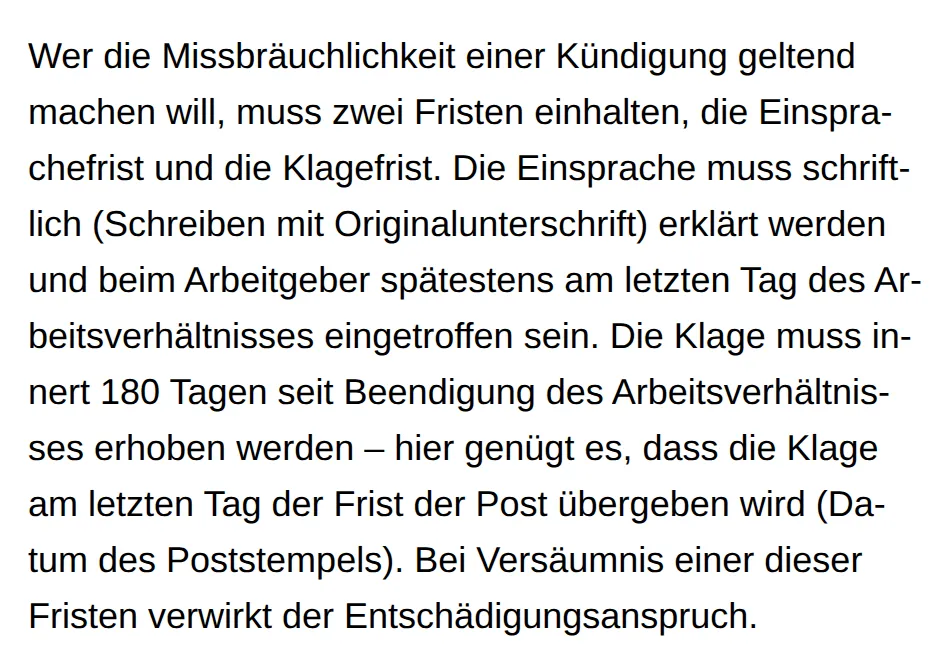
On content, the Federal Supreme Court asks for little. It is enough to say in writing that you do not accept the dismissal. You do not have to give reasons. But if you only dispute the accusations in the dismissal letter and accept that the job is over, you have not objected (4A_571/2008). The objection is meant to give the company a chance to talk about keeping you on. A few lines will do:
[Your name, address]
Registered mail
[Company, address]
[Place, date]
Objection to the notice of termination of [date]
Dear Sir or Madam,
Under Art. 336b CO, I hereby object to the notice of termination of my employment dated [date]. I consider the termination abusive and am willing to continue the employment.
Please state the reasons for the termination in writing, as provided for in Art. 335 para. 2 CO.
Yours faithfully,
[Handwritten signature]
Send the letter straight away, not just before the deadline. The deadline does run until the end of the employment, and it moves with it if an illness extends the notice period. But if you write at once, you never have to work out exactly when that is. During probation this matters twice as much. A bar employee given three days' notice waited six days. The Zurich High Court had awarded her CHF 13,800; the Federal Supreme Court took it away because her objection came too late (BGE 136 III 96).
Keep a copy and the registered mail receipt. If it comes to a lawsuit, you yourself have to show when the objection reached the company. Waiting for the company to complain that it was late is not enough. That is exactly where the contract manager from Basel failed. The second step gives you more time, but it too has a fixed limit.
The claim: 180 days, and a request is enough
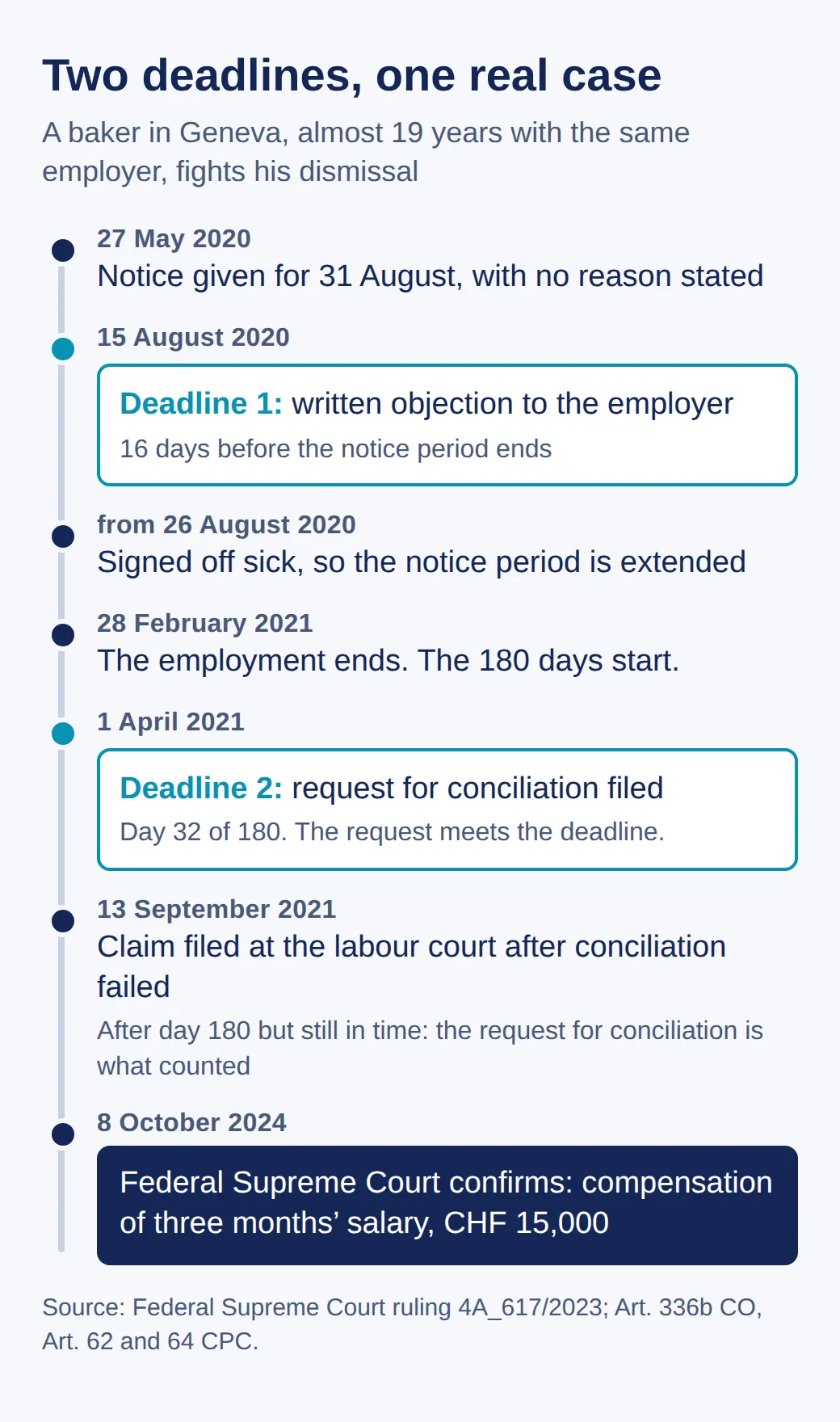
After your employment ends, you have 180 days to bring your claim. What many people do not know: a request for conciliation is enough. Once you file it with the conciliation authority, the case is pending (Art. 62 CPC), and that meets the deadline (Art. 64 CPC). You can file the request in writing or even make it orally at the authority, which records it. The conciliation authority responsible is the one where the company has its seat or where you usually worked (Art. 34 CPC). If conciliation fails, you receive an authorisation to proceed, and from then on you have three months to file your claim with the court (Art. 209 CPC).
The Geneva baker's case shows how this works in practice. Because of his illness, his employment only ended in February 2021, and he filed the actual claim in September, after day 180. He was still in time.
As a rule, the procedure is not expensive. In conciliation and in court, no court costs are charged in employment disputes up to CHF 30,000 (Art. 113 and 114 CPC), and up to that amount the court establishes the facts on its own initiative (Art. 247 CPC). Above it, you have to put everything forward yourself, and that can decide the case, as the Basel lawsuit over CHF 53,670 shows. In conciliation, nobody has to pay the other side's legal fees. In court that risk remains: whoever loses may have to bear them (Art. 106 CPC). At the Federal Supreme Court, the contract manager paid CHF 2,500 in court costs and CHF 3,000 to the company towards its fees. Whether it is worth it depends on how much there is to win in the end.
How much compensation can you get?
Six months' salary at most, with the court setting the amount after weighing all the circumstances (Art. 336a CO). In a mass redundancy without consultation, the cap is two. The compensation is meant to punish the company and to make up for the infringement of your personality rights, and courts may also take into account the financial impact of the dismissal on you (BGE 123 III 391). They look at how much the company was to blame, the way it dismissed you, how long you worked there, your age and how hard it will be for you to find a new job. The calculation uses your gross salary, including a 13th month's salary and commission (4A_571/2008). There is no fixed scale. We compared the compensation awarded in eight cases that went all the way to the Federal Supreme Court:
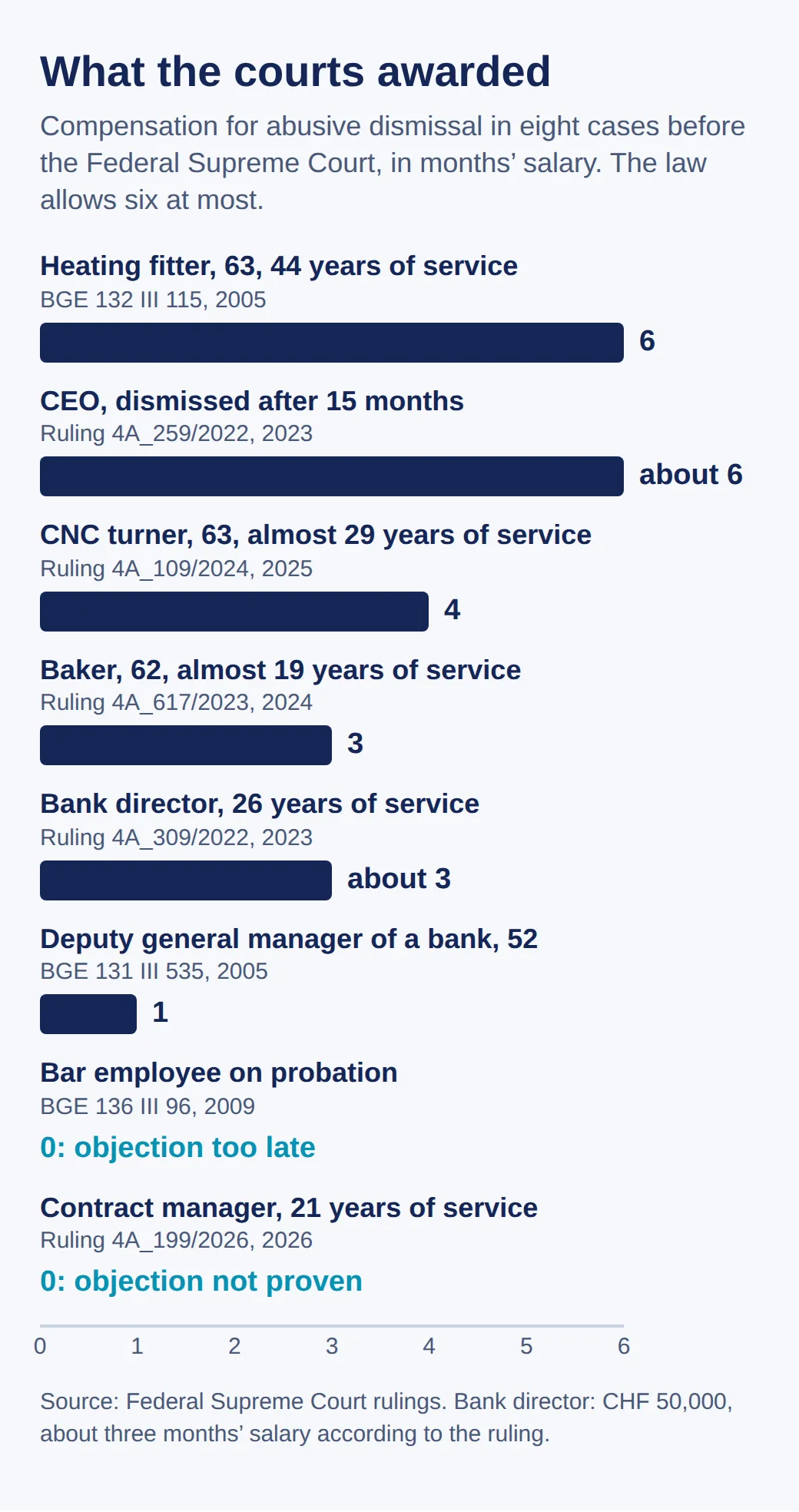
The maximum is the exception and goes to cases where the company was especially ruthless or its reasons were a pretext. Even for the CEO of a grain trader, who received CHF 250,000, the Federal Supreme Court called the amount "particularly high" (4A_259/2022, in the original «particulièrement élevée»), but did not correct it, because the company had not argued its appeal well enough. The older employees in the two more recent cases got three and four months' salary. The single month for the deputy general manager is somewhat misleading: he also received a contractual severance payment of just over CHF 584,000. And two of the eight cases end at zero, both because of the objection and not because of the merits.
A new job does not rule out compensation. The Geneva bank director, with his bank since 1990, started at another bank the day after his employment ended and was still awarded CHF 50,000, about three months' salary according to the Geneva judges (4A_309/2022). Other claims, such as for damages, remain open alongside the compensation. And what you receive is all yours: the Federal Supreme Court treats the compensation as tax-free compensation for non-material harm (2C_546/2021).
What to do after you are dismissed
Do things in this order. On day one, ask for the reasons in writing and send your objection by registered mail, signed by hand, keeping a copy for your records. In the weeks that follow, gather evidence and write down what was said and when, while you still remember it clearly. Get advice if you are a union member or have legal expenses insurance. After your last working day, note the date on which the 180 days run out, and file the request for conciliation well before then. If no agreement is reached there, you have three months from the authorisation to proceed to file your claim.
Taking legal action does not stop you looking for work, and a new job does not cost you the claim. A temporary job can bridge the gap until the right permanent one comes along. For your next application, our article on the Swiss application dossier sets out what belongs in it.
Common questions
- Am I protected against unfair dismissal during the probation period?
- Yes, although courts apply the protection more cautiously during probation. Time is tightest for the objection: the law sets a notice period of seven days during probation, and a written contract can set even less. In BGE 136 III 96, a bar employee had three days and wrote after six, which cost her the claim. So if you are on probation, write your objection the same day or the next.
- Is compensation for unfair dismissal taxable in Switzerland?
- No, not if it is awarded under Article 336a CO. Since 2022 the Federal Supreme Court has treated it as fully tax-free compensation for non-material harm (BGE 148 II 551), and it confirmed this in January 2026. No AHV social security contributions are due on it either. Compensation under federal staff law can be treated differently.
- Can I still claim compensation if I already have a new job?
- Yes. A bank director in Geneva started a new job the day after his employment ended and was still awarded CHF 50,000. A new job can lower the amount, though, because the court also weighs the financial impact the dismissal had on you.
- Do the same rules apply if I work for the federal government?
- Not in the same form. As a federal employee, you challenge the decision terminating your employment with an appeal. If the dismissal is abusive, the Confederation must offer you your previous job or other reasonable work, or you can ask for compensation instead, usually six to twelve months' salary. Cantons and communes have their own staff law with their own rules.
More posts
All posts
Overtime pay in Switzerland: what the law really says
Overtime or extra time? When you are owed 25% on top, what your contract can cut, who decides on time off in lieu and when Swiss overtime claims expire.

Swiss job application dossier 2026: contents, order, PDF
What goes into a Swiss job application dossier, in what order, whether to send one PDF or three, and what HR managers check first.

Arbeitszeugnis: how to read and fix a Swiss work certificate
What the wording in a Swiss work certificate (Arbeitszeugnis) means, why there are no secret codes and how to get it corrected. With rulings up to 2026.