Arbeitszeugnis: how to read and fix a Swiss work certificate

The short answer
A Swiss work certificate (Arbeitszeugnis) must be true and worded with goodwill, and where the two clash, the truth wins. Secret codes are not allowed, but graded words such as "very good" and "good" are, and courts read them exactly that way. If a sentence is wrong, ask in writing for a change with your own wording, and if that fails, go to the conciliation authority, with no court fees for claims worth up to CHF 30,000.
Full certificate or confirmation of employment: what you are entitled to
You are entitled to a certificate at any time, in the middle of a job too, and even after a few weeks. That is set out in Article 330a of the Code of Obligations, and the article is mandatory: no contract may restrict it to your disadvantage. The official English text of the law calls it a "reference"; in everyday Swiss English it is usually a work certificate.
The law provides for two forms. The full certificate (Vollzeugnis, also called a qualified certificate) describes the nature and length of the job and assesses your work and your conduct. The confirmation of employment (Arbeitsbestätigung) only states what you did and for how long, with no assessment at all. According to the Zurich courts (in German), a confirmation of employment may not hint at the reason for the dismissal either. You choose which form you want, and you can ask for both.
The choice is yours, not the company's. A case decided by the Federal Supreme Court in 2003 shows this (BGE 129 III 177, in German). In his third month, an employee had sent two letters to an American licensor of his company describing the firm as disorganised and close to bankruptcy. The company dismissed him without notice. The cantonal court only granted him a confirmation of employment, because the parties could not agree on what a certificate should say. The Federal Supreme Court saw it differently: he was entitled to a full certificate, and that has to cover both his work and his conduct, not just one of them. A certificate that leaves one out is incomplete.
So much for what you get. How it has to be worded is governed by two principles that come up in almost every dispute.
Truth before goodwill: the two rules behind every sentence
The word "goodwill" (wohlwollend) is not in the law. Both rules come from case law, and the Federal Supreme Court described how they relate in BGE 136 III 510 (in German): the certificate should help your career and so be worded with goodwill. At the same time it should give a future employer as accurate a picture as possible, and so it must be true and complete. Negative facts may, and must, go in if they matter to the overall picture.
Goodwill sets the tone, then, not the content. The canton of Bern's personnel office puts it in one sentence in its guidelines on work certificates (in German): employees are entitled to a true certificate, not to a good one. On the other hand, a one-off slip that isn't typical of you can stay out, even if it happened. Bern's example is a bookkeeper who sometimes comes in late after a lot of overtime: not a matter for the certificate. A train driver whose lateness holds up trains is a different story.
The line is clearest with illness. In the case behind BGE 136 III 510, a regional secretary of a trade union had been unable to work for almost a year and a half because of illness when his job ended, and nobody knew whether he would ever be able to do the job again. The certificate therefore had to state that he could no longer perform his role for health reasons. An illness you have recovered from and did not affect work or conduct, on the other hand, does not belong in it, the court held in the same ruling. The company may never name a diagnosis, the canton of Bern writes, and ordinary sick days, even a few weeks a year, are part of the employer's risk.
That leaves the question of how good "good" is. Here it helps to look at how employers build their own certificates.
What the usual phrases signal
Swiss certificates grade with ordinary words, and the grading sits in adjectives and intensifiers. There is no official grading system; the law sets no scale. The canton of Zurich, as an employer, shows what the levels look like in practice. Its form for requesting a certificate (in German) has managers tick an overall rating on a five-point scale (excellent, very good, good, adequate, inadequate) and then offers ready-made sentences to choose from, each running from strongest to weakest.
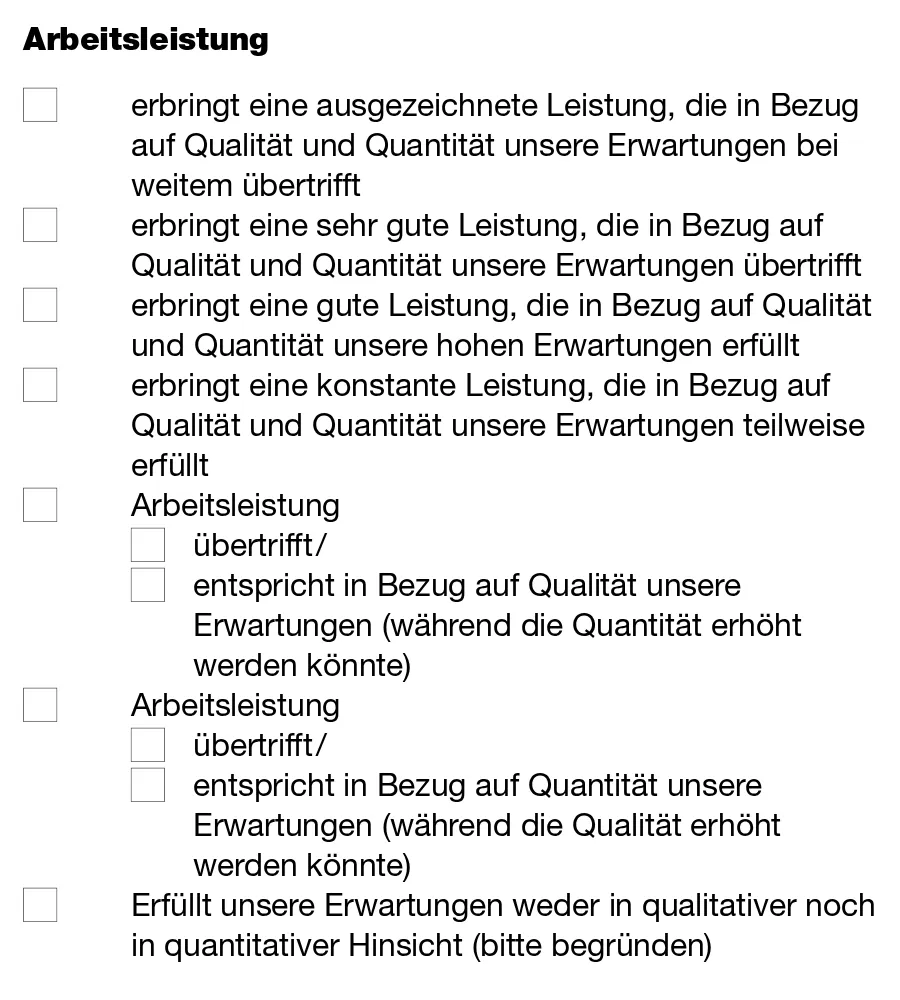
Read the sentences from top to bottom and the principle is plain: work that "far exceeds" expectations (bei weitem übertrifft), "exceeds" them (übertrifft), "meets our high expectations" (erfüllt unsere hohen Erwartungen), "partly meets" them (teilweise erfüllt). The same pattern runs through the whole form; on deadlines, for instance, it goes from "always meets deadlines, even under heavy pressure" to "has difficulty meeting the deadlines set". Next to them is a sentence that matters to you as well: "All statements are uncoded and need no interpretation."
The documents of the cantons of Bern, Solothurn (in German) and Zurich, together with the case law, point to a few signals. They are practice, not law:
| Wording (German original) | What it signals | Found in |
|---|---|---|
| "very good work", "very good work that exceeds our expectations" (sehr gute Leistungen) | Very good performance | Solothurn, Zurich request form |
| "good work", "meets our high expectations" (eine gute Leistung) | Good, one level lower | Solothurn, Zurich request form |
| "as a rule", "mostly", "not always", "by and large" (in der Regel, meistens) | A weakness, gently put | Bern, Solothurn, Zurich |
| "made an effort", "did her best", "within her abilities" (war bemüht) | Too vague, not allowed in the canton of Bern | Bern guidelines |
A single word carries more weight than many people think. In 2007 the Federal Supreme Court decided that an employee who cannot show above-average work has no claim to the phrase "à notre entière satisfaction" (to our complete satisfaction) (ruling 4A_117/2007). The company had written only "satisfaction", and that is where it stayed. And according to the employers' association Swissmem (in German), the Lucerne Labour Court found that an employee with frequent conflicts cannot demand "highly valued" (sehr geschätzt); "valued" (geschätzt) was enough.
Which leads to the question that turns up in every search for certificate wording: what about the secret codes?
Are there secret codes in a Swiss work certificate?
No, not as a permitted system. Lists circulate online that give harmless sentences a hidden meaning. In Germany, the law expressly bans encoding: under section 109 of the German Trade Regulation Act (in German), a certificate may not contain wording meant to say something other than what the words say. That provision does not apply in Switzerland, and German grading scales cannot simply be carried over.
In Switzerland the same ban follows from the principle of good faith. The Federal Supreme Court wrote in ruling 4A_117/2007 that the company chooses the wording, but it may not use disparaging, unclear or ambiguous terms. The trade union Unia (in German) states in its guide that the text may not contain veiled statements. The canton of Solothurn has written it into its collective labour agreement: certificates are issued uncoded and marked as uncoded. The canton's model certificate carries the note "Our certificates are uncoded and transparent" for that reason.
One form of code is tricky, though, because you can't read it, only notice it: leaving things out. If there is no sentence on how you dealt with customers although you worked with customers every day, that can be read as a message. The canton of Bern calls this "qualified silence" and names it as a form of coding that is not allowed. So check your certificate not only for what it says but also for what is missing.
If there are no codes, only graded words, then every grade counts. A Zurich ruling from March 2026 shows how closely courts look.
Your interim certificate binds the company
A company cannot simply downgrade a good interim certificate in the final one. The Zurich Labour Court worked this through in ruling AH250141 of 24 March 2026 (in German). An executive assistant had worked for a company in Zurich since 2020 and was given notice in November 2024. In January 2025 she received a very good interim certificate. On her last working day in February she sent a farewell email to colleagues in which she made sarcastic remarks about the company. The final certificate of May 2025 was noticeably weaker.
The court held that an interim certificate binds the company just as a final one does. It may only get worse if something so serious has happened in the meantime that a much poorer assessment is justified, and the company has to prove it.
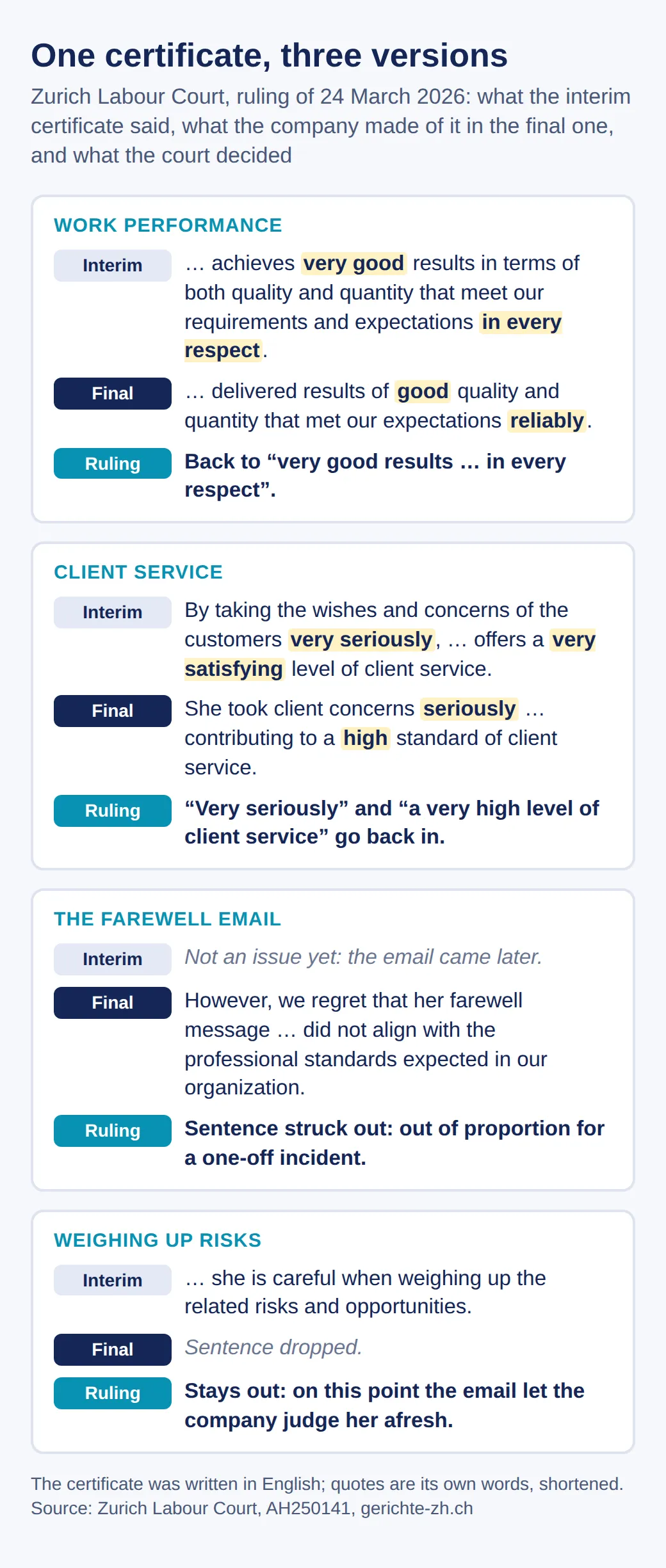
The result was a draw with a clear lesson. The certificate was written in English, so the quotes here are its original English wording. A single email says nothing about the quality of years of work, so "very good results" came back. "Seriously" went back to "very seriously": the court expressly read the change as saying her work had been only "good" instead of "very good". The sentence about the farewell message was struck out entirely, because prominently mentioning a one-off incident that did the company no harm would have held back her career out of all proportion. On some points the company won, though: someone who sends an email like that has not carefully weighed up the consequences of her actions, so the sentence on weighing up risks stayed out. And someone who mocks her workplace and managers in a group email no longer gets to read that she "incorporated other people's needs".
For you, this means an interim certificate is useful for more than applications. It also protects you later, especially before a change of manager; the canton of Bern expressly recommends interim certificates when the manager changes. And it is the best basis when you ask for a correction.
How do you ask for a correction?
In writing first, with your own suggested wording. The Zurich courts advise thinking carefully about which sentences should change and drafting your own proposal while you are still dealing with the employer. In court you have to ask for specific wording anyway, as the employee in the Zurich case did.
Go through the certificate sentence by sentence. Are the dates, job title, work percentage and main duties right? Does it cover your work and your conduct? Is an area of your job missing? Is it weaker than your interim certificate or your last appraisals? The canton of Bern requires its own managers to make sure the assessment in a certificate matches the appraisals of previous years. And is it signed by a manager and dated?
Then write to the company, ideally after a conversation. Short and factual is enough:
Dear Ms [Name]
Thank you for my work certificate dated [date]. I would like to ask for two changes.
The third paragraph says: "She did good work." In my interim certificate of [date] and in my appraisal of [date], my work was rated very good, and nothing has changed since. I suggest: "She did very good work that exceeded our expectations."
There is also no statement on how I dealt with customers, although customer care was one of my main duties. I suggest: [your sentence].
Please send me the amended, signed certificate with the original date by [date, about two weeks later].
Kind regards [Name]
Enclose copies of the documents you rely on and keep the originals. Also ask for the certificate to keep its original date. In the Zurich case the employee asked for exactly that, the company did not dispute it, and the court ordered it.
If the company says no or does not answer, the official route remains. Before you take it, it pays to look honestly at who has to prove what.
When is it worth going to court?
Going to court is worth it when the certificate is demonstrably wrong or weaker than what you can prove. A court only changes a certificate if it is objectively inaccurate or the company has gone beyond its discretion. Your taste in wording is not its concern.
What decides it is the burden of proof, and the Zurich Labour Court set it out clearly in its 2026 ruling. If the certificate gives a below-average assessment, the company has to prove it is right. If you want an above-average one, you have to provide the facts for it. If neither side can back up its view, the Zurich courts in practice uphold a "normally decent", average certificate. So if you have "good" and want "very good", you need evidence: earlier appraisals, target agreements, bonuses, an interim certificate.
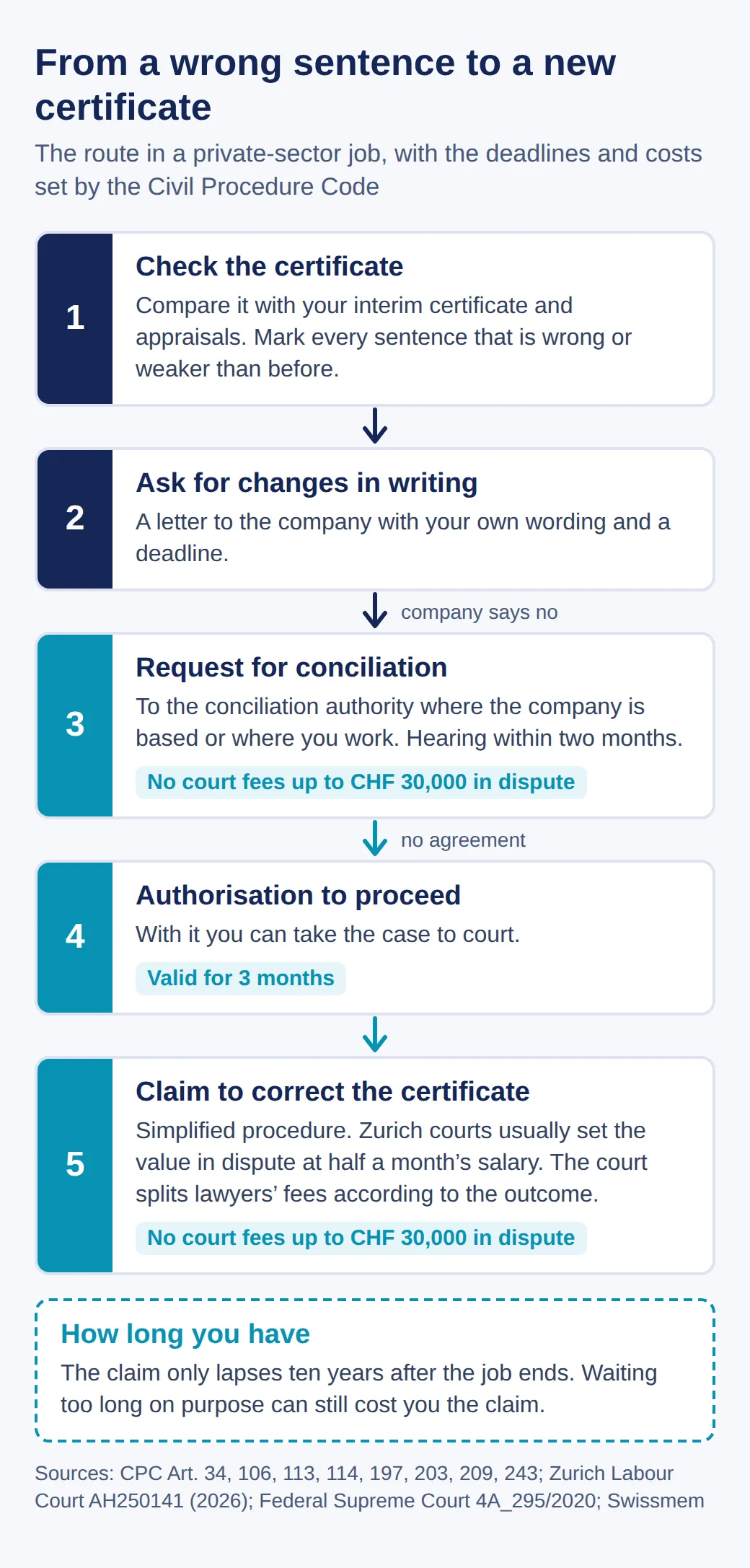
The route itself is cheap. Every lawsuit starts with an attempt at conciliation (Article 197 of the Civil Procedure Code), before the conciliation authority where the company has its registered office or where you worked. In the city of Zurich that is the Friedensrichteramt, the justice of the peace. The hearing must take place within two months. In employment disputes worth up to CHF 30,000, there are no court fees, either in conciliation or in court (Articles 113 and 114 CPC). In Zurich practice a certificate dispute almost always stays far below that: the Zurich Labour Court routinely values it at half a month's salary, which in the 2026 case came to CHF 3,833.60.
Free of court fees does not mean free of risk, though. If you go to court with a lawyer, the court divides the legal costs according to the outcome (Article 106 CPC). If you lose completely, you may have to pay the other side's costs. In the Zurich case each side won about half, and each bore its own costs. In conciliation itself, no party costs are awarded.
If no agreement is reached, you receive an authorisation to proceed, which is valid for three months (Article 209 CPC). For the claim itself you have plenty of time: according to the Federal Supreme Court (ruling 4A_295/2020), it only lapses ten years after the job ends. Swissmem (in German) points out, however, that deliberately dragging things out can count as an abuse of rights and cost you the claim. In practice everything speaks for acting quickly anyway, while everyone still remembers your work.
There is also a way out without a court. Under BGE 129 III 177 you can ask for a confirmation of employment instead of a correction, stating only the nature and length of the job. That settles the dispute but takes away any assessment. For a short job in a long CV that may be enough; for your most important job of recent years, probably not. Union members can get advice first; Unia, for example, offers it in its local offices.
Before you apply
Before your certificate goes into your next application, lay it next to your interim certificate and your notes from recent appraisals, and mark every passage that sounds weaker or is missing. Have anything that is wrong changed now. As long as the company can correct the sentence itself, a letter is the quickest route.
In your new job, ask for an interim certificate whenever something changes, such as your manager, and while things are going well. It costs nothing and is strong evidence in a dispute. If you are looking for a job with a lower work percentage right now, you will find the current openings in our overview of part-time jobs.
Common questions
- Does my employer have to thank me in my work certificate?
- No. You have no enforceable right to words of thanks or good wishes for the future, as the Zurich Labour Court held in 2026, citing the Federal Supreme Court. Many employers add a closing line anyway, and the canton of Bern calls it desirable in its guidelines. If it is missing, a friendly request is worth making; a lawsuit is not.
- What language should my Swiss work certificate be in?
- In the language usually spoken where you work. If you work in a different language, say in English in Geneva, the Federal Supreme Court has held that you are entitled to a version in both languages. You have to ask for it, though, otherwise the certificate stays in the language the company chose.
- Do the same rules apply if I work for the federal government or a canton?
- For federal staff, yes. The Federal Personnel Act does not cover work certificates itself, so Article 330a of the Code of Obligations applies by analogy, with the same rules as in the private sector. The route in a dispute is different: you ask for a formal ruling that can be appealed and then appeal it to the Federal Administrative Court. Cantons and municipalities have their own staff law, and their HR department can tell you the route.
- How long does an employer have to issue a work certificate in Switzerland?
- The law sets no fixed deadline. The claim falls due as soon as you ask, and according to the employers' association Swissmem, practitioners treat about two weeks as reasonable for a full certificate. The canton of Bern usually issues interim certificates within two to three weeks and the final certificate on the last working day at the latest.
- Who has to sign a Swiss work certificate?
- Someone above you in the hierarchy who is authorised to sign for the company. If the company uses joint signatures by two people, it needs two signatures. A signature from someone at your own level weakens the certificate, the canton of Bern warns in its guidelines.