Swiss job application dossier 2026: contents, order, PDF
The short answer
A Swiss application dossier contains your cover letter, your CV, copies of all your work certificates and your diplomas, in that order and as PDF files. References go in the CV or are given on request. HR managers often look at the CV first and decide within seconds whether to read on. That first look is what you build the dossier for.
What goes into a Swiss application dossier
Four parts, and all four belong in it when you reply to a job ad. The official careers guidance portal, berufsberatung.ch (in German), describes the classic dossier as an application or motivation letter, a CV, and your work certificates and qualifications. The cantonal fact sheets say the same in a little more detail. The canton of Graubünden, in its fact sheet on the application dossier (in German), also counts "any references", and the St. Gallen careers guidance service (in German) lists your vocational or university degree separately from diplomas and further training.
In Switzerland, the application letter and the motivation letter are usually one and the same document. The guide from ZHAW, the Zurich University of Applied Sciences (in German), notes that job ads and advice pages use both terms interchangeably. Only a longer "third page" placed after the CV is sometimes also called a motivation letter, and that page is optional.
The order isn't laid down anywhere, but the advice services agree on it. The letter comes first, then the CV, then the work certificates, and last your diplomas and further training. Within each part, the most recent comes first.
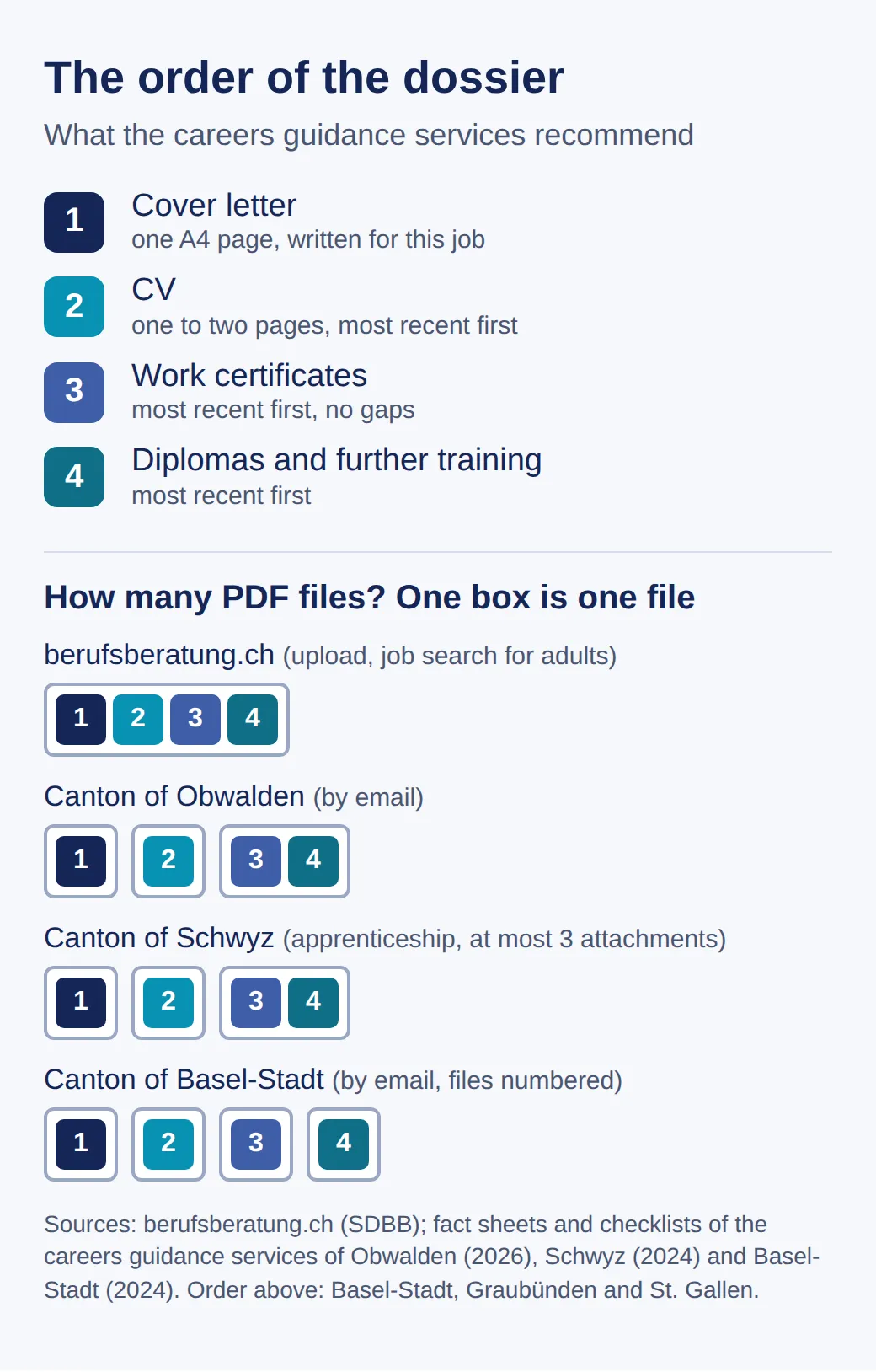
The chart also shows where the advice splits: on the number of files. We come back to that further down. First, the question of which part gets read at all.
What HR managers check first
The CV, and they do it fast. According to ZHAW (in German), HR managers often look at it first, "sometimes in 10 to 60 seconds". The careers guidance service of the canton of Obwalden, in its fact sheet on the application dossier (in German), puts it at around 40 seconds to decide whether a dossier gets any further attention.
In 2024, the outplacement firm von Rundstedt (now Alixio Mobility) and the trade magazine HR Today surveyed how much each part counts. In their survey (in German), 936 HR managers and executives from across Switzerland took part. Obwalden turned the weighting from it into a chart in its fact sheet. The fact sheet doesn't give the exact question behind the percentages, so read the figures as a ranking rather than a precise measurement.
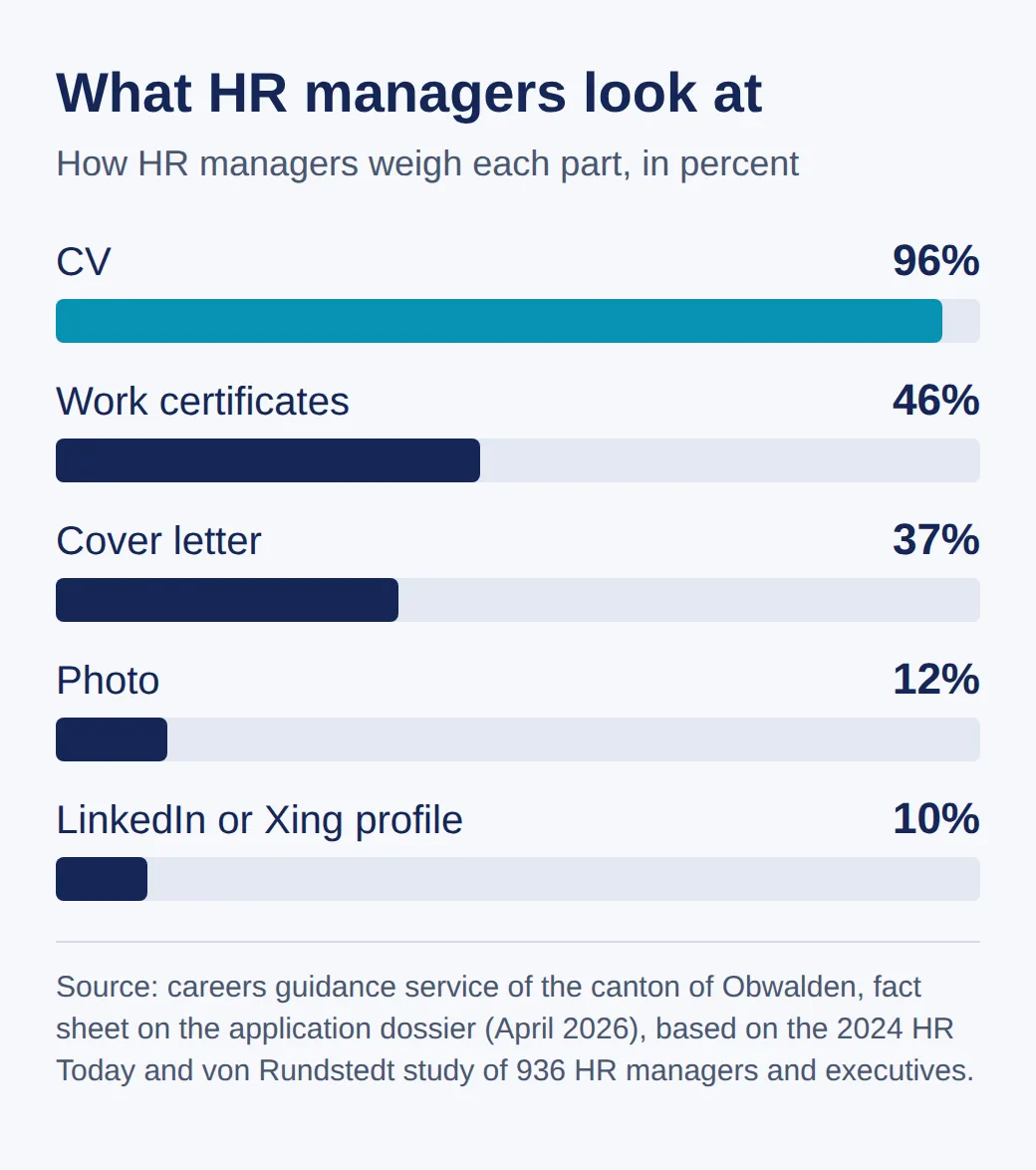
Even so, the gap is clear. The CV scores 96 percent, everything else less than half. The study itself calls the formal CV "the heart of an application". According to von Rundstedt, recruiters focus on the hard facts in it, above all industry experience and expertise, and less on your motives. Military leadership experience, side jobs or a sabbatical often make no difference to the assessment either way.
For your dossier, this means that whatever matters for the job has to be in the CV and visible there at a glance. The letter adds to it, but it won't rescue a CV that doesn't show the experience they're looking for.
The CV: two pages that have to carry the weight
One to two pages, most recent first, with no gaps. ZHAW gives 1 to 2 pages as the rule, and up to 3 only with a great deal of experience or an academic career. Graubünden expects "a complete list in table form" of your school and work history, each entry with month and year.
Your personal details go at the top: name, address, a phone number, a professional email address and your date of birth, which ZHAW says is expected in Switzerland. If you don't hold a Swiss passport, it's best to state your nationality and your permit, such as B or C: ZHAW recommends it, and Graubünden leaves it up to you. Marital status and children are optional, both say.
A photo isn't a legal requirement, but it's customary. Graubünden recommends a professional application photo on the CV or on a cover page, and ZHAW advises against selfies and photo booth pictures. In the survey above, the photo counts for little, at 12 percent. A bad picture can still spoil the first impression.
Below that come work experience, education and training, languages and IT skills. For each job, give your role, the company, the place and the dates, plus a few keywords on what you achieved there. Languages are best stated with the levels A1 to C2, your mother tongue first. If you're at the start of your career, ZHAW puts education before work experience. If you're looking for an internship right now, do the same.
Fill gaps with what you did during that time: travel, further training, family, looking for work. A diagnosis doesn't belong in a CV. For illness, ZHAW suggests wording such as "time out for health reasons" (Auszeit aus gesundheitlichen Gründen in a German CV), with a note that you're fit to work again.
A few Swiss habits show at once whether a CV was written for Switzerland. If you write in German, there is no ß, only ss. Swiss grades run from 1 to 6, with 6 the best, so explain foreign grades briefly, for example by adding the top mark. And you don't sign the CV.
The cover letter: one page for this exact job
One A4 page, written fresh for every job ad. Graubünden asks for an individual letter for each job that fits on one page if possible and picks up the keywords from the ad. ZHAW and the canton of Schwyz recommend the "you, me, us" structure for it: first the company and the job, then you and what you bring, and finally the future together and your request for an interview.
The letter counts for only 37 percent in the weighting, and the von Rundstedt study describes recruiters as preferring to look at the facts in the CV. That doesn't make it unimportant. The letter is where you explain what the CV alone can't: a change of industry, a gap, a move, an unsolicited application. For unsolicited applications, von Rundstedt even sees "realistic chances of success" if the motivation letter is convincing. Don't repeat details from your CV in the letter.
Avoid negative remarks about former employers, Graubünden advises, as well as stock phrases and the conditional. In a German letter, "Ich würde mich freuen" (I would be pleased) is weaker than "Ich freue mich" (I look forward to it). Sign the letter, and have someone proofread it.
Work certificates: complete, most recent first
For every job in your CV, a work certificate goes in, as a copy and never the original. Graubünden writes that the jobs you describe should be "documented by work certificates without gaps". ZHAW calls work certificates a Swiss feature with "extremely high standing" that must go in the attachments.
Basel-Stadt, in its guide to the digital application dossier (in German), advises scanning all certificates in colour and putting them in reverse chronological order, most recent first. If you have a great many, include only those from the last 5 to 10 years.
The von Rundstedt study shows why this matters, from an uncomfortable angle. At many companies, it says, work certificates have had their day as far as their content goes, but they remain a formal necessity. A certificate that isn't in order, or a negative one, can knock you out before the first round. According to the study, though, certificates contribute hardly anything to an application's success. So a certificate is mainly a filter you mustn't get caught in.
So check every certificate before it goes into the dossier. How to read the wording and ask for a correction is explained in our post on the Swiss work certificate. If a certificate is missing altogether, request it from your former employer rather than leaving the gap.
Diplomas, including foreign ones
After the certificates come your qualifications: apprenticeship certificate, diploma, degree, then further training and language certificates. Basel-Stadt puts these in reverse chronological order too, and Graubünden reminds you to hand in copies only. Leave out courses that have nothing to do with the job. The von Rundstedt study found that further training appears far less often among the mandatory requirements than age limits, language skills or years in the industry.
With a foreign diploma, everything depends on whether your profession is regulated in Switzerland. Basel-Stadt's fact sheet on recognising foreign diplomas (in German), based on federal information, sums it up like this: in a non-regulated profession you don't need recognition, and your diploma gives you direct access to the job market. The State Secretariat for Education, Research and Innovation (SERI) does, however, recommend a level certificate, which shows where your qualification sits in the Swiss education system. In regulated professions, such as healthcare or teaching, you can't work without recognition.
If your diploma has been recognised, attach the recognition decision to it, Graubünden advises, and do the same with a level certificate. It saves the company from wondering what your qualification is worth. The procedure generally involves fees. If your diploma isn't in German, French, Italian or English, you need an official translation for the procedure, according to Basel-Stadt.
Do references belong in the dossier?
Yes, but as a line in the CV, not as a separate attachment. ZHAW suggests a "References" section at the end of the CV marked "available on request", with no names. Graubünden accepts both, names or "on request", and sets two conditions: list only people who can judge your current professional skills, and ask their permission first.
Don't underestimate this part. According to the von Rundstedt study, personal references are "much more important" than work certificates in Switzerland. More than half of recruiters and companies also gather informal information from personal contacts, even though the study's authors say such enquiries are not legally allowed. By law, an employer may only process data about you that concerns your suitability for the job or is needed to carry out the employment contract (Article 328b of the Code of Obligations).
In practice, choose your referees deliberately, tell them about the job, and expect your reputation in the industry to be checked without your involvement. Only give a referee from your current job if your employer is allowed to know you're looking.
One PDF or several?
It depends on how you apply, and this is where the official sources disagree. For adults, berufsberatung.ch says you should upload your documents "in the right order and, if possible, in one PDF file".
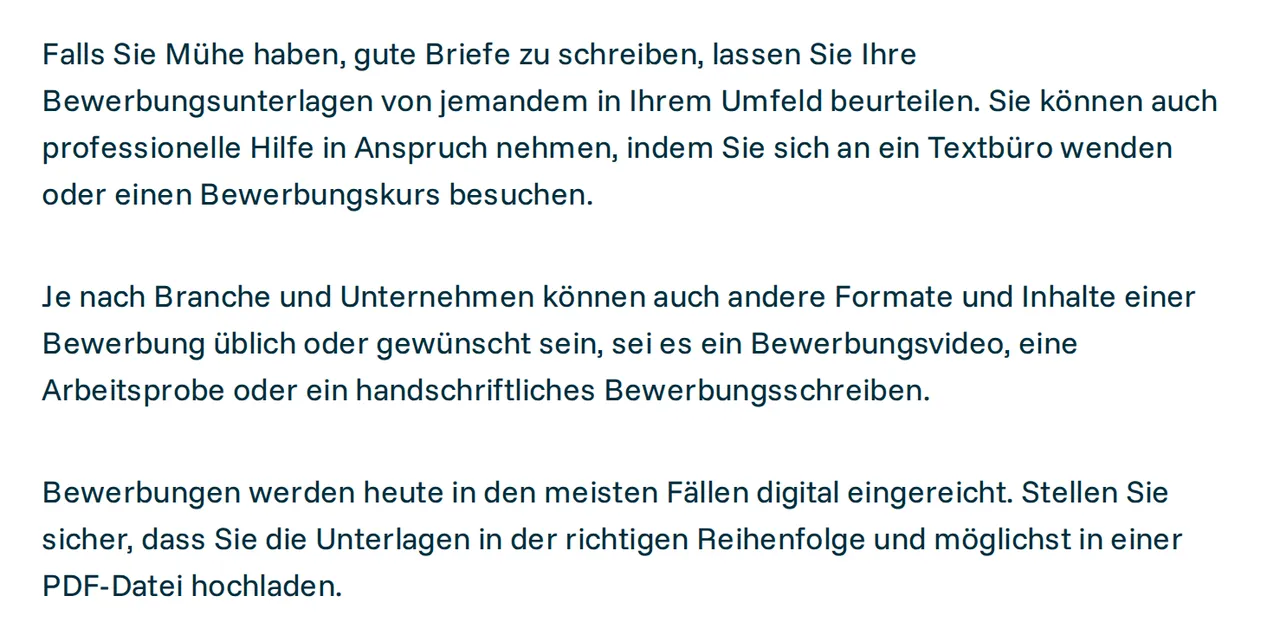
For applications by email, the cantons advise differently. Obwalden recommends three attachments: cover letter, CV, certificates. The canton of Schwyz's checklist for apprenticeship applications (in German) says the same: three at most, with the rest in one file. Graubünden sets a maximum of three attachments, "at most 2 to 3 MB per attachment", not zipped. Basel-Stadt sends four numbered files, so that certificates and diplomas stay separate.
A simple rule follows from this. If an application portal has separate fields for the CV and the attachments, follow the portal. Obwalden says you should respect the required split and the maximum file size, and that the photo sometimes has to be uploaded separately. If there's only one field, upload the whole dossier as one PDF in the right order. By email, send three files: the letter, the CV, and all the attachments together, because that way the recipient can open the CV without scrolling through the letter.
A few technical points apply everywhere. Save everything as PDF, never as a Word file, so the layout doesn't shift on the recipient's screen. Scan certificates in colour and legibly, but compress the files until they stay under the limit. Name each file with its content and your name, for example CV_Firstname_Lastname.pdf. And send the email to yourself first, as Graubünden and Basel-Stadt advise, to see what actually arrives.
Before you click send
Go through the dossier once the way HR will: open the CV first and look at it for 40 seconds. Can you see the experience the ad asks for in that time? Then check that there's a certificate for every job in the CV, that the dates match and that your referees know about the application. Only then read the letter, as an addition to what's already there.
Put together a separate dossier for each application, as berufsberatung.ch recommends: adapt the letter and the CV every time, while the certificates and diplomas stay the same. If you're unemployed or have been given notice, register straight away with the regional employment centre (RAV) and the unemployment insurance fund. Besides daily allowances, they also help with your job search, for example with application courses.
Common questions
- Does a Swiss application dossier need a cover page?
- No, a cover page is optional. The canton of Graubünden mentions it as a possible first part and a place for your photo, while Basel-Stadt and St. Gallen don't mention it at all. If you use one, your name, the job title and a photo are enough.
- What should I send with an unsolicited application in Switzerland?
- Less than when you reply to a job ad. The St. Gallen careers guidance service notes that a cover letter and CV alone can then be enough. Say in the letter that you're happy to send your certificates and diplomas later, and explain why you're contacting this particular company.
- Do I have to sign my cover letter in Switzerland?
- Yes, the letter carries your signature, by hand or electronically. The canton of Schwyz's checklist asks for it explicitly. You don't sign the CV, though: according to ZHAW, that isn't customary in Switzerland.
- Do I need to include my old school reports?
- Mainly at the start of your career. Graubünden lists school reports as a possible attachment and expects people starting out to list their schooling in detail in the CV. If you left school a long time ago, the school, place and qualification in your CV are enough, and the attachments that count are your work certificates and diplomas.
- How should I name the PDF files of my job application?
- So that nobody mixes them up: the content and your name, such as CV_Firstname_Lastname.pdf. Basel-Stadt also suggests a number at the front, so the files appear in the right order for the recipient.
More posts
All posts
Overtime pay in Switzerland: what the law really says
Overtime or extra time? When you are owed 25% on top, what your contract can cut, who decides on time off in lieu and when Swiss overtime claims expire.
Unfair dismissal in Switzerland: deadlines and compensation
When a dismissal in Switzerland is abusive, the two deadlines you must meet and how much compensation the Federal Supreme Court actually awards.

Arbeitszeugnis: how to read and fix a Swiss work certificate
What the wording in a Swiss work certificate (Arbeitszeugnis) means, why there are no secret codes and how to get it corrected. With rulings up to 2026.