Overtime pay in Switzerland: what the law really says

The short answer
Overtime means hours beyond your contractual hours. For those, your employer owes your pay plus 25%, unless you agree to take the time off instead or your contract says otherwise in writing. Extra time only starts above the legal maximum of 45 or 50 hours a week. No contract can remove its pay and supplement, and in an office that applies from the 61st hour of the year.
In German the two terms are Überstunden (overtime) and Überzeit (extra time). They sound almost the same, yet they follow two different laws, and that is where the money is. Many employment contracts say that overtime is included in the salary, and many employees assume that settles it. In 2000 the Federal Supreme Court showed, in the case of a manager at a Geneva advertising agency, why it often does not. We go through the case further down, but first the two limits everything depends on.
Overtime and extra time: two limits, two laws
The first limit is in your contract, the second in the law. Hours beyond the hours you agreed are overtime under Article 321c of the Code of Obligations. Hours beyond the legal maximum working week are extra time under the Employment Act (Arbeitsgesetz, ArG; the link goes to the German text, as there is no official English translation). The Code of Obligations governs the contract between you and your employer. The Employment Act is public law that protects your health, and a contract cannot depart from it.
Under Article 9 of the Employment Act, the maximum is 45 hours a week in industrial firms, for office staff, technical and other employees, and for sales staff in large retail businesses with more than 50 employees. Everyone else has a maximum of 50 hours. The guidance on the Employment Act from the State Secretariat for Economic Affairs (SECO) (in German) names manual work above all for the 50-hour group, in the trades for example, and sales in small and medium-sized businesses. According to the guidance, people working in healthcare, in hospitals or in care homes are not "technical and other employees" either. In its answers on overtime (in German), SECO works through an example: someone in an industrial firm with a 40-hour contract who works 52 hours in a week does 5 hours of overtime and 7 hours of extra time.
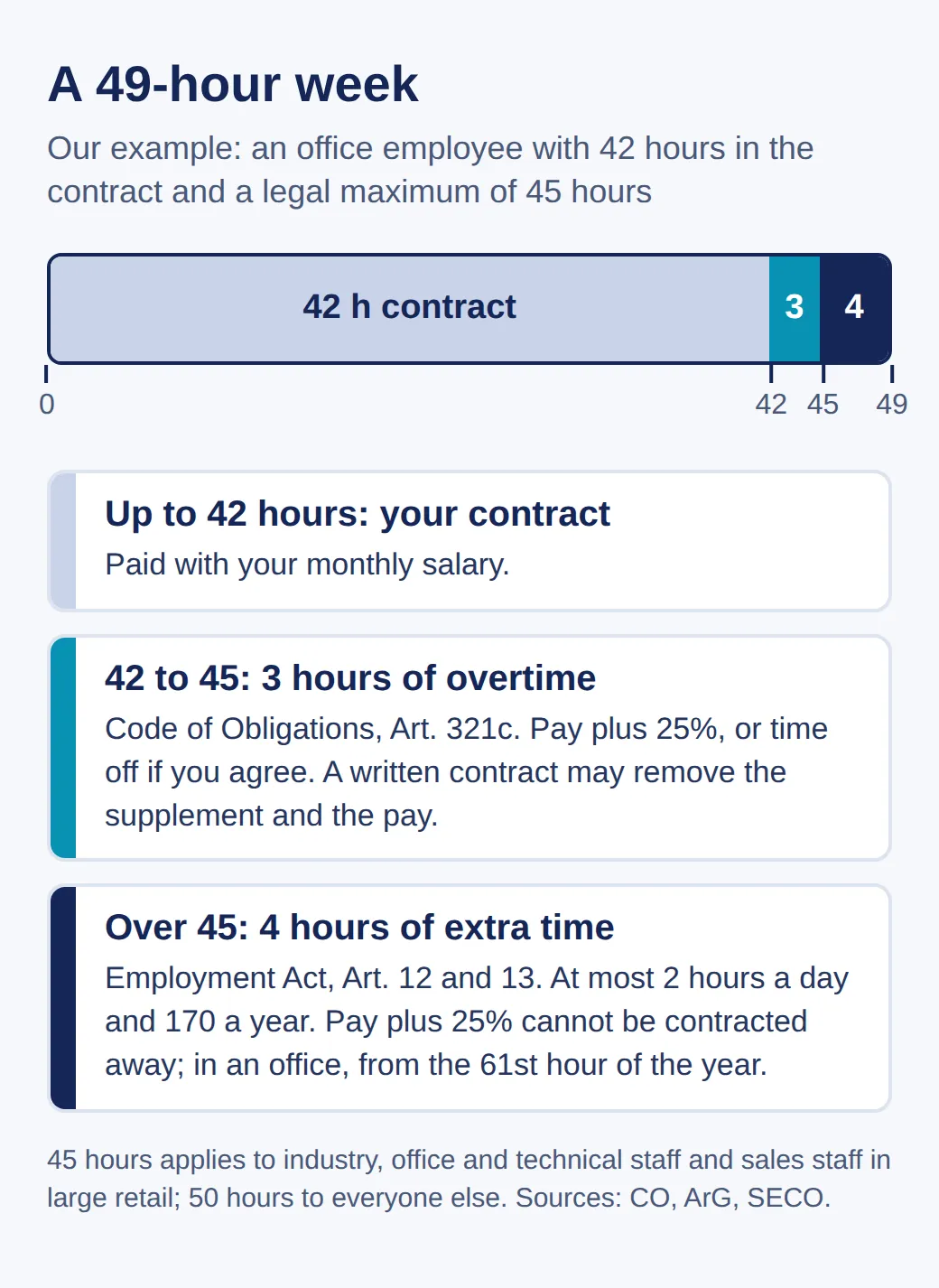
On a 40- to 42-hour office contract, then, only three to five hours a week lie between your contract and extra time. If you regularly work longer, you soon reach hours whose pay no contract can exclude.
Not everyone is covered by the Employment Act. As a rule it does not apply to the administrations of the Confederation, the cantons and the communes, to agriculture or to private households (Article 2). Article 3 also excludes people in "senior management positions", along with teachers at private schools, homeworkers and commercial travellers, among others. Where the Act does not apply, there is no extra time; in the private sector you are then left with overtime under the Code of Obligations. The Geneva case shows how narrow the exception for managers is.
Do you have to work overtime?
Yes, if it is needed and can reasonably be expected of you. That is what Article 321c paragraph 1 says: you must work overtime as far as you are able to and as far as it can be expected of you in good faith. Your employer does not need your consent. SECO names four conditions. The extra work is needed, for example because of urgent orders, and could not easily be avoided with temporary staff or better planning. It does not overstrain you physically or mentally. It is reasonable to expect of you in your situation. And the working and rest hours of the Employment Act are respected.
For extra time, the law adds hard limits. It is only allowed as an exception: for urgent work or an unusual volume of work, for stocktaking and closing the books, or to fix a breakdown. Per person it may not exceed two hours a day, except on days off or in emergencies, and in a calendar year it may not exceed 170 hours on a 45-hour week and 140 hours on a 50-hour week. Under Article 25 of Ordinance 1 to the Employment Act (in German), it is as a rule only allowed during the day and in the evening on working days, not at night and not on Sundays, emergencies aside.
The annual quota hides a trap. According to SECO's guidance, the 170 or 140 hours count all the extra time worked in the year, and taking time off does not reduce them again. If you work 100 hours of extra time in spring and take them off in summer, you still have only 70 left for the rest of the year.
Having to work the extra hours is one thing. The other question is what you get for them.
What an hour of overtime costs: pay plus 25%
Unless something else was agreed, your employer pays every hour of overtime at your normal rate plus a quarter. That is the rule in Article 321c paragraph 3. Instead of money, your employer can give you time off of at least the same length, but only with your consent (paragraph 2). Then there is no supplement either: one extra hour worked means one hour off.
For extra time the supplement is also 25%, but it is mandatory. Article 13 of the Employment Act requires it, and SECO's guidance states that an agreement removing it is invalid. It is calculated on the hourly wage, without local, household and child allowances (Article 33 of Ordinance 1). For a monthly salary, the guidance calculates it like this: weekly hours times 52.178 weeks, divided by 12, gives the hours per month. At 42 hours that is 182.6, and a monthly salary of CHF 4,000 gives CHF 21.90 an hour. According to the guidance, the 13th monthly salary, commissions and bonuses belong in this base.
Extra time can also be taken as time off instead of money, again only with your consent, and then within 14 weeks. By agreement that period can be stretched to twelve months at most. If your employer gives you no chance to take the time off within that period, the guidance says you are entitled to be paid, supplement included.
For office workers there is an exception that surprises many people. For office staff, technical and other employees and sales staff in large retail businesses, the mandatory supplement only applies to extra time beyond 60 hours in a calendar year. The first 60 hours fall back under the Code of Obligations, where a written contract may remove the supplement or the pay altogether. In industry and on the 50-hour week, by contrast, every hour of extra time counts from the first.
How much you are owed in the end therefore depends heavily on one sentence in your contract.
The "included in the salary" clause
A written clause can exclude pay for overtime in full or in part, but for extra time only the part the Employment Act leaves open. SECO puts it briefly: pay for overtime can be excluded by a written contract, pay for extra time cannot. A collective labour agreement or a standard employment contract can also set different rules.
The Federal Supreme Court decided the case on this in March 2000 (BGE 126 III 337, in French). In 1997 a woman had started at an advertising agency in Geneva on CHF 9,000 gross a month, paid 13 times a year, with a company car. Her contract stated that overtime was unavoidable in an advertising agency and that its pay «est déjà comprise dans le salaire», in other words already included in the salary. She built up a new department, sat on the extended management board and regularly gave the firm lists of her hours, but did not ask to be paid for them. Beyond the legal 45 hours a week, they came to 366 hours in 1997 and 223 in 1998, 589 hours of extra time in all. At the end of July 1998 the agency gave her notice for the end of October, and only in October did she ask to be paid for them.
The Geneva courts dismissed her claim. The Federal Supreme Court ruled in her favour, for two reasons. First, she was not a "senior manager": she could not decide on any budget herself, could not sign for the firm, and her contracts needed the management's approval. Title and salary do not count for this, only real power to decide the course of the business. Second, the clause only covers overtime up to 45 hours. Anything above that is extra time and must be paid with the base wage plus 25%, and that means the wage itself, not just the supplement. For office staff this applies from the 61st hour of extra time in the year.
Our worked example, with the same hours under four different contracts, shows how much the contract clause still matters.
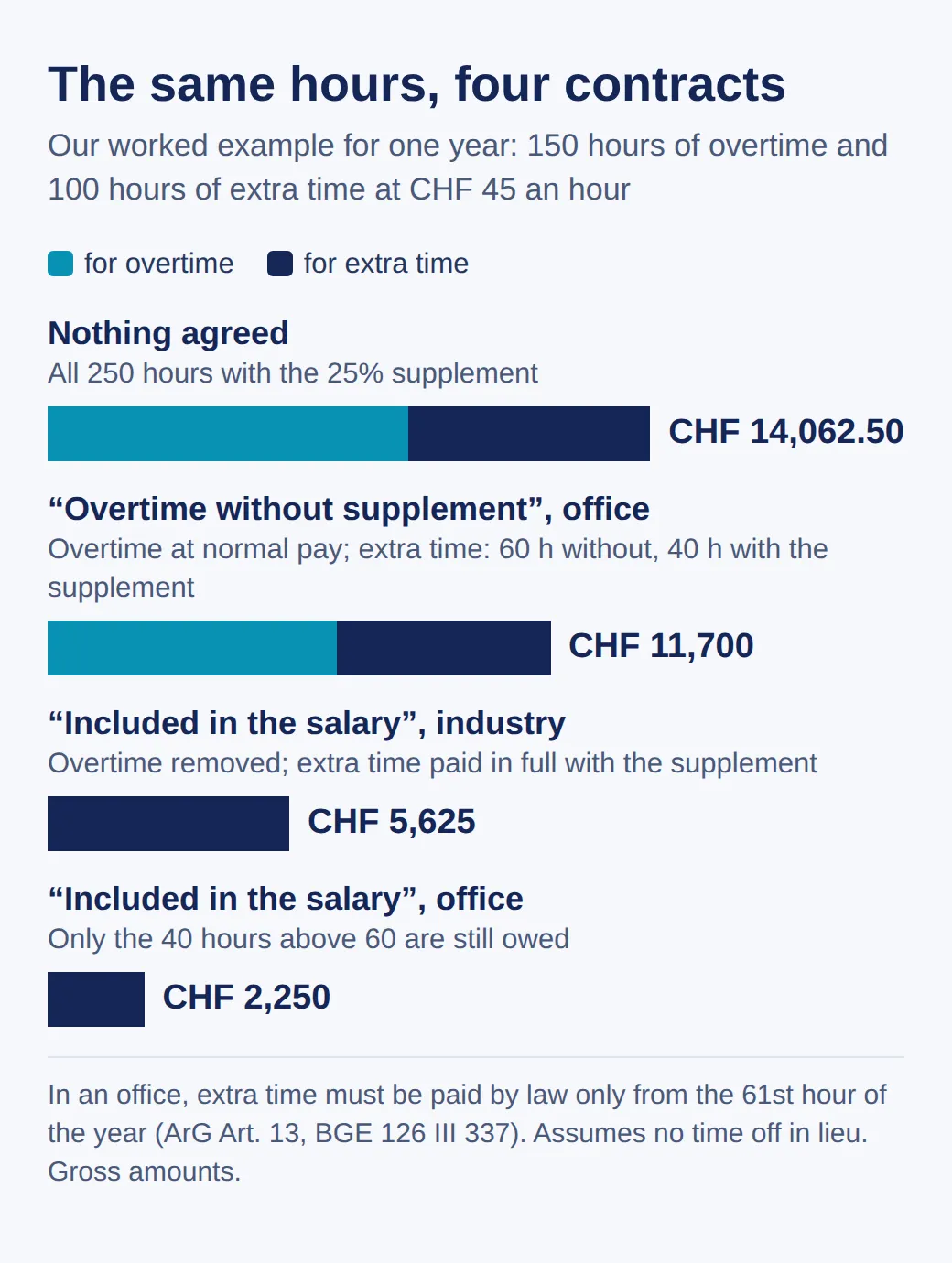
Two points on the clause itself. It must be in writing; a verbal agreement or an announcement in a team meeting is not enough. And it only applies to the future. In BGE 124 III 469 (in French), an employee in Geneva had built up more than 800 hours of overtime over the years, all shown on every payslip. In 1996 he signed a letter from the firm that set his balance to zero. The Federal Supreme Court declared this waiver void: while you are employed and for one month afterwards, you cannot give up overtime you have already worked (Article 341).
Managers and overtime: your title is not what counts
Two special rules apply to managers, and both apply less often than a job title suggests. The first concerns the Employment Act. Senior managers are exempt from its rules on working and rest hours, and so from extra time. Who counts is defined in Article 9 of Ordinance 1: people who make far-reaching decisions, or have a decisive influence on them, and so shape the structure, the running and the development of a business in a lasting way. SECO's guidance makes clear that neither the level of pay nor signing authority nor having staff of your own is enough, and that the exception is to be read narrowly.
The second concerns the Code of Obligations. If your contract sets no fixed working hours, the Federal Supreme Court expects managers to work somewhat more than the usual hours. Overtime is then only paid if you are given additional tasks or the whole workforce works considerably more for a longer period (BGE 129 III 171, in German). If your contract does state weekly hours, though, Article 321c applies to managers too. So it pays to check your contract: a figure such as "42 hours a week" puts you in the stronger position.
Time off instead of money: who decides?
You have a say. Unless your contract says otherwise, your employer cannot impose time off in lieu on you. The Federal Supreme Court said so explicitly in BGE 123 III 84 (in German), and that includes the period after notice has been given: if you are on garden leave, you may use that time to look for a new job, and your employer cannot simply fold your overtime into the garden leave. You also have to agree to the timing. Overtime is in principle to be paid, the court writes, whereas holidays are to be taken as time off. Only on very long garden leave can saying no exceptionally be in bad faith, and even there the court urges restraint.
Flexitime is different. If you plan your own hours, you also have to reduce a surplus yourself in good time. In BGE 123 III 469 (in German), a specialist at an AHV compensation office had 23 days in credit on her flexitime account when her job ended. Because the office had put her on garden leave and she could have used up the credit during that time, she was not paid for it. If you let flexitime hours build up on a large scale, you carry the risk of not being able to use them up before the end. They are only paid if business reasons or instructions stopped you from reducing them. Then they count as real overtime, and you have to prove it.
Proof is the point most claims turn on.
How to prove your overtime
The burden of proof is on you. You have to show that you worked the hours and that the firm needed them. According to SECO, your employer has to compensate overtime it ordered, whether it was needed or not. Overtime it did not order counts if it was needed or if you could assume in good faith that it was. If your employer does not know about it, you have to report the extra work within a reasonable time so it can react.
But if you miss that report, you do not lose the money that easily. Only if your employer did not know about the extra work, and had no reason to know, can a court read accepting your salary without reservation as a waiver. In BGE 129 III 171, a tourism director had worked four months in 1998 for an association in Graubünden, and the association only learned about his overtime from the season six months after the job ended. The Cantonal Court of Graubünden held that the claim had lapsed. The Federal Supreme Court overturned that ruling: the association knew that overtime would build up during the season and was meant to be compensated in the off-season. In that situation you do not have to report the exact amount as you go, and after the job ends you can make your claim throughout the limitation period.
Good records make the difference. Your employer has to record working time anyway: Article 73 of Ordinance 1 requires records of daily and weekly working time, including extra time and breaks of half an hour or more, kept for at least five years. Your employer may only drop this under narrow conditions: with a collective labour agreement, a high degree of autonomy, gross annual pay above CHF 120,000 and your written consent (Article 73a). If your employer uses simplified recording, covering only daily working time, you may still record your hours in full, and it has to give you a suitable tool for that (Article 73b).
Keep your own list anyway, with the date, start, end, breaks and the reason for the extra work, and send it to your manager regularly. A short email at the end of each month is enough:
Dear [name]
In [month] I worked 14 hours over my contractual hours because of [reason, for example: the quarterly closing]; the breakdown is attached. That brings my overtime balance to [number] hours. I would be glad to discuss with you whether they will be paid out or when I can take them off.
Kind regards [name]
If it comes to a dispute and the exact number can no longer be proven, the court may estimate it. In BGE 128 III 271 (in German), the Federal Supreme Court names proof of the number of overtime hours worked as a case where it is enough that the number is more likely than not. That does not reverse the burden of proof, though: you have to put forward everything you reasonably can. The more complete your list, the smaller the part a court has to estimate.
When does overtime expire?
After five years. Claims arising from employment become time-barred after five years under Article 128 no. 3, and the period starts when the claim falls due (Article 130). All claims fall due when the job ends at the latest (Article 339). The law does not say exactly when the period starts for the hours of a given month. To be safe, count from the month in which you worked the hours.
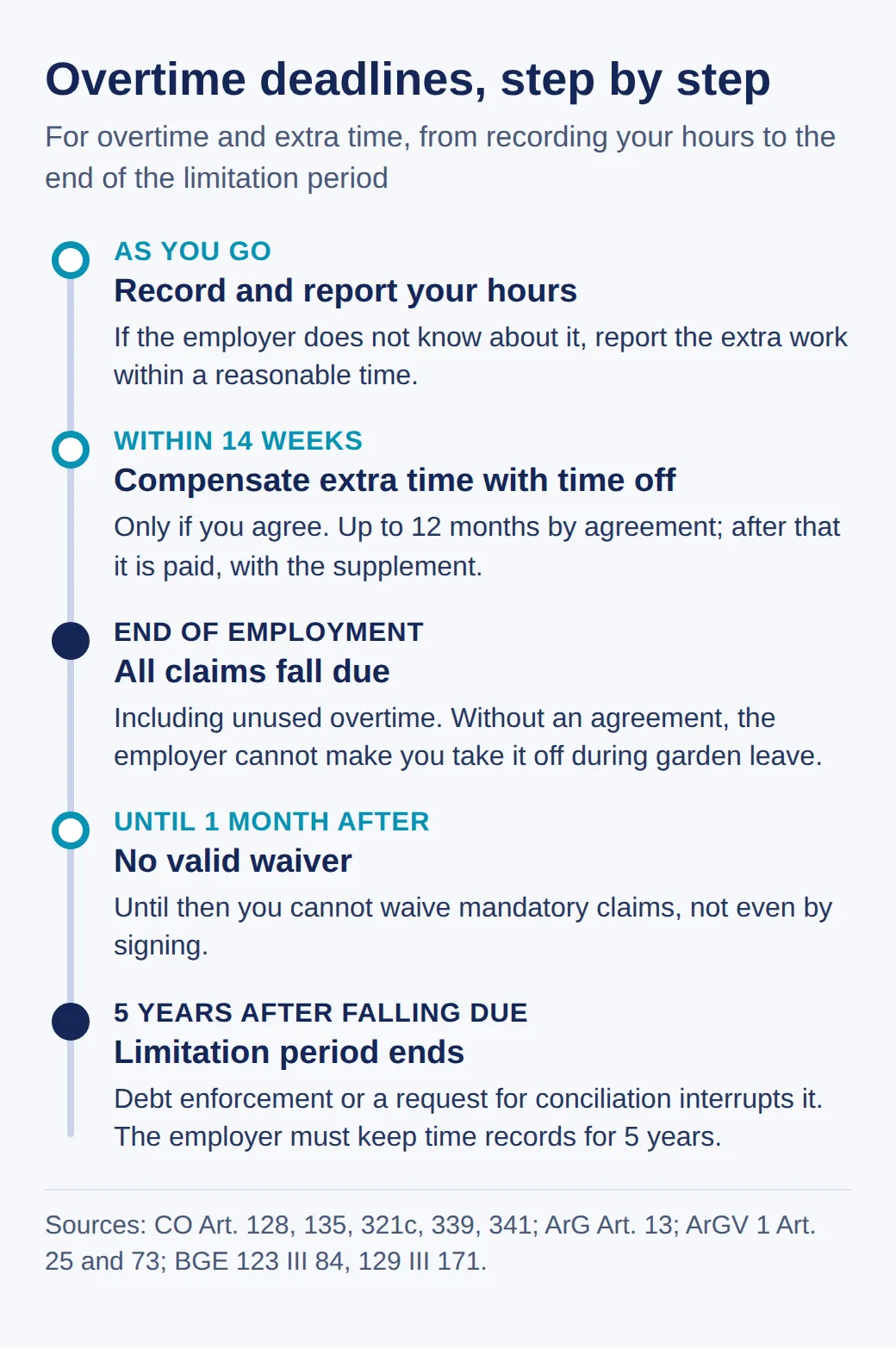
Waiting alone does not cost you the claim. In the Geneva case the Federal Supreme Court made clear that time passing counts neither as a waiver nor as an abuse of rights, and in BGE 129 III 171 that an abuse of rights only comes into question in exceptional circumstances. You can interrupt the limitation period with debt enforcement proceedings or an application for conciliation; a reminder by letter is not enough. If your employer acknowledges your claim, the period also starts again (Articles 135 and 137).
Going to court is cheap. In employment disputes worth up to CHF 30,000, there are no court costs, either in the conciliation proceedings or in court (Articles 113 and 114 of the Civil Procedure Code). Lawyers' fees can still arise. If you claim while you are still employed, you may fear being dismissed. Dismissal because you assert your claims in good faith is abusive (Article 336). What you can do then is explained in our post on unfair dismissal.
Before you put in another hour
Take out your employment contract and look for three things: the agreed weekly hours, a sentence on overtime and a reference to a collective labour agreement. If it says that overtime is included in your salary, work out whether you regularly go above 45 hours. Whatever lies above that is still yours, in an office from the 61st hour of the year.
Start keeping your own list now and send it on every month. Take time off when it suits you, and say no when it does not, especially on garden leave. And if the extra work is no longer the exception but the rule, that tells you something about the job too. Fewer hours with clear limits can then be worth more than a balance you first have to sue for.
Common questions
- Do the overtime rules apply if I work part-time?
- Yes. Overtime starts at your contractual hours, so on a 60 percent contract it starts just a few hours above your agreed weekly hours. According to SECO, though, your contract may say that only hours above the usual full-time week in the company are paid. Extra time only starts above 45 or 50 hours a week, which you will rarely reach part-time, and whether extra work can be expected of you also depends on your other commitments.
- Does the Employment Act apply to federal, cantonal or municipal jobs?
- As a rule, not to the administrations of the Confederation, the cantons and the communes. Only its health protection rules apply there, not the extra time rules with 45 or 50 hours and the 25 percent supplement. How overtime is paid is set out in the staff regulations of your administration, which your HR department can point you to.
- What can I do if my employer goes over 170 hours of extra time a year?
- Report it to the cantonal authority in charge of the Employment Act, since the cantons enforce it. An employer who deliberately breaks the rules on working and rest hours commits an offence. The breach does not cost you your pay: in the Geneva case from 1997 it was 366 hours of extra time in one year, and the firm still had to pay for them: since she worked in an office, from the 61st hour on, supplement included.
- Can I be fired for claiming my overtime pay in Switzerland?
- Not for that reason. Dismissing you because you assert claims from your employment in good faith is abusive. The notice still ends the job, but it can earn you compensation. To claim it, you must object in writing by the end of the notice period at the latest.
More posts
All posts
Unfair dismissal in Switzerland: deadlines and compensation
When a dismissal in Switzerland is abusive, the two deadlines you must meet and how much compensation the Federal Supreme Court actually awards.

Swiss job application dossier 2026: contents, order, PDF
What goes into a Swiss job application dossier, in what order, whether to send one PDF or three, and what HR managers check first.

Arbeitszeugnis: how to read and fix a Swiss work certificate
What the wording in a Swiss work certificate (Arbeitszeugnis) means, why there are no secret codes and how to get it corrected. With rulings up to 2026.