Sick pay in Switzerland: Bern, Zurich and Basel scales

If you're off sick
Without sickness benefit insurance, your employer pays your full salary when you are ill, but only for a limited time: three weeks in your first year of service, longer after that depending on your canton's scale, and six months or 31 weeks in your 25th year. The right usually starts only after three months in the job. If your employer has sickness benefit insurance, you usually get 80 percent instead, but for up to 720 or 730 days.
That much is in most guides. What they rarely mention is that the official tables don't agree either. The federal portal ch.ch gives four months as the maximum, and the Zurich courts put the steps of the Basel scale two years earlier than Basel itself does. So we laid the tables of the bodies that actually apply them side by side, and used rulings from Zurich and the Federal Supreme Court to show where things go wrong in practice: gaps in the insurance cover, and the medical certificate.
Which rule applies to you?
It depends on four things, and the order matters. The basic rule is in Article 324a of the Code of Obligations: if you cannot work because of illness through no fault of your own, you are paid your salary for a limited time, "provided the employment relationship has lasted or was concluded for longer than three months". A collective employment contract (in German GAV), a standard employment contract or your own contract may set a different rule, but only in writing and only if it gives you terms "of at least equivalent benefit".
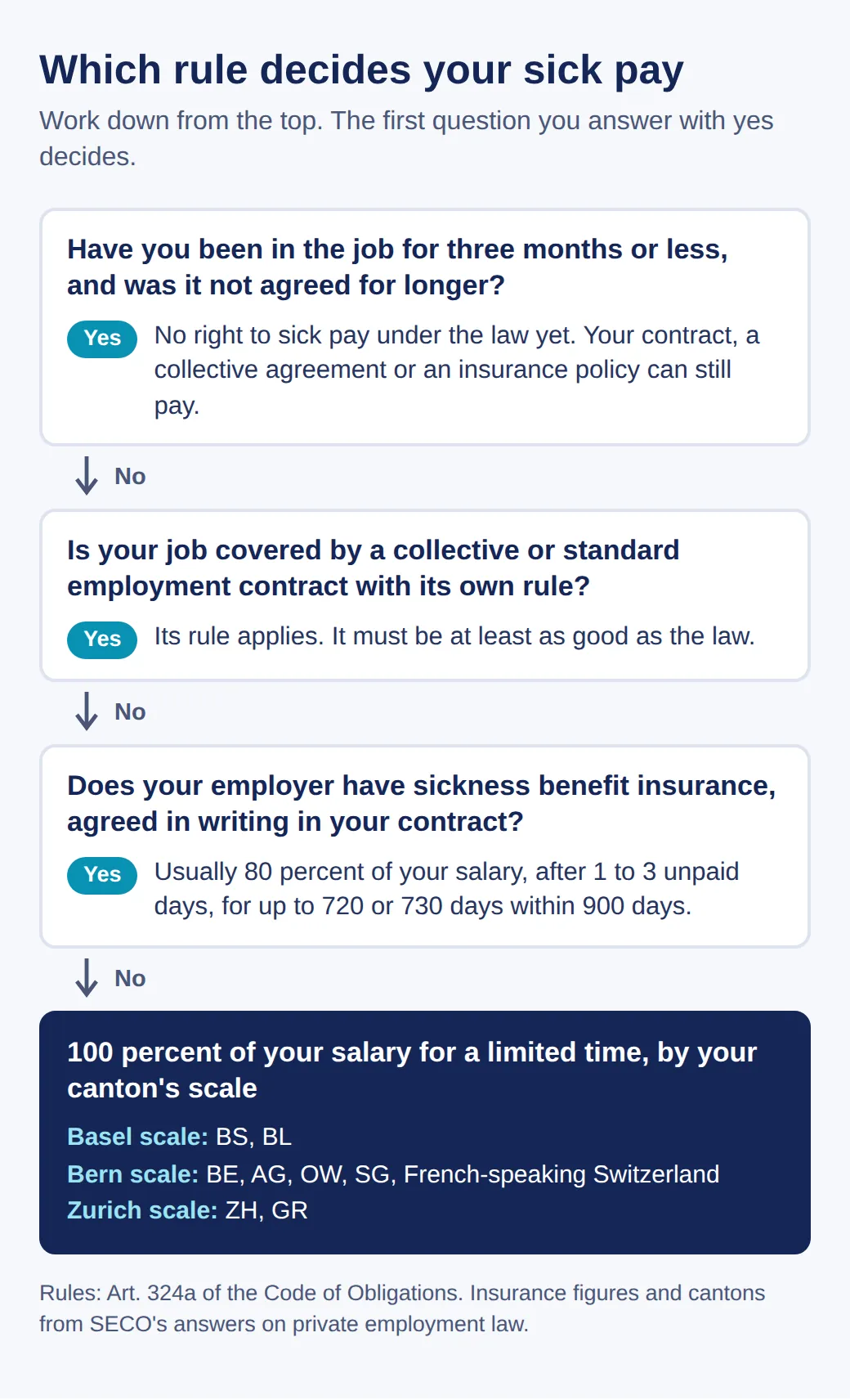
The first hurdle is the three months. The Basel-Stadt Office of Economy and Labour explains in its fact sheet on wages (in German) that the right usually starts on the first day of your fourth month in the job. It applies from your first working day only if your contract is fixed-term and meant to last more than three months without being terminable earlier, or if an open-ended contract can, from the start, be ended no sooner than a date after three months. If you fall ill in your first weeks, read your contract: sickness benefit insurance or a collective employment contract may pay even when the law does not require it yet. What else the first months mean is in our post on the probation period.
After that, the first rule that fits you decides: first a collective or standard employment contract, then sickness benefit insurance agreed in writing, and only if there is neither, your canton's scale. The scales are what most people are looking for.
The three scales at a glance
The law only says three weeks in the first year of service, "and thereafter the salary for appropriately longer periods". How long that is was set by the courts in tables, and there are three of them. According to the answers on private employment law from the State Secretariat for Economic Affairs (SECO) (in German), Basel-Stadt and Basel-Landschaft use the Basel scale; Bern, Aargau, Obwalden, St. Gallen and French-speaking Switzerland use the Bern scale; Zurich and Graubünden use the Zurich scale. SECO does not assign the other cantons. If you work in one of them, your best bet is to ask your canton's conciliation authority or a legal advice service there.
We took the figures from the bodies that apply them: the Bern scale from the Bern courts, the Basel scale from the Basel Office of Economy and Labour, and the Zurich scale from the Zurich courts, all three in German:
| Year of service | Bern scale | Zurich scale | Basel scale |
|---|---|---|---|
| 1st | 3 weeks | 3 weeks | 3 weeks |
| 2nd | 1 month | 8 weeks | 2 months |
| 3rd | 2 months | 9 weeks | 2 months |
| 4th | 2 months | 10 weeks | 3 months |
| 5th to 9th | 3 months | 11 to 15 weeks | 3 months |
| 10th | 4 months | 16 weeks | 3 months |
| 11th to 14th | 4 months | 17 to 20 weeks | 4 months |
| 15th | 5 months | 21 weeks | 4 months |
| 16th to 19th | 5 months | 22 to 25 weeks | 5 months |
| 20th | 6 months | 26 weeks | 5 months |
| 21st to 25th | 6 months | 27 to 31 weeks | 6 months |
Two of these figures don't come from the body itself. The Bern courts list their scale only up to the 19th year of service; the six months from year 20 come from the Zurich courts' table. And the Zurich table stops at the 25th year with 31 weeks. Up to then it grows by one week a year.
On all three scales, this means your full salary, from the first day of illness and with no unpaid waiting days. According to SECO, that includes every other part of your pay you would have earned had you not been ill, such as allowances. If your pay varies, it is based on the average over a representative period of up to a year. And this statutory sick pay cannot be excluded by contract.
Where the tables part ways
Most clearly in the second year of service. In Bern you get one month, in Zurich eight weeks, in Basel two months. If you are ill for two months in your second year, you keep your full salary in Basel and get only half of it in Bern. Later the lines come together and drift apart again, because Bern and Basel climb in one-month steps while Zurich adds a week every year. Counted in weeks, the biggest gap comes at the end of the tables: in the 25th year Zurich gives 31 weeks, Bern and Basel six months, or roughly 26 weeks.
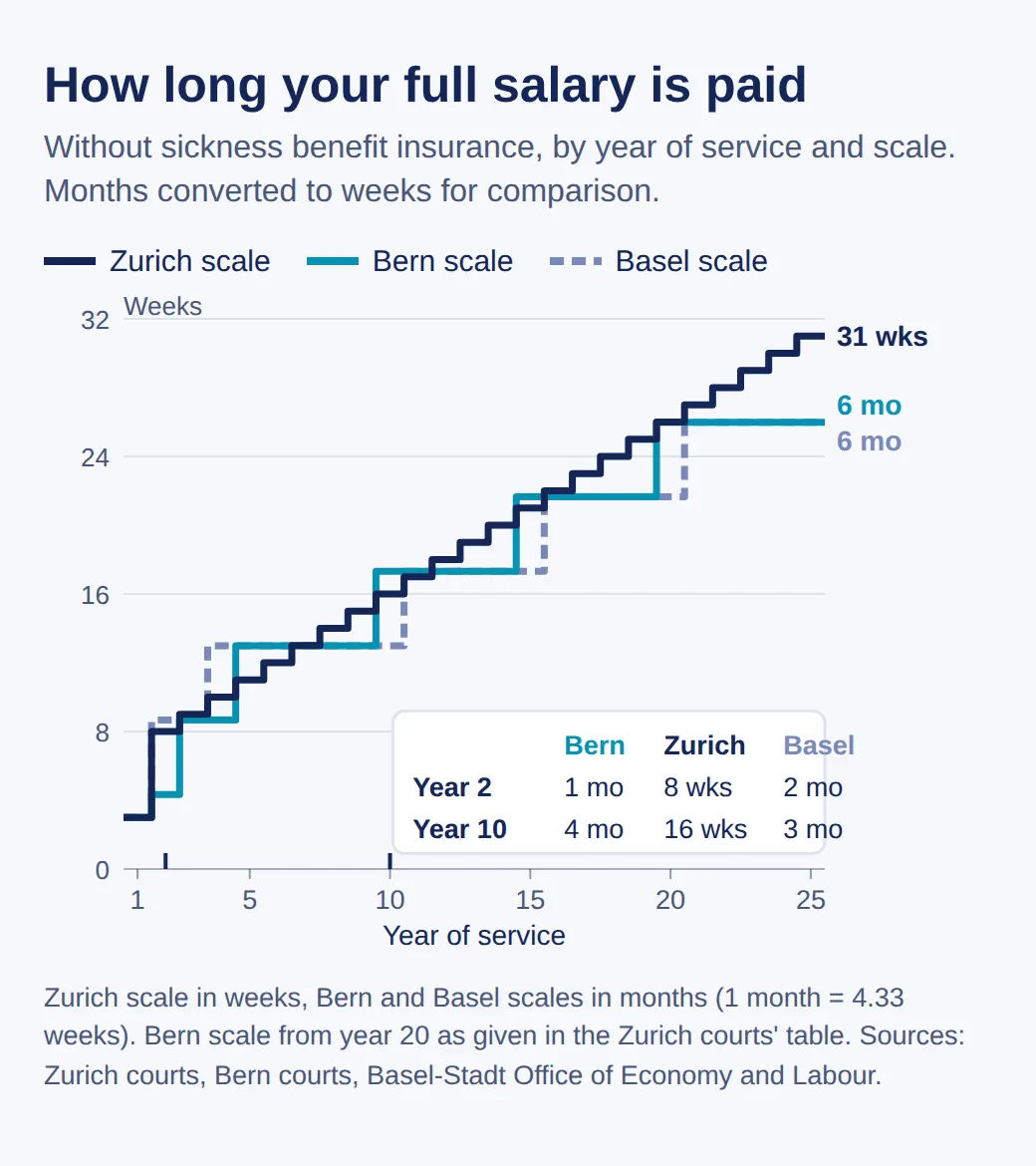
On top of that, the sources contradict each other. The Zurich courts' table gives the Basel scale four months from the 9th year of service, five from the 14th and six from the 19th. Basel itself gives four months only from the 11th year, five from the 16th and six from the 21st. SECO agrees with Basel as far as its own table goes, which is up to the 11th year. And ch.ch says the period increases "to a maximum of four months", which matches none of the three tables.
What counts in the end is the court that would hear your case. You can sue where the company has its registered office or where you normally work (Article 34 of the Civil Procedure Code). So if you work in Basel, rely on Basel's own figures, not on another body's copy of them. If your contract names a specific scale, that one applies, as long as it is not worse for you.
The table tells you how much pay you are owed. How fast you use it up depends on how the year of service is counted.
How is the year of service counted?
From your start date, not by calendar year, and your entitlement starts again with each year of service. Within one year of service, all illnesses add up. If you are ill for two weeks in spring and six weeks in autumn, you have used eight weeks, even if they were two different illnesses.
The Basel Office of Economy and Labour works through an example in its fact sheet. An employee's fourth year of service begins on 1 January 2022, and under the Basel scale he is owed three months. He is ill in April and then again from October to February. April, October and November are paid. December is not, because that would go beyond the three months. January and February are paid again, because a new year of service begins on 1 January 2023 and the entitlement starts afresh.
For you, this means two things. First, it pays to note every sick day with its date, so you know how much of the year you have left. Second, the anniversary of your start date can be worth a lot of money: if you fall ill shortly before it, you get a new, often longer entitlement afterwards. Once the entitlement is used up, your employer owes you no pay until the next year of service begins. That gap is exactly why most employers take out insurance.
Sickness benefits: 80 percent, but for up to two years
According to ch.ch, most employers have sickness benefit insurance (Krankentaggeldversicherung). In that case the policy applies instead of the scale, as long as it is at least equivalent. SECO considers a daily benefit of 80 percent of your salary for 720 days to be equivalent. Most policies pay for 720 or 730 days within a period of 900 days. In return, the employer must pay at least half of the premium, and the contract may provide for a few unpaid waiting days (Karenztage), days with no pay at all. SECO puts that at one to three days depending on the court, and so do the Bern courts.
Whether this is better for you depends on how long you are ill. A worked example, simplified to 365 calendar days: you earn CHF 6,000 a month, are in your third year of service in Bern and are ill for a whole year. Under the Bern scale you get two months' salary, CHF 12,000, and then nothing. With sickness benefits at 80 percent and two unpaid days, you get about CHF 57,300 in the same year, and the benefits carry on into the second year. With a week of flu it's the other way round: the unpaid days and the missing 20 percent cost you money. SECO says equivalence is still judged in general, not by whether you come out ahead in your particular case.
After deductions, the gap is smaller than it looks. No contributions to old-age and survivors', disability and income compensation insurance (AHV, IV and EO) are taken off sickness benefits, SECO writes. The Basel fact sheet adds unemployment insurance, accident insurance and the sickness benefit insurance premium itself; only pension fund contributions may still be deducted.
Two points are disputed in practice. The first is the waiting period, the time before the insurer starts paying. Often the employer pays during that time. Whether it then owes your full salary or only 80 percent is disputed, according to the Basel fact sheet. Under more recent case law, the Basel-Stadt labour court requires the full salary unless something else was agreed in writing. The second point is information. The insurer doesn't have to show you its terms, because you are not a party to its contract. Your employer does, and if need be you can enforce that right in court. It's best to ask in writing, before you need it:
Dear Ms [Name]
According to my employment contract, I am covered by sickness benefit insurance. Please send me the policy and the general terms and conditions so that I know the benefits, the unpaid waiting days and the waiting period. Please also let me know whether you pay my full salary or 80 percent during the waiting period.
Kind regards [Name]
A policy, though, is only as good as its terms. A case from Zurich shows what happens when they leave a gap.
When the insurer won't pay
Then your employer often has to step in. A man started a full-time job with a company in the main construction sector on 23 May 2022. On 9 August he fell ill, still in his probation period, and a week later the company dismissed him with effect from 23 August. The sickness insurer paid nothing: its terms ruled out continued cover when employment ends during the probation period. But the collective employment contract for the main construction sector requires cover from the first working day.
In May 2025 the High Court of the Canton of Zurich (ruling in German) upheld the labour court's judgment: the company has to pay him CHF 29,899.80 in damages for the benefits he missed out on. The rule behind it: if an employer does not insure you the way it must, for example with gaps, exclusions or by never registering you, it has to put you in the position you would be in had the insurance been set up correctly. The court also noted that, as a rule, you must first go after the insurer yourself where that is reasonable, because the policy gives you a direct claim against it. Here it was not reasonable: an expensive lawsuit against the insurer had an uncertain outcome, and the man was ill and in a weak financial position.
If your insurer turns you down, ask for its reasons in writing and have them checked by a union, a legal advice service or the conciliation authority. In employment disputes up to CHF 30,000 there are no court costs (Articles 113 and 114 of the Civil Procedure Code). That does not cover lawyers' fees, and if you lose in court you may have to compensate the other side. Many refusals, however, have a different cause from a gap in the policy: the insurer doubts that you are really unable to work. Then the medical certificate is what counts.
When do you need a medical certificate?
From the day your contract or your employer names, and when in doubt from the first day. The law sets no day. According to SECO, your employer can in principle ask for a certificate from the first day of illness, while many contracts ask for it only from the third or fourth day. You must report sick straight away, though, and if you can't do it yourself, ask someone to do it for you.
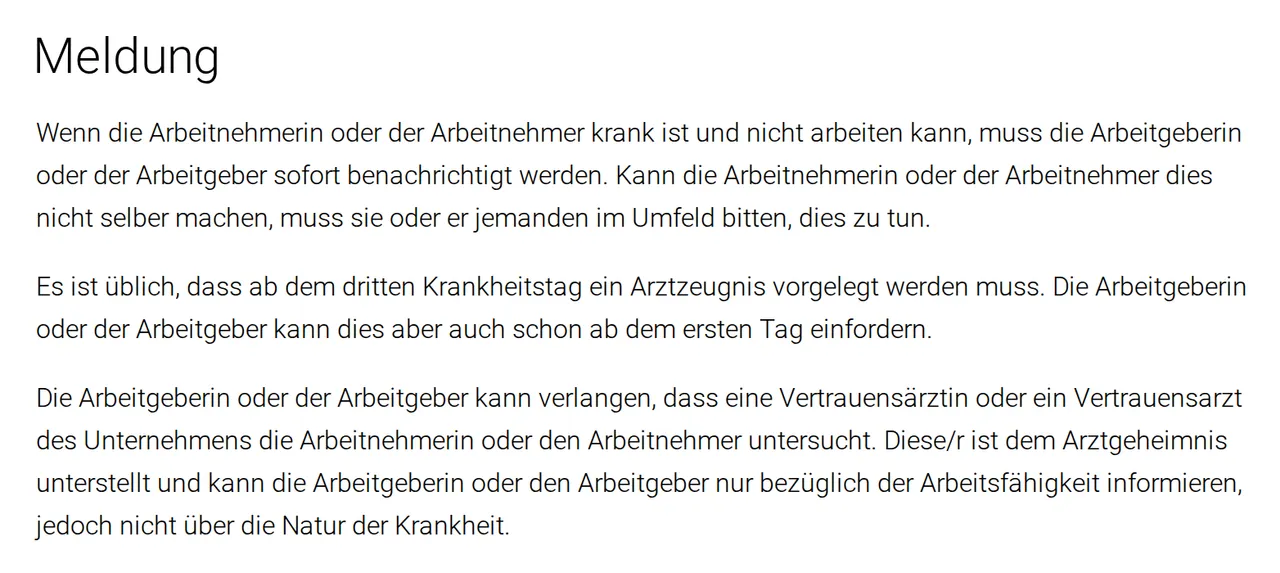
What goes into the certificate is settled too, though not by law. It must show whether you are fully or partly unable to work, and if partly, to what extent, for example how many hours a day you can manage. According to SECO it should not include a diagnosis. If your illness drags on, send in new certificates regularly without being asked. The employer paying your salary and the sickness insurer may send you to a doctor of their choosing (Vertrauensarzt), at their expense. That doctor reports only whether and how far you can work, not what you are suffering from.
A medical certificate is strong evidence, but not a free pass. The Federal Supreme Court made that clear in April 2026 in ruling 4A_42/2026 (in German). The salaried managing director of a limited liability company, who was also its only partner with signing authority, was off sick from 18 April 2022. The sickness insurer paid in full until early January 2023, then 30 percent for three more weeks and nothing after that, based on a psychiatrist's expert report. He sued for a further CHF 76,490.62 for the period up to April 2024 and submitted certificates from his GP. He lost. The certificates contained no findings, the GP was not a psychiatrist, and the letters from his treating doctors contradicted each other.
The court holds that a medical certificate, in principle, only proves that the doctor made that statement. At first it can be presumed to be true, partly because a false certificate is a criminal offence. But its weight drops if the doctor did not examine you and simply wrote down what you said, if the diagnosis was made over the phone, or if you behave inconsistently while signed off. According to the ruling, GPs sometimes lean towards their patients when in doubt, and courts may take that into account. Don't work on the side while you are on sick leave either: according to ch.ch, the insurer can then take action against you and demand the benefits back.
So if your illness lasts longer, see a specialist, get examined and ask for a certificate that gives its reasons. A brief note from your GP will do for flu, but for months off work it often won't.
If your illness lasts a long time
Then several deadlines run at once, and none of them waits for you. The scale runs out at some point, and sickness benefits end after 720 or 730 days. According to SECO, your pension fund usually releases you from paying contributions after a few months of illness.
Get in touch with the disability insurance (IV) early. For what is called early detection, you can notify your canton's IV office yourself, and so can family members in your household, your employer, your doctor or your sickness insurer (Article 3b of the Invalidity Insurance Act, in German). The aim is to prevent disability, ideally so that you keep your job or find another one. For a disability pension you also need to file the actual IV application. The pension starts no earlier than six months after that (Article 29 of the same Act) and only after a year in which you were, on average, at least 40 percent unable to work. If you wait too long to apply, you lose months.
Being ill protects you from dismissal only for a while. After the probation period, there is a protection period of 30 days in your first year of service, 90 days from the second to the fifth year and 180 days from the sixth, ch.ch says. Notice given during that time is void. After that the company may dismiss you, and how to fight a dismissal that comes precisely because you were ill is covered in our post on unfair dismissal. If your job ends while you are ill, the insurance terms decide whether the benefits keep coming. The Zurich case shows how much can hang on that.
An illness belongs in your work certificate only if it significantly affected your performance or conduct, or called your suitability for the job into question. In ruling 4A_187/2010 the Federal Supreme Court found it right to mention it for a man who had been unable to work for over a year and for whom, when he left, it was unclear whether he would ever come back. How to read the rest of a work certificate is in our post on Swiss work certificates.
Before you sign your next contract
Your sick pay is decided not when you fall ill but when you sign. Look for three things in the contract: whether sickness benefit insurance is mentioned, how many unpaid waiting days it has and who pays the premium. If there is no insurance, your canton's scale applies, and then the table above is worth a look, especially for your first years of service. If the contract refers to a collective employment contract, read its article on illness, because that one takes precedence.
And if you are ill right now: report it straight away, get the certificate in time, note every sick day with its date and ask in writing for the insurance terms. If it lasts more than a few weeks, contact the IV as well. The earlier you take these steps, the less you have to prove later.
Common questions
- Do I get paid if my child is sick in Switzerland?
- Yes, for the time you need to look after them. If your child, spouse or registered partner has health problems, the law gives you paid leave of up to three days per case and ten days per year of service. According to SECO, the ten-day limit does not apply to caring for children. If a child is seriously ill, there is separate care leave of up to 14 weeks with daily allowances.
- Is my salary paid the same way after an accident?
- No, accidents have their own compulsory insurance. From the third day after the accident it pays a daily allowance of 80 percent of your salary, and for the days before that your employer owes at least 80 percent. If you work less than eight hours a week, you are covered only at work and on your way to work, not in your free time.
- Do hourly paid and temporary workers get sick pay?
- Yes. If your pay varies, the courts use the average over a representative period of up to a year. For temporary work, what counts is how long you have been employed by the staffing agency, not the length of a single assignment, and assignments that follow on directly count together. If the agency is bound by the collective employment contract for staff leasing, you have compulsory sickness benefit insurance under it.
- Can my employer fire me while I am on sick leave?
- Not straight away once your probation period is over. Depending on your year of service, there is a protection period of 30, 90 or 180 days during which notice from the company is void. If notice was given before you fell ill, the notice period is put on hold during the protection period. There is no such protection during probation, and you yourself can resign at any time.
More posts
All posts
Arbeitszeugnis: how to read and fix a Swiss work certificate
What the wording in a Swiss work certificate (Arbeitszeugnis) means, why there are no secret codes and how to get it corrected. With rulings up to 2026.

Swiss probation period: when it ends, what illness changes
Probation period in Switzerland: one to three months, seven days' notice, no protection while sick. How illness extends it and the rules for fixed-term jobs.

Overtime pay in Switzerland: what the law really says
Overtime or extra time? When you are owed 25% on top, what your contract can cut, who decides on time off in lieu and when Swiss overtime claims expire.