Swiss probation period: when it ends, what illness changes

The short answer
In Switzerland, the probation period (Probezeit) lasts one month unless otherwise agreed, and three months at most if agreed in writing. During that time either side can give seven days' notice, on any day and without a reason. Illness and accident extend probation by the working days you miss; holidays do not. Protection against dismissal while you are sick or pregnant only starts afterwards, and a fixed-term contract has a probation period only if one is agreed.
How long is the probation period in Switzerland?
One month if nothing is agreed, up to three months with a written agreement. That is what Article 335b of the Code of Obligations says: the probation period "is considered to be the first month of an employment relationship", and a written agreement, a standard employment contract or a collective employment contract may set different terms, but "the probation period may not exceed three months". If your contract says more, the three-month maximum applies. The Federal Supreme Court confirmed this in BGE 136 III 562.
Probation can also be dropped altogether, again in writing. Whatever the change, the clause has to say clearly what it means. In a case from Graubünden (ruling 4C.45/2004), a civil engineer's contract said only: «Die Kündigungsfrist beträgt die ersten 3 Monate 1 Monat, später 2 Monate.» (The notice period is one month for the first three months, two months after that.) The employer read this as a three-month probation period. The Federal Supreme Court did not: the clause set a notice period, not a probation period, and unclear wording counts against whoever wrote it. Probation stayed at one month. A little over three weeks after he was given notice, the engineer had to do twelve days of military service. His dismissal therefore fell within the protected period the law sets before such service, and the company had to pay him until the end of February 2002 instead of only until the end of November 2001.
As a rule, there is no second probation period with the same employer. The Zurich courts (in German) give the example of an employee who first works for an hourly wage and then gets a contract with a monthly salary: the two sides already know each other, so a new probation period is not allowed. Temporary work is different. If you worked at a company through a temp agency and are then hired there permanently, you can still be given a probation period, according to the Federal Supreme Court (BGE 129 III 124). In that case, a woman had worked at a bank as a temp for a little over two months, then signed a permanent contract with three months' probation and was dismissed in January with seven days' notice. Rightly so, the court found, because she had never had a contract with the bank itself.
The length is in your contract. When probation actually ends is a different question, and it is the one behind most disputes.
When exactly does the probation period end?
It starts on the day you actually begin work. If the contract was only concluded that same day, that day is not counted, and probation ends on the same date one, two or three months later. The Federal Supreme Court settled this in 2018 (ruling 4A_3/2017, published as BGE 144 III 152), applying the general rule on time limits in Article 77 CO. An accountant had started on 15 July 2015 without a written contract. His one-month probation therefore ran until 15 August. The court expressly left open how to count when the contract is signed before the first working day.
The same case shows what holidays do: nothing. The accountant was sick for one day on 24 July and on holiday from 27 July to 14 August, which he had agreed with his boss. Of his month on probation, he worked less than two weeks. Even so, probation was extended only by the one sick day, to 16 August. On exactly that day, a Sunday, he was given notice by email. It was in time, and his employment ended seven days later.
Two things are worth remembering. First, what counts is the day the notice reaches you, not the day it was written. The collective labour agreement for hotels and restaurants (in German) even says so in as many words: notice must reach the other side by the last day of probation at the latest. Second, the seven days' notice may run past the end of probation. All that matters is that the notice arrives within probation.
In 2022, the Federal Supreme Court expressly left open whether a probation period that ends on a Sunday on paper runs on to the Monday. How illness counts, on the other hand, is clear.
Does illness extend the probation period?
Yes, by the working days you missed because you were sick. Article 335b(3) names three reasons: illness, accident and a legal obligation you did not take on voluntarily, which mainly means military service, civilian service and civil defence. Other absences do not count. Neither holidays nor unpaid leave extend probation, as the Federal Supreme Court decided in the case of a pregnant employee of a Geneva café-restaurant, in BGE 136 III 562 mentioned above. She had taken a little over five weeks of unpaid leave. When the company dismissed her at the end of January 2009, her probation was over, and the dismissal was void because of the pregnancy.
An SBB case the Federal Supreme Court decided in 2022 (ruling 8C_317/2021) shows how the extension is counted. A production worker had started on 16 March 2020 with three months' probation, which on paper ended on 16 June. He was sick from 15 to 19 June. He came back on Monday 22 June and was given seven days' notice that same day. He argued it came too late. SBB staff normally fall under federal personnel law, but on probation the court applied the Code of Obligations by way of the SBB's collective labour agreement.
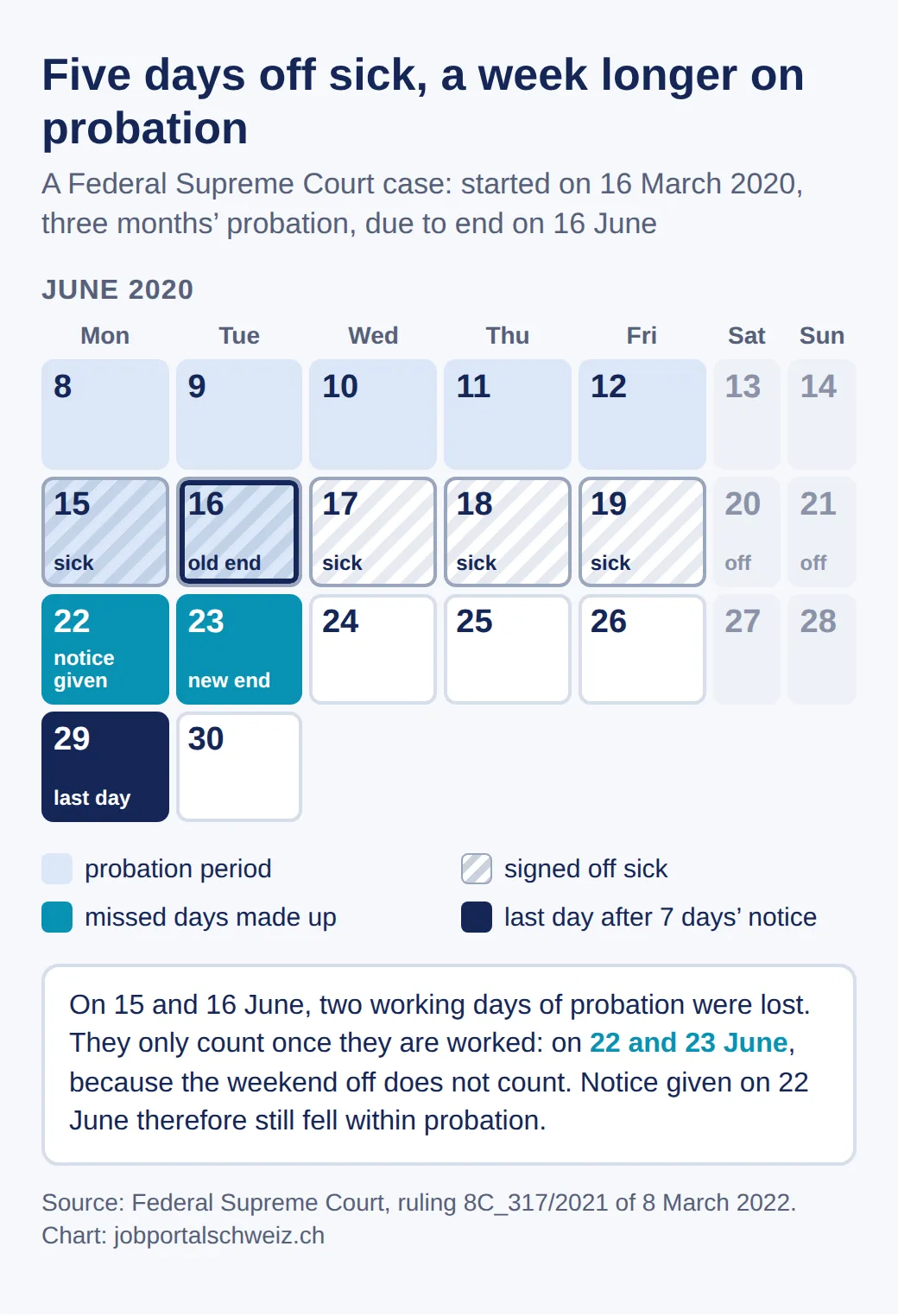
The court counted in working days, not calendar days. Two working days of probation, 15 and 16 June, had been lost to illness. Those two days have to be actually worked, otherwise probation would be shorter after all. The man could only make them up on the Monday and Tuesday of the following week, because he was sick until Friday and did not work at weekends. Probation therefore ended on 23 June, and the notice of 22 June came in time. In the same ruling, the court held that even short absences extend probation. For the accountant in 2015, it was a single day.
What this means for you: in your first months, write down every sick day with its date, counting the full days on which you really could not work. A longer illness can push the end of probation back by weeks or months. And during that time you lack more than protection against dismissal. Under Article 324a CO, the company only owes you pay while you are sick once the employment relationship "has lasted or was concluded for longer than three months", unless your contract, a collective labour agreement or a daily sickness allowance insurance gives you more.
The extension for illness is not mandatory law, though. Employer and employee can agree together to exclude it. And a company can also lose the right to rely on an extended probation period with a single email.
The congratulations that made a dismissal void
An employer who congratulates you on passing probation cannot rely on probation afterwards. The Federal Supreme Court decided this in November 2025 (ruling 4A_254/2025). A woman had started at a cooperative on 5 December 2022, with three months' probation under her contract. From 27 February 2023 she was off sick, a few days before her probation would normally have ended. She was pregnant. Because of the illness, her probation was, by law, still running. At the end of June 2023 the company dismissed her "within the probation period", with effect from 12 July.
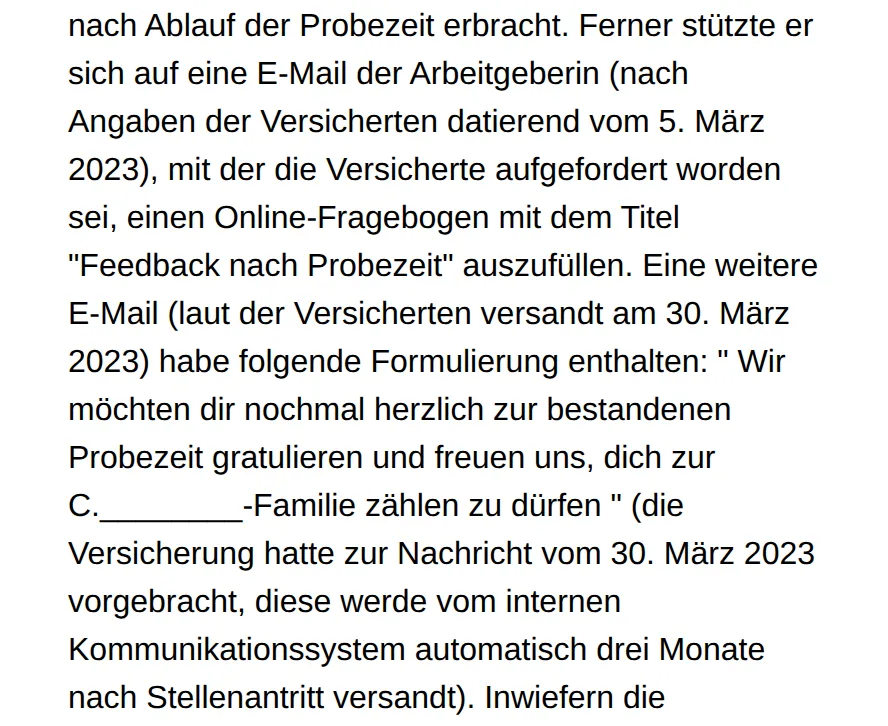
In the meantime, though, the company had sent her two emails. The first asked for feedback «nach Probezeit» (after probation), the second explicitly congratulated her on passing probation. From March she was also paid her share of the 13th-month salary, a benefit that under the staff handbook only fell due after probation. The daily sickness allowance insurer objected that the congratulations had gone out automatically three months after she started. The Federal Supreme Court did not accept that: a company is bound even by an automatic email, as long as the recipient has no reason to see that it was sent by mistake. Congratulating someone first and then giving notice that is only allowed during probation is contradictory. For the dismissal, her probation therefore counted as passed, and because she was pregnant, the protected period applied: the dismissal was void. The insurer had to pay her CHF 16,100 in daily allowances plus interest.
So keep messages like these: emails about the end of probation, invitations to a probation review, payslips with new benefits. They can make the difference later. What the protected periods are and why they do not apply during probation is covered next.
Notice during probation: what still applies
The seven days apply to both sides, on any day of the week and not tied to the end of a month. So you can also leave at short notice yourself if the job does not live up to what it promised. No reason has to be given. But you can ask the other side to give its reasons in writing (Article 335(2) CO), and that is the first step if you suspect there is more behind it.
What you do not have during probation is protection against dismissal at an inopportune time. Article 336c CO opens with the words "After the probation period has expired". Only from then on is a dismissal during illness, accident, military service or pregnancy void. During probation, the company can dismiss you even on your first day off sick, and it can also dismiss a pregnant employee.
That is not a free pass. The Federal Supreme Court also checks whether a dismissal during probation is abusive. A certain degree of arbitrariness is allowed, because that is exactly what probation is for: both sides should be free to decide whether to commit for the long term. But the dismissal has to serve that purpose. In BGE 134 III 108, an anaesthetist had started an 80 percent job on 1 May 2006 and, with the company's knowledge, kept a second job at 20 percent. Three weeks later he was dismissed because he could not increase his hours right away and had reservations about a planned project. That was abusive, and the company had to pay him CHF 20,000 in compensation. We explain more generally when a dismissal counts as abusive in our post on unfair dismissal.
If you are pregnant, the Gender Equality Act applies as well. It prohibits dismissing someone because of a pregnancy and makes no exception for probation. But it only gives you a right to compensation of at most six months' salary, not to the job. And this is where the trap lies: in both cases, abusive and discriminatory dismissal, you have to lodge a written objection by the end of the notice period under Article 336b CO. During probation that is seven days, in hotels and restaurants three. A short letter is enough:
Dear Sir or Madam
I object to the notice of termination dated [date], which I received on [date], and ask you to give me the reasons in writing. I consider the dismissal to be abusive.
Yours faithfully [Name]
Send it by registered post and keep a copy. You then have 180 days from the end of your employment to bring a claim, but the objection itself must arrive within the notice period.
What applies to fixed-term contracts?
A fixed-term contract has no probation period by law. The rules on probation sit in the part of the Code of Obligations on open-ended employment, and in BGE 144 III 152 the Federal Supreme Court describes the one calendar month as something the law gives the parties in open-ended employment. A fixed-term employment relationship, by contrast, "ends without notice" (Article 334 CO), on the agreed date. Until then both sides are bound, unless the contract allows for notice or there is good cause to end it with immediate effect.
A probation period can be agreed, however. The notes to the collective labour agreement for hotels and restaurants say so expressly: a probation period can be agreed for fixed-term contracts too, but without a written agreement there is none. The law does not say which maximum length and notice period apply if the contract is silent on them, and we have not found a Federal Supreme Court ruling on it. In hotels and restaurants, fixed-term contracts, for a season for example, also cannot be terminated (in German) unless the right to give notice was agreed in writing. So read your contract carefully. If it has no probation period, you cannot simply leave with seven days' notice before the end date, but the company cannot simply dismiss you either.
Three more points come up often with fixed-term contracts:
- Tacitly extended: If you simply keep working after the end date, the contract is treated as open-ended (Article 334(2)). That does not create a new probation period, since you already know each other.
- Chain contracts: In BGE 129 III 124, the Federal Supreme Court notes, citing legal literature, that a series of fixed-term contracts can be used to get around the rules on probation.
- Sick pay: Going by the wording of Article 324a, a contract concluded for more than three months gives you a right to continued pay from the start, even during an agreed probation period.
Hotels and restaurants, temporary work and apprenticeships also have their own notice periods.
Hotels and restaurants, temporary work, apprenticeships: their own rules
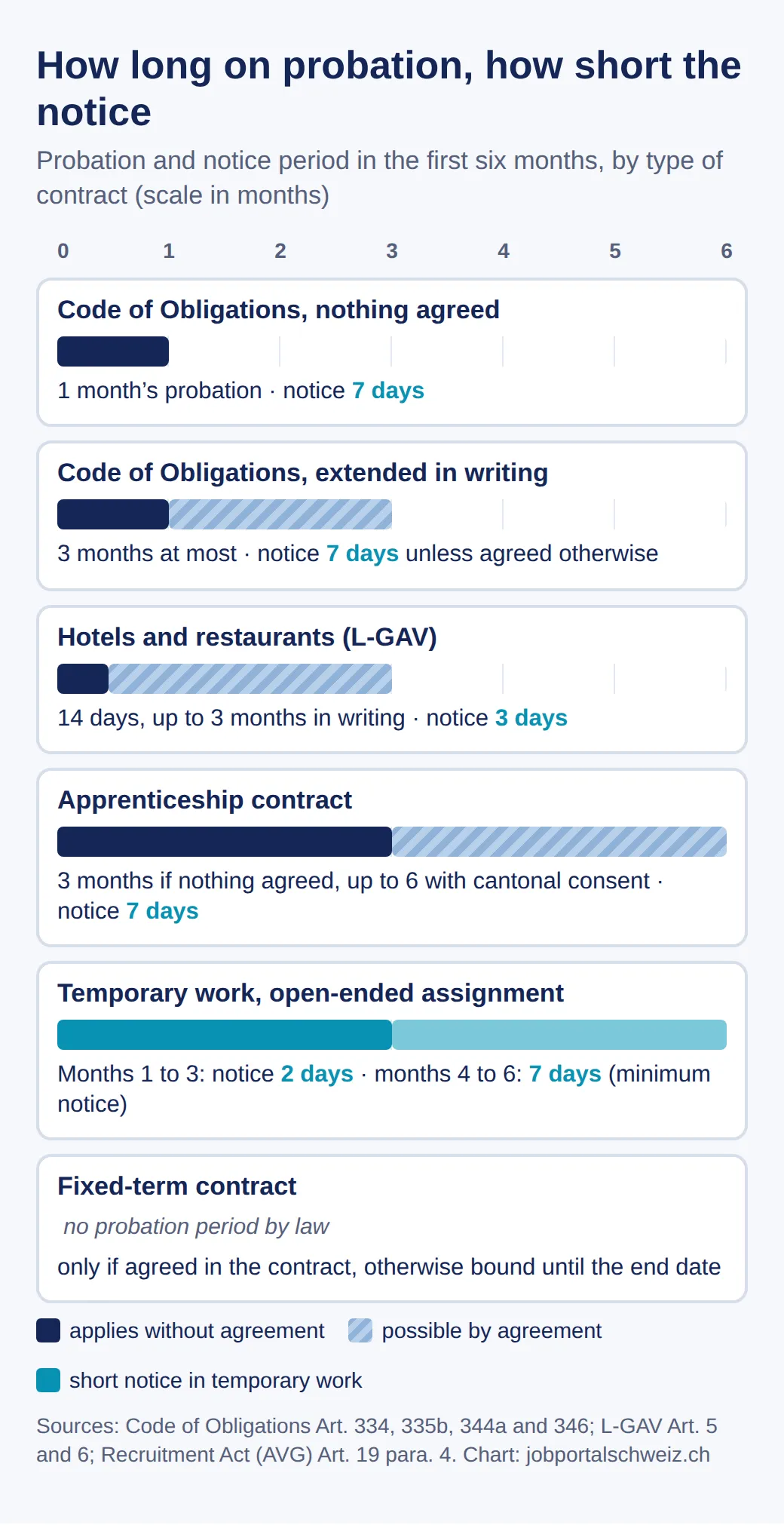
A collective labour agreement or a special law can set probation differently from the Code of Obligations, and for three groups it does. The chart shows the differences over the first six months.
Hotels and restaurants
Hotels and restaurants are covered by the national collective labour agreement for the hospitality industry, the L-GAV. Under Article 5 L-GAV, probation lasts only 14 days and can be extended to three months in writing. Notice during probation is three days, ending at the close of any day. If you start at a hotel or restaurant, treat the first weeks as a real trial, for both sides.
Temporary work
For temporary work, the Federal Act on Recruitment and the Hiring of Services (AVG, in German) governs the first six months of an open-ended assignment. In the first three months, the notice period is at least two days, and from the fourth to the sixth month at least seven days. Formally that is not a probation period, but it works like a long one. If the company where you work then hires you permanently, it may agree its own probation period, as in the case of the bank employee above.
Apprenticeships
For apprentices, Article 344a CO applies: probation lasts at least one and at most three months. If the apprenticeship contract says nothing, it is three months. With the consent of the cantonal authority, it can exceptionally be extended to up to six months, as long as this happens before it runs out. Notice during probation is seven days.
When notice comes, or you want to leave yourself
Check the dates first. When did you start the job, when did you sign the contract, how long is your probation, on which full working days were you sick or on military service, and when did the notice reach you? If the notice came after probation ended, the normal notice period applies, which without another agreement is one month to the end of a month in the first year of service (Article 335c CO), and you are protected during illness or pregnancy. If in doubt, lodge an objection within the seven days and get advice, from your union for example.
If you have no new job, register with the regional employment centre (RAV) straight away. Being dismissed by the company during probation usually costs you nothing with the unemployment insurance fund, as long as you gave no cause for it. If you resign yourself without being promised a new job, though, you count as unemployed through your own fault (Article 44 of the Unemployment Insurance Ordinance, in German). Without an excusable reason, that is serious fault, and it means 31 to 60 days without benefits, unless staying on could not reasonably be expected of you. So the seven days' notice is short, but the consequences of leaving in a hurry are not.
Whatever happens, ask for a work certificate or a confirmation of employment, even after three weeks. You are entitled to one at any time, and how to read it is explained in our post on the wording of a Swiss work certificate. For your next job, three lines in the contract deserve a look before you sign: the length of probation, the notice period during probation and, for a fixed-term contract, whether notice can be given at all. You will find new openings among our full-time jobs, and the best time to prepare your application dossier for them is now.
Common questions
- Can my employer extend my probation period?
- Not on its own. The law requires a written agreement for that, which means your signature, and more than three months is never allowed. Otherwise probation is only extended by law, when you miss working days because of illness, accident or a legal duty such as military service.
- Do I get holidays during my probation period in Switzerland?
- Yes. For an incomplete year of service, you are entitled to holidays pro rata, so with four weeks a year that is about one twelfth per month. Taking holidays during probation does not extend it, because the law only counts illness, accident and legal duties as reasons for an extension.
- Is there a new probation period if I get a new contract with the same employer?
- Usually not. If you already know each other, there is nothing left to try out, as the Zurich courts put it, for example when a job paid by the hour becomes one with a monthly salary. The Federal Supreme Court made an exception for people who had previously worked at the same company through a temp agency.
- Can I quit without notice during probation?
- Only for good cause, meaning that in good faith you cannot reasonably be expected to keep working there. That applies during probation just as it does afterwards. In every other case, seven days' notice is enough, and that is short enough that a dispute over leaving with immediate effect is rarely worth it.
- Does notice during probation have to be in writing in Switzerland?
- The Code of Obligations does not require any form, so an email or a conversation can be enough. Your employment contract may require it to be in writing, though, so read it. Putting it in writing is safer in any case, because what counts is the day the notice arrives.
More posts
All posts
Unfair dismissal in Switzerland: deadlines and compensation
When a dismissal in Switzerland is abusive, the two deadlines you must meet and how much compensation the Federal Supreme Court actually awards.

Sick pay in Switzerland: Bern, Zurich and Basel scales
How long your salary is paid when you are ill in Switzerland: the Bern, Zurich and Basel scales, 80% sickness benefits and the medical certificate.

Overtime pay in Switzerland: what the law really says
Overtime or extra time? When you are owed 25% on top, what your contract can cut, who decides on time off in lieu and when Swiss overtime claims expire.