Changing jobs in Switzerland: moving your pension fund money

Before you switch
If you start a new job on 1 January, the money in your old pension fund has to move to your new employer's fund. Before you leave, you tell the old fund where to send it. If the money has not arrived 30 days after the fund has all your details, it owes you default interest. Whatever the new fund cannot take usually goes to a vested benefits account.
It sounds like one form and you're done, and most of the time that's true. The mistakes happen at the edges: when nobody sends the old fund the new address, when the new fund can take in less money than arrives, or when there are a few weeks between two jobs. We go through the switch step by step, from the conversation with your new employer in November to the confirmation in February. We rely on the Vested Benefits Act (FZG), the BVG (Occupational Pensions Act) and the federal leaflet on changing jobs. Note that Fedlex publishes these pension laws in German, French and Italian only, so the law links below open the German text.
Step 1: Find out which fund you are joining
Ask your new employer now for the name and address of its pension fund (Pensionskasse). Every employer has to be affiliated with a pension institution, either its own or a collective foundation that covers many companies together. According to the Federal Social Insurance Office (FSIO) leaflet on changing jobs (in German), your old fund has to ask you for these details. If it doesn't, it's up to you to get them.
The switch itself is not a choice. If you stay employed and earn enough, you remain covered by the mandatory scheme, and your termination benefit must go to the new fund (Art. 3 FZG). The termination benefit (Austrittsleistung) is the money your old fund owes you when you leave. The FSIO also calls it vested benefits (Freizügigkeitsleistung); it means the same thing.
Use the same conversation for two more questions. First: will the new fund send you an entry questionnaire? The FSIO leaflet says to expect one, and you have to fill it in completely. Second: can you see the new fund's regulations? They state the most money the fund will take in for its full benefits. You'll need that figure later, when it comes to buying in.
With the name and address in hand, you're ready for the letter that sets the whole switch in motion.
Step 2: Write to your old fund before you leave
Before your last working day, tell your old fund which institution it should transfer the money to. The Vested Benefits Ordinance requires this in Art. 1, and it says explicitly “vor dem Austritt” (before you leave). Your employer tells the fund separately that your job is ending. What it doesn't know is where the money should go. Only you know that.
Some funds have their own form for this. If there isn't one, a short letter or email with the details the fund needs for the transfer is enough:
Leaving on 31 December 2026, member number [number], AHV number [number]
On 1 January 2027 I am starting a new job at [company]. Please transfer my termination benefit to its pension fund:
[Name of pension fund], [address], IBAN [number], in favour of [your name], contract or affiliation [number, if known]
Please send the exit statement to my address [address].
You can get the new fund's account details from the fund itself or from your new employer. Make a note of when you sent the letter: the 30-day deadline we come to in step 5 depends on your details.
If you switch on 1 January, what happens between your last day at the old job and your first day at the new one is quick to explain.
Step 3: From 1 January, the new fund covers you
From your first day at the new company, its fund is responsible for you, even while your money is still on its way. Mandatory cover starts when the employment begins (Art. 10 BVG). The old fund would remain liable for death and disability for one more month, but only as long as no new pension relationship has started. So when you move straight from one job to the next, the new fund takes over at once.
The new fund has to let you keep building up your pension cover and must credit you with the money you bring (Art. 9 FZG). You are covered for the benefits its regulations grant you on the basis of that money. Your health plays a part too: the new fund may not cut the cover you buy with the money you bring by adding a new health reservation (Art. 14 FZG).
One detail that often gets lost in a year-end switch: the termination benefit falls due when you leave, on 31 December, and must earn interest from then on (Art. 2 FZG). The exact amount is on the paper that lands in your letterbox in early January.
Step 4: What's on the exit statement?
The exit statement (Austrittsabrechnung) shows how the fund calculated your termination benefit, and it must list three amounts (Art. 8 FZG). You are paid the highest of them. Once you know that, you can check the statement in two minutes.
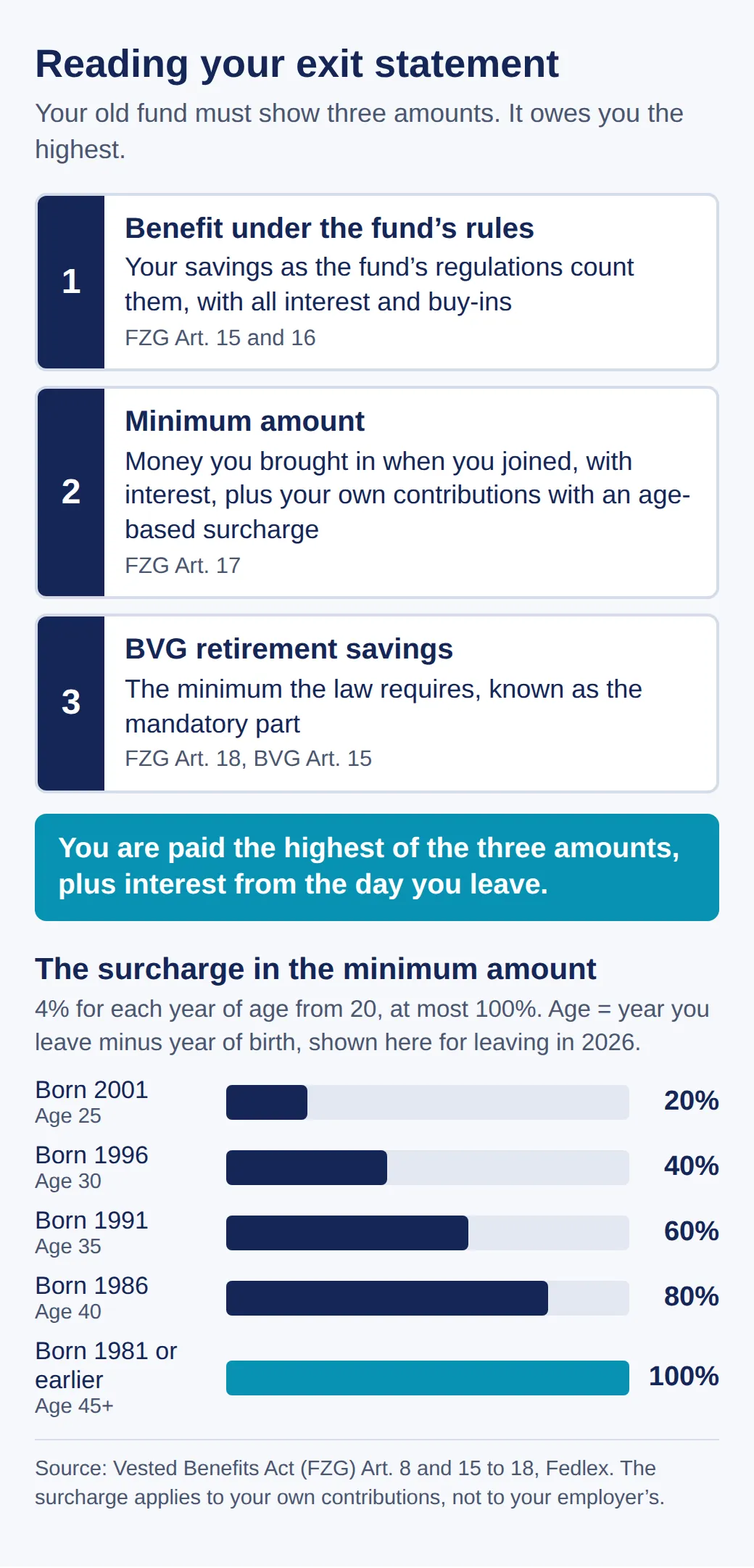
The first amount is the termination benefit under the fund's regulations. At most funds this is your savings: all contributions from you and your employer, buy-ins and interest (Art. 15 FZG). If the fund runs a defined benefit plan, the present value of the benefits you have earned applies. This is usually the largest figure on the page.
The second is the minimum amount (Art. 17 FZG). It mainly protects you after short jobs. It includes the money you brought into the fund when you joined, with interest, and your own contributions plus a surcharge of 4 percent for each year of age over 20, up to 100 percent. Your age is the year you leave minus the year you were born. If you were born in 1991 and leave at the end of 2026, you count as 35 and get 60 percent added to your own contributions. Your employer's contributions don't count here.
The third is your BVG retirement savings (BVG-Altersguthaben), the minimum part of your pension that the law requires. Every registered fund must pay out at least this amount (Art. 18 FZG). It also matters if you ever move to an EU or EFTA country and are covered by a mandatory scheme there: according to the FSIO, this part then has to stay in Switzerland until retirement age, and only the rest can be paid out.
Also check the date you left, the interest rate and the number of interest days. From the day you leave, the fund must pay at least the BVG minimum interest rate. Under the BVV 2 ordinance, that rate has been 1.25 percent since 2024, and the Federal Council kept it for 2026 (in German). If you leave on 31 December, though, the interest days fall in 2027, and the 2027 rate applies to them. In August 2026 the BVG Commission recommended raising it to 1.75 percent (in German); as of 20 October 2026 the Federal Council had not yet decided.
With the statement, the fund must also tell you how you can keep your death and disability cover. If you move straight to a new job, that's taken care of. If there's a gap, it's the most important sentence on the page. But first, the money itself.
Step 5: The money arrives, or default interest is due
The old fund has 30 days from the moment it has all the details it needs. If it transfers the money later, it owes default interest from the end of that period (Art. 2 para. 4 FZG), at the BVG minimum rate plus one percentage point (Art. 7 FZV). At a minimum rate of 1.25 percent, that's 2.25 percent; if the Federal Council raises the 2027 rate to 1.75 percent as recommended, it would be 2.75 percent.
The deadline depends on your details: as long as the fund doesn't know where the money should go, the clock isn't running. If you only send your details in March, you get just the normal interest that runs from the day you leave anyway, and no default interest. Above all, the money is missing all that time from the fund that now covers you.
The new fund confirms that the money has arrived. The FSIO advises comparing the amount on the exit statement with the amount on the new fund's pension certificate. If the figures don't match, ask the new fund first. It may ask to see your old statements and can claim the money from the old fund itself (Art. 11 FZG), and it usually has a more direct line to the old fund.
Usually the amount fits the new fund exactly. Sometimes, though, it's too much, or too little.
When more money arrives than the new fund can take
Anything beyond the full buy-in stays your pension money, but usually in a different place. This happens when the new fund insures lower benefits than the old one, for example because the plan is leaner or the insured salary is lower. You can only buy in up to the fund's full benefits under its regulations (Art. 79b BVG).
For the rest, the law gives you two options (Art. 13 FZG). You can keep it in another permitted form, which means a vested benefits account or a vested benefits policy. Or you can leave it with the new fund to buy higher benefits later, if its regulations allow that; the fund then has to send you a yearly statement on it. The FSIO leaflet describes the first option as the normal case.
You decide which vested benefits institution to use. Your former fund or former employer may not tell you which one to choose, the FSIO points out. Compare interest and fees yourself rather than taking the first offer, and switch later if another provider pays more. You can do that at any time (Art. 12 FZV).
The opposite case is more common: the money you bring isn't enough for the new fund's full benefits. You can then close the gap with a buy-in. It is never compulsory and, according to the FSIO, can usually be deducted from your taxable income. There is one catch: benefits that come from a buy-in can't be taken as a lump sum for three years afterwards (Art. 79b BVG). If you plan to withdraw capital for a home or for retirement during that time, talk to the fund first.
Everything so far assumes you move from one job to the next without a break. A gap changes things.
Between two jobs: what applies during a gap
If there's a break between the old job and the new one, your money goes into a vested benefits account or a vested benefits policy for the time being. And you are only covered against death and disability for a short while.
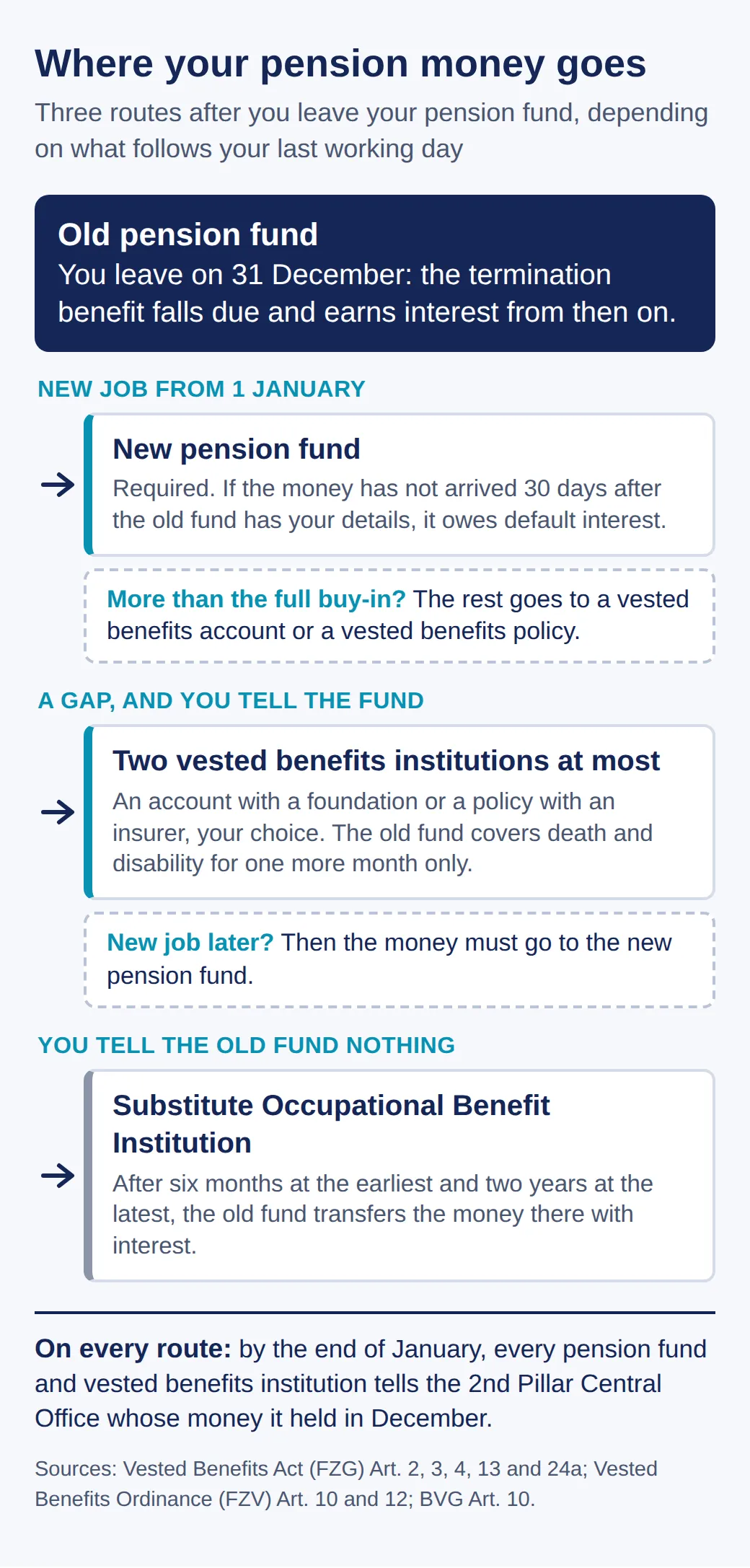
The old fund covers death and disability for one month after the pension relationship ends (Art. 10 BVG). After that, you are no longer insured against them in the second pillar. A vested benefits account (Freizügigkeitskonto) is a pure savings account with a foundation, which can be combined with risk insurance. A vested benefits policy (Freizügigkeitspolice) is an insurance policy that can include extra cover for death and disability (Art. 10 FZV). If you expect a longer break and have a family, this difference is worth knowing.
You may split the money between no more than two vested benefits institutions (Art. 12 FZV). The FSIO leaflet explains why that can make sense: later on, an account can only be closed in full, not in part. If you split the money between two accounts when you leave, you can, for example, withdraw just one of them when you become self-employed.
If you want to keep saving for retirement during the break, you can keep your pension cover going voluntarily, with the Substitute Occupational Benefit Institution or with your old fund if its regulations allow it (Art. 47 BVG). According to the FSIO, you must be insured under AHV for this and decide immediately after leaving. If you receive unemployment benefit above a minimum amount, you are covered for death and disability through the Substitute Occupational Benefit Institution, but you don't save for retirement.
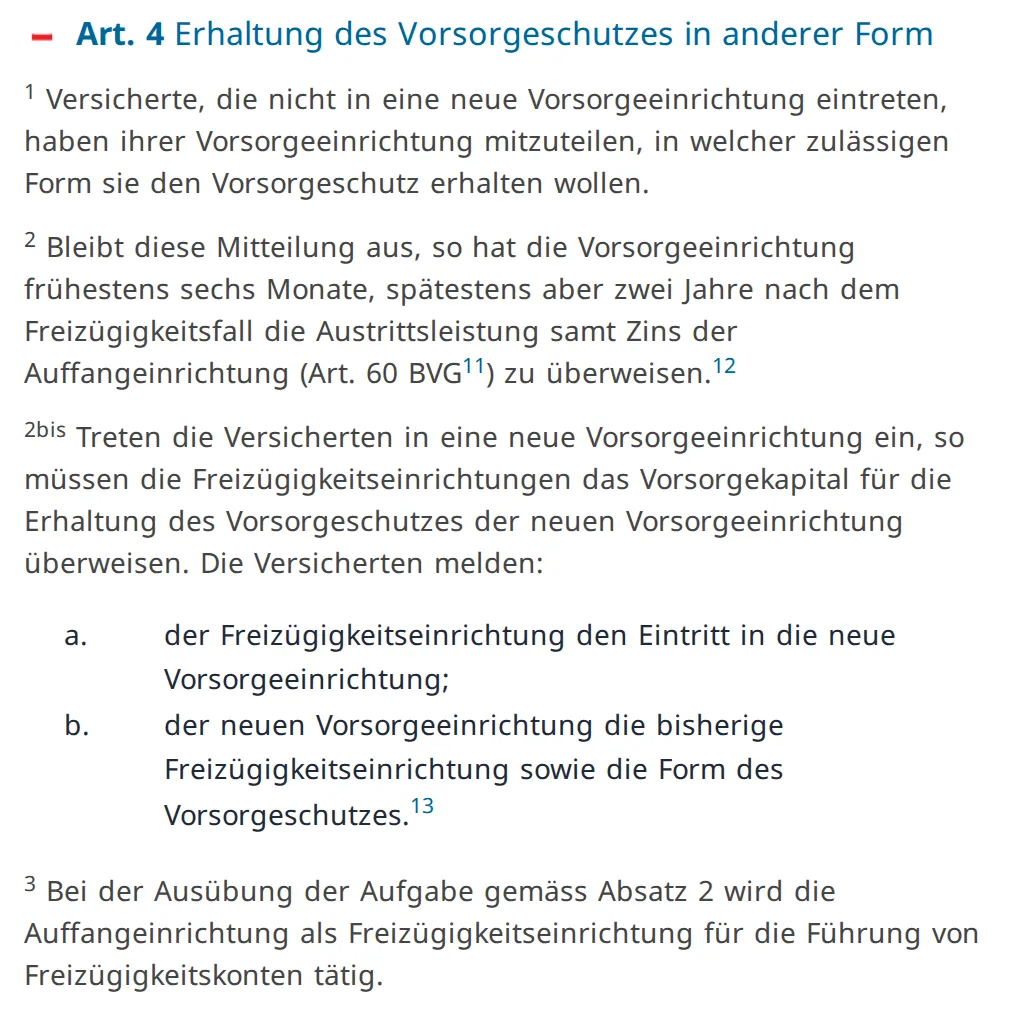
Once your next job starts, the money must go to the new fund. The vested benefits institutions then have to transfer it, and you notify both sides of the change (Art. 4 para. 2bis FZG). So deliberately leaving the money in the account is not an option. And unless you tell it, the new fund won't know about the money.
What happens if you don't tell your fund anything?
Then your money goes to the Substitute Occupational Benefit Institution (Stiftung Auffangeinrichtung BVG), but not straight away. The old fund transfers it, with interest, no earlier than six months and no later than two years after you leave. That is what Article 4 of the Vested Benefits Act says.
The Substitute Occupational Benefit Institution is a foundation of the social partners based in Zurich, with offices in Lausanne and Bellinzona. It opens an interest-bearing account in your name. According to its regulations and information sheet for vested benefits accounts, the board of trustees sets the interest rate, the interest is credited each year on 31 December and the account is free of charges. So the money isn't lost there. But it sits in a place you didn't choose, and you get whatever interest the foundation sets.
You can have it passed on at any time, to a new pension fund or another vested benefits institution. If you have a new job, request the transfer to the new fund through the institution's web form. The foundation may also check on its own whether you are insured again and then transfer the money without a request from you. It isn't worth waiting for that.
Things get harder when you no longer know where all your money is.
Forgotten pension money: the 2nd Pillar Central Office
By the end of January, every pension fund and vested benefits institution reports everyone for whom it held money in December of the previous year (Art. 24a FZG). The reports go to the 2nd Pillar Central Office (Zentralstelle 2. Säule) at the LOB Guarantee Fund. If you ask, it tells you which institutions have reported money in your name.
People search often, and usually with success. According to the Guarantee Fund's 2025 annual report, its business office handled around 190,000 requests in 2025. In 78 percent of cases it found at least one account, and in total it matched 269,000 accounts. The Substitute Occupational Benefit Institution says the search is free.
The enquiry to the Central Office is made in writing, with an online form or a PDF, which is also available in English, Portuguese and Spanish. The Central Office gives no information about balances by phone. It doesn't manage any money either, and it doesn't decide on claims. With its reply, you contact the institution that holds your money and have it transferred from there to your current fund.
The easiest way is never to have to search. The FSIO advises keeping every pension certificate and giving every vested benefits institution your new address, especially before moving abroad.
What to do now
If your new job starts on 1 January, you have exactly three things to do in November and December: ask your new employer which pension fund it uses, write to your old fund before 31 December and fill in the new fund's entry questionnaire. In January, check the exit statement for the three amounts, and in February, check that the money has reached the new fund. If there's money left over, you choose where it goes.
If you have never had to read pension fund regulations before, you don't have to read them alone. The association Kostenlose Pensionskassen-Auskünfte (in German and French) gives members of pension funds free advice from volunteers, on the first Wednesday of every month in eleven places, without an appointment, and also by phone or video. And because changing jobs involves more than your pension: ask your old company for your final reference and read it carefully. Our article on the Swiss Arbeitszeugnis shows what to look for. What applies in your first months at the new place is in our article on the probation period.
Common questions
- Can I withdraw my pension fund money when I change jobs in Switzerland?
- Only in three cases: you leave Switzerland for good (only in part if you move to the EU or EFTA), you become self-employed and are no longer covered by the mandatory scheme, or your termination benefit is smaller than your own annual contribution. A simple change of job is not one of them. If you are married or in a registered partnership, your spouse or partner also has to agree in writing.
- Can a new pension fund add a health exclusion when I join?
- Not for the cover you buy with the money you bring with you. The new fund may not reduce that cover with a new health reservation. If your old fund had already applied a reservation, the time that has passed counts towards it.
- What happens if my new salary is below the BVG threshold?
- Then you are not covered by the mandatory scheme with that employer, and your money belongs in a vested benefits account or policy. The entry threshold is an annual salary of CHF 22,680 in 2026 and CHF 23,040 in 2027. Some funds also cover lower salaries; their regulations say so.
- How long can money stay in a vested benefits account?
- As long as you are not a member of a new pension fund. If you join one, the money has to move there. Otherwise it falls due at the reference age, or up to five years earlier if you ask. If you show that you are still working, you can defer it by five years at most.
More posts
All posts
Sick pay in Switzerland: Bern, Zurich and Basel scales
How long your salary is paid when you are ill in Switzerland: the Bern, Zurich and Basel scales, 80% sickness benefits and the medical certificate.

Arbeitszeugnis: how to read and fix a Swiss work certificate
What the wording in a Swiss work certificate (Arbeitszeugnis) means, why there are no secret codes and how to get it corrected. With rulings up to 2026.

Sick child leave in Switzerland: days off and who pays
Three days per illness, not per year: what parents get when a child is sick in Switzerland, who pays the salary and when 14 weeks of carer's leave apply.