Sick child leave in Switzerland: days off and who pays

The short answer
If your child is sick, your employer has to give you up to three working days off per illness against a medical certificate, as often as your child falls ill. Ten of those days a year are always paid, and the company pays for more under conditions, by the same rules as for your own illness. If the child is seriously ill, you can take up to 14 weeks of carer's leave at 80 percent of your salary.
Many answers stop at "three days". For parents, though, the real question starts in February, when the third virus has made its way through the daycare: is there a limit, and who pays for day eleven? To answer it, we read the laws, the guidance from the State Secretariat for Economic Affairs (SECO) and the AHV leaflet on carer's leave.
Three days per case: what the law guarantees
Two laws cover short absences. Article 36 of the Employment Act (in German) requires your employer to give you time off, on presentation of a medical certificate, to care for a family member with health problems, for at most three days per event. Article 329h of the Code of Obligations makes that paid leave. Both rules have applied since 1 January 2021.
Three days is a ceiling, not a fixed entitlement. The law covers the time "required" for the care. If your child can go back to daycare on the second day, your leave ends after one day. SECO's guidance on Article 36 of the Employment Act (in German) also makes clear that this means at most three working days per event, that is, an illness or an accident.
You cannot sign this away. Article 329h is on the list in Article 362 of the Code of Obligations, which neither your contract nor a collective employment contract (GAV in German) may change to your disadvantage. A clause saying "absences for sick children are unpaid" is invalid to that extent.
So far, so clear. What seems unclear is the question that matters most in winter.
Is the limit per illness or per year?
Per illness, as far as the time off goes. For guaranteed pay, there is also an annual limit of ten days.
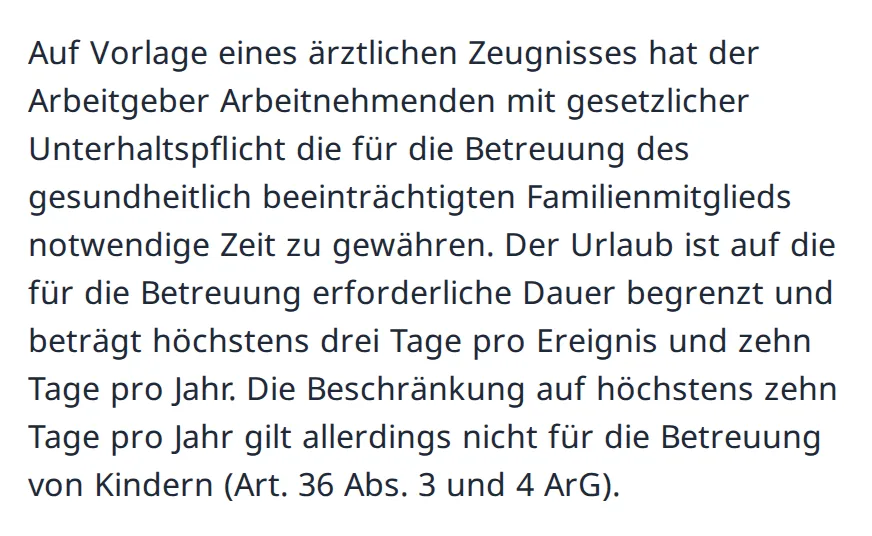
Article 36(4) of the Employment Act says that, except for children, care leave is limited to ten days a year. For a sick mother, a brother or your partner, ten days a year is the end of it. For your children it is not: each new illness gives you up to three days again, even the fifth one in the same winter. SECO says so explicitly in its answers on private employment law (in German).
Pay is a different matter. Article 329h of the Code of Obligations limits paid leave to three days per event and ten days per year, and according to SECO's guidance those ten days include children. SECO counts them per year of service, so from the date you started the job.
That does not make day eleven unpaid. Caring for sick children is also covered by Article 324a of the Code of Obligations, which keeps your salary paid when you are prevented from working through no fault of your own. For pay, SECO treats time off for a sick child like your own illness. It also states that you can choose: take days under 324a without touching your 329h allowance, or add further days under 324a after the three days under 329h.
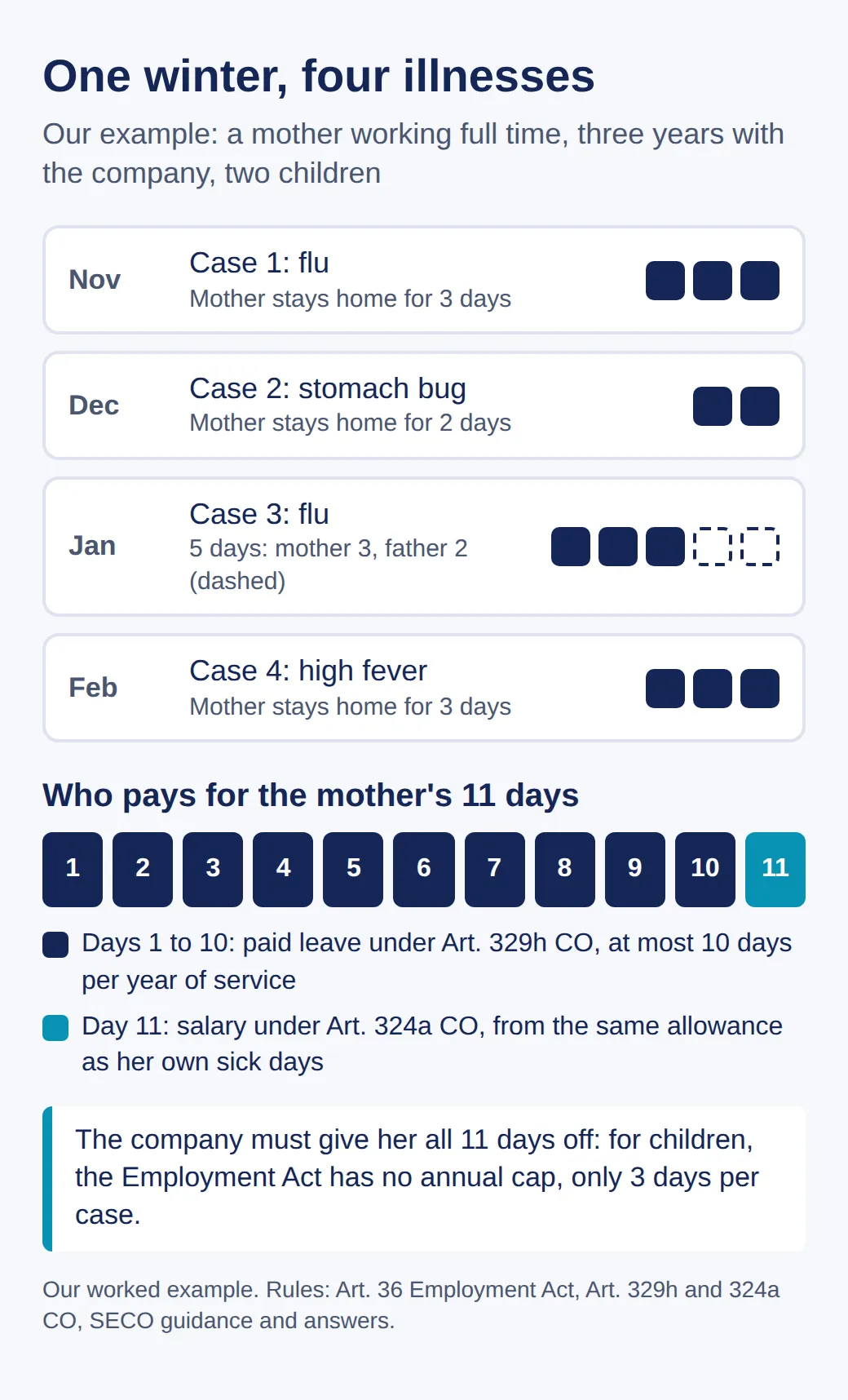
The law defines an "event" no more precisely than as illness or accident. Flu in November and a stomach bug in December are clearly two cases. None of the sources we read says whether the same cold flaring up again a week later is a new case. If it comes to a dispute, a court decides.
That leaves the question of who pays for these days.
Who pays your salary
Your employer, out of its own pocket. Sickness benefit insurance does not step in, because you are not the one who is ill. The social services team at the University Children's Hospital Zurich (in German) says so in its information sheet for parents: collective sickness benefit insurance does not cover these absences, since you are not ill yourself.
For the first three days per case, up to ten a year, the company pays under Article 329h from your first working day. There is no waiting period in that article. Anything beyond that falls under Article 324a and its conditions: the job must have lasted more than three months or been agreed for more than three months, and the entitlement is limited. In your first year of service it is three weeks, after that more, depending on your canton's scale. These days come out of the same pot as your own sick days: according to SECO, you must not yet have used up the number of days allowed for the year. What the Bern, Zurich and Basel scales look like is in our post on sick pay.
In practice, this second part often goes unpaid. Most employers are willing to grant the days off, but without pay, the University Children's Hospital Zurich reports from its counselling work. The law sees it differently, but it asks something of you that many people overlook.
Your duty to look for another solution
The company must give you the time off, but you have to make an effort to find an alternative. The federal portal ch.ch says so right next to the three days: you are required to look for suitable alternatives, such as care by relatives or friends. That duty falls away when a parent really has to be there, for example with a seriously ill baby.
The weight of this duty grows with time. In the first three days it hardly matters, because that is exactly what the leave is for: SECO's guidance explains the right by saying that working people find it hard to arrange care at short notice. From the fourth day, things change. According to SECO, the company owes pay under Article 324a only until a suitable alternative has been found. The University Children's Hospital Zurich calls this a duty to mitigate loss: you have to be able to show that you tried.
Being able to show it means writing down whom you asked and why it did not work. Grandma lives in Lugano, the neighbour is ill too. One option ch.ch mentions is the Swiss Red Cross childcare service: a carer comes to your home, for children up to the age of twelve, and some health insurers cover the cost. Ask your insurer before winter, not on the morning you have a feverish child on the sofa.
When it happens, one thing matters most: the certificate.
The medical certificate counts from day one
The law ties the leave to a medical certificate, from the very first day. Article 36 of the Employment Act requires time off on presentation of a medical certificate. SECO's guidance repeats it: the need for care of the person you look after must be backed by a certificate. For your own illness, your contract often sets the day from which you need a certificate. For caring, the law itself requires it, so even for a single day.
In practice, ask the doctor straight away for a note confirming that your child is ill and needs care, even if your employer has never asked for one before.
Let your employer know as early as you can, ideally in writing. A short message is enough:
Good morning Mr [Name],
My son came down with a high fever during the night and can't go to daycare. I'm staying at home today to look after him (Art. 36 Employment Act and Art. 329h CO) and I'm looking for another solution for the next few days. I'll send you the medical certificate later. I'll let you know tomorrow morning how things stand.
Kind regards, [Name]
It gets more complicated if you don't work every day, or if two parents are involved.
Part-time work and two working parents
Part-time staff are also entitled to three days per case. According to SECO, working days are what counts, meaning days on which you would otherwise have worked. This is how we read it for part-time work: if you work Monday to Wednesday and your child falls ill on Wednesday, then Wednesday, Monday and Tuesday are the three possible days, as long as the illness lasts that long. Your Thursday off is not a day of leave and uses nothing up.
Each working parent has their own entitlement from their own employer. How you split it is up to you. SECO's guidance states in general terms on Article 36 that where parents share family duties, the person who is looking after the child at the time can usually claim this protection, and how a family organises itself is irrelevant. If a flu lasts five days, you can cover three days and your partner two. How many days you need in total, though, depends on the care. If the other parent is off that day anyway, the care is covered. In our reading, this means both parents usually do not get leave for the same day, because the law only covers the time needed for the care.
For parents of children up to 15, Article 36 has two more rules that help in winter. You only have to work excess hours, meaning hours beyond the legal maximum working week, if you agree to it. And if you ask, the company must give you a lunch break of at least an hour and a half. More on the line between overtime and excess hours is in our post on overtime.
When three days are not enough
Then you need another solution or pay under Article 324a. Pneumonia or a broken leg often lasts longer than three days without the child being "seriously" ill in the legal sense. There is no special leave for this middle ground.
If you stay at home because there really is no other care, you are paid as long as your allowance under the scale lasts and you cannot find a reasonable alternative. SECO names a second limit: the obligation lasts only until care by the parents is no longer needed for medical reasons. If an illness drags on, have the doctor confirm this on the certificate.
If your entitlement is used up, or you have been employed for less than three months, what remains is unpaid leave, holiday or time off in lieu of overtime. You have to agree on that with the company. Dismissing you because you looked after your sick child would be risky for the company, though. Article 336 of the Code of Obligations makes a dismissal unlawful if it is given because someone asserts claims under the employment relationship or performs a legal obligation they did not take on voluntarily. How to fight back and which deadlines apply is in our post on unfair dismissal.
For a child who really is seriously ill, there has been a separate solution since 2021.
Seriously ill child: 14 weeks of carer's leave
Parents of a child under 18 whose health is seriously impaired by illness or accident are entitled to carer's leave of up to 14 weeks (Article 329i of the Code of Obligations). It is not paid by the company but through the income compensation scheme (EO), as a daily allowance under Articles 16n to 16s of the Loss of Earnings Compensation Act (in German).
"Seriously" is defined narrowly. By law, four conditions must all be met: the child's physical or mental condition has changed drastically, the course is hard to predict or a lasting impairment or death is to be expected, the child needs more care from the parents, and at least one parent has to interrupt work for it. AHV/IV leaflet 6.10 (in German) gives examples that do not qualify: broken bones, diabetes, pneumonia. Cancer is the example ch.ch gives for carer's leave.
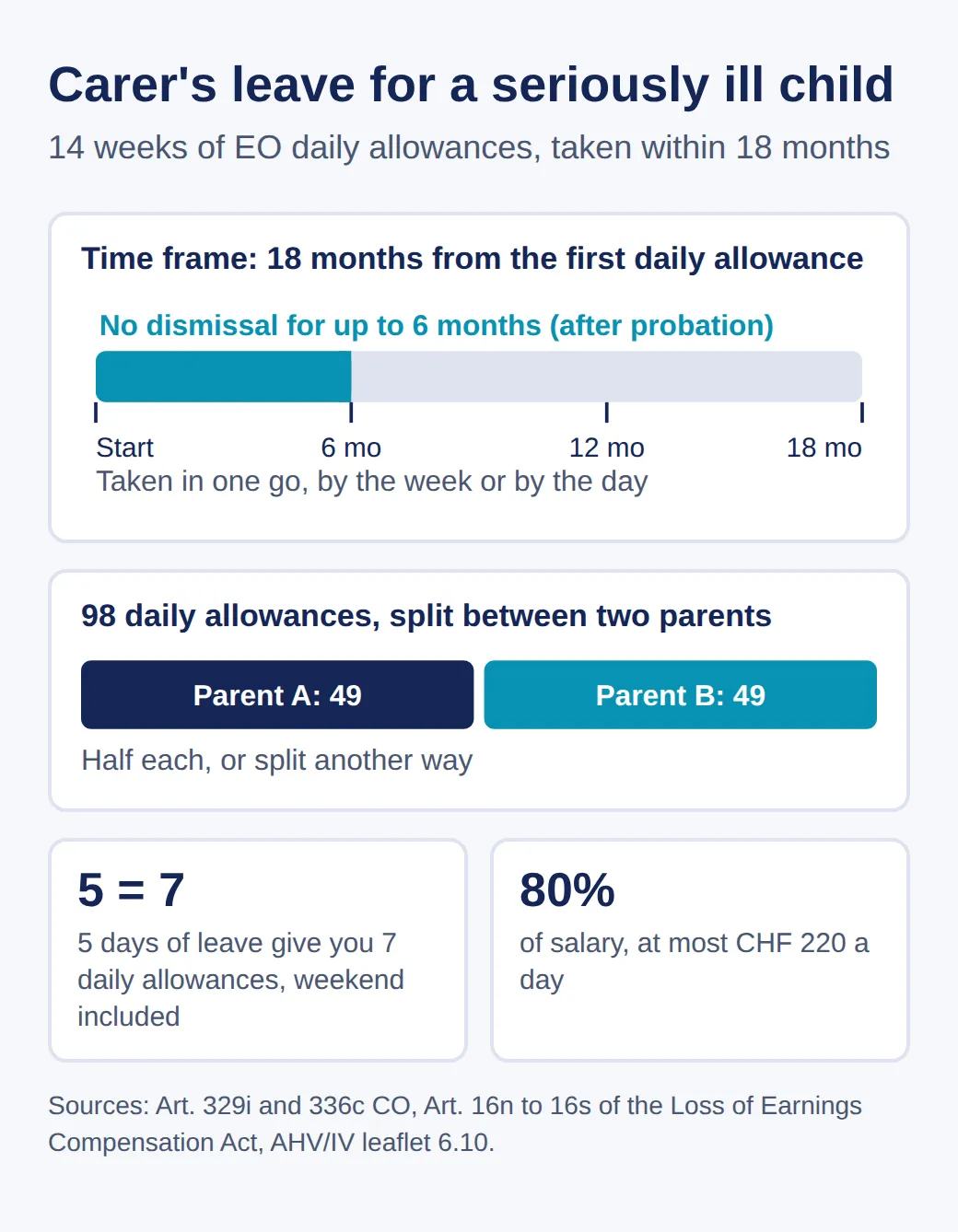
The 14 weeks equal 98 daily allowances. You can take them in one go, by the week or as single days, within 18 months of the first daily allowance. A full-time employee who takes five days of leave gets seven daily allowances, so the weekend is covered. For part-time work, the leaflet says the number of days of leave can be converted in proportion to your workload. If both parents are employed, each is entitled to half, so seven weeks, and you can choose a different split. If you both take the same day off, each of you gets a daily allowance for that day.
The daily allowance is 80 percent of your average income before the leave, at most CHF 220 a day. The Federal Council (in German) has left this maximum unchanged for 2027 as well. The leaflet works through an example: on a monthly salary of CHF 5,250 you get CHF 140 a day, so CHF 13,720 for all 98 days. You reach the maximum from CHF 8,250 a month, which gives at most CHF 21,560. AHV, IV and EO contributions are deducted from the daily allowance.
According to the leaflet, you register with form 318.744, which includes a certificate from your doctor. If you are employed, your employer submits the application to its compensation fund, says the Federal Social Insurance Office. If your employer keeps paying your salary during the leave, the daily allowance goes to the employer. Claims you do not make expire five years after the last day of leave (Article 20 of the Loss of Earnings Compensation Act, in German).
Three protections come with it. After probation, the company may not dismiss you while the entitlement lasts, for at most six months from the start of the 18-month time frame (Article 336c of the Code of Obligations); what this protection period does exactly is explained in our post on protection periods. Your holiday may not be cut because of the leave (Article 329b of the Code of Obligations). And you don't lose the three days under Article 329h: according to SECO's guidance, you can take three days first to sort out what is most urgent, and the long leave afterwards if the conditions are met.
There is only one entitlement per illness or accident. A relapse after a longer period without symptoms, however, counts as a new case according to the leaflet.
What your collective agreement or staff rules say
A collective employment contract may give more, never less. The collective employment contract for staff leasing (in German), which covers temporary work, lists in Article 15 care of your own sick child, or one living in the same household, for up to 3 days per illness, after probation. Limiting it to after probation changes nothing about the law: Article 329h has no waiting period and so applies during probation too. Article 20 of the national collective employment contract for hotels and restaurants (L-GAV, in German) lists the paid days off, from your wedding to moving house, and a sick child is not among them. There, the law simply applies.
If you work for the state, check your own staff regulations. Under Article 2 of the Employment Act, the act does not apply to the administrations of the Confederation, the cantons and the communes. One example: during carer's leave for a seriously ill child, the Confederation pays its staff their full salary instead of 80 percent, for up to 14 weeks (Article 60c of the Federal Personnel Ordinance, in German). People in a senior executive role are also outside the Employment Act (Article 3), as are, under Article 2, private households and farms, among others. Article 329h of the Code of Obligations still applies to them, with its three days per case and ten per year.
Before the first fever: what to sort out now
The best time for these questions is a quiet day before winter, not the morning your child is burning up. Read what your contract, staff regulations or collective agreement say about sick children and from which day a certificate is required. Ask your health insurer whether it pays for a home care service, and agree with your partner, the grandparents or the neighbours who can step in on which weekday. In winter, write down every care day with its date and reason, so you know when the ten paid days are used up.
And if you're looking for a new job right now, ask in the interview how the company handles absences for sick children. The answer tells you a lot about how family-friendly a job really is day to day.
Common questions
- Do I have to take holiday when my child is sick?
- No. The three days per illness are separate paid leave, not holiday. Your employer may not deduct them from your holiday entitlement. The 14 weeks of carer's leave do not reduce your holiday either.
- Do I have to make up the hours I missed?
- No. SECO counts caring for close relatives among the reasons you may stay away from work without having to make up the time you lost.
- What if my child is in hospital?
- The three days per case apply here too, and a doctor's certificate of the illness or the hospital stay is your proof. If the child is seriously ill, the 14 weeks of carer's leave come on top. Otherwise, the social services team at the University Children's Hospital Zurich notes that you generally still have to work while your child is in hospital, as long as you are fit to work yourself.
- Do stepchildren and foster children count?
- For the 14 weeks of carer's leave, yes, under conditions: foster parents need an official permit, a step-parent must live with the parent who has custody, and one parent gives up their own claim entirely. For the three days, the law speaks of family members without mentioning stepchildren, so ask if in doubt. Some collective employment contracts name children living in the same household outright, such as the one for staff leasing.
- What happens if I catch my child's illness?
- Then you are ill yourself, and the rules for your own illness apply: sick pay under your canton's scale or sickness benefit insurance, depending on your contract. Those days no longer count as caring for your child. Tell your employer about the change and get a medical certificate for yourself.
More posts
All posts
Dismissal during illness in Switzerland: protection periods
Ill, pregnant or on military service: when your Swiss employer cannot dismiss you, how long the protection lasts and how your notice period shifts.

Overtime pay in Switzerland: what the law really says
Overtime or extra time? When you are owed 25% on top, what your contract can cut, who decides on time off in lieu and when Swiss overtime claims expire.
Sick pay in Switzerland: Bern, Zurich and Basel scales
How long your salary is paid when you are ill in Switzerland: the Bern, Zurich and Basel scales, 80% sickness benefits and the medical certificate.