Unused holiday in Switzerland: does it expire at year end?

Before 31 December
No, your unused holiday does not expire on 31 December, and a clause in your employment contract or staff regulations cannot change that. Your claim only becomes time-barred after five years, separately for each year of service. But you cannot have the days paid out while you are still employed. You only get money when the job ends, and only for days you could no longer take by then.
We show when the five years start running, when your employer may tell you to take holiday, over Christmas for example, and what happens to unused days if you are given notice or put on garden leave. We draw on the Swiss Code of Obligations (CO), rulings of the Federal Supreme Court, a decision by a Zurich labour court and the guidance of the State Secretariat for Economic Affairs (SECO).
Why your holiday does not expire on 31 December
The law sets no expiry date for holiday. Article 329c CO only says that holiday is "generally" granted during the year of service it belongs to. That is a duty for your employer, not a cut-off date on which your balance disappears.
The Federal Supreme Court settled this in a case from the canton of Appenzell Ausserrhoden (BGE 130 III 19, in German). A kitchen assistant had worked at a country inn from 1995 to 1999 and, after leaving, sued for the holiday she had not taken. The employer argued that holiday had to be taken by the following year at the latest. The court disagreed: "The law provides for no such forfeiture or limitation period," it wrote (our translation). And it added who carries the responsibility: it is the employer who sets the timing of holidays, so as a rule it is also the employer who is responsible if the claim is only made much later.
Many staff regulations still say that leftover holiday must be taken by a cut-off date, say the end of March, or it is lost. Legally, that does not stand up. Article 329c is one of the provisions a contract may not change to your disadvantage (Art. 362 CO), and nobody can alter the limitation periods by agreement (Art. 129 CO). That is why the employers' association Swissmem (in German) tells its members that such deadlines can at most be an incentive to take holidays on time. Nor can you give the days up: you may not waive mandatory claims such as your statutory holiday while you are employed and for one month afterwards (Art. 341 para. 1 CO).
None of this lets you save up days forever, though. The real limit is the limitation period, and it works differently from what many people think.
After five years it's over: how to work out the time limit
A holiday claim becomes time-barred after five years. The Federal Supreme Court decided this in 2009 (BGE 136 III 94, in French), based on the time limit for claims from employment in Article 128 CO. The period runs separately for each year of service, and it does not start on 1 January but as soon as the claim falls due (Art. 130 CO).
It falls due on the holiday dates set in your contract or fixed by your employer. If there are none, it falls due on the last day on which you could still take your whole holiday within the current year of service. With four weeks of holiday and a year of service that matches the calendar year, Swissmem puts that after week 48 of 52, so in early December. Five years later the claim is time-barred.
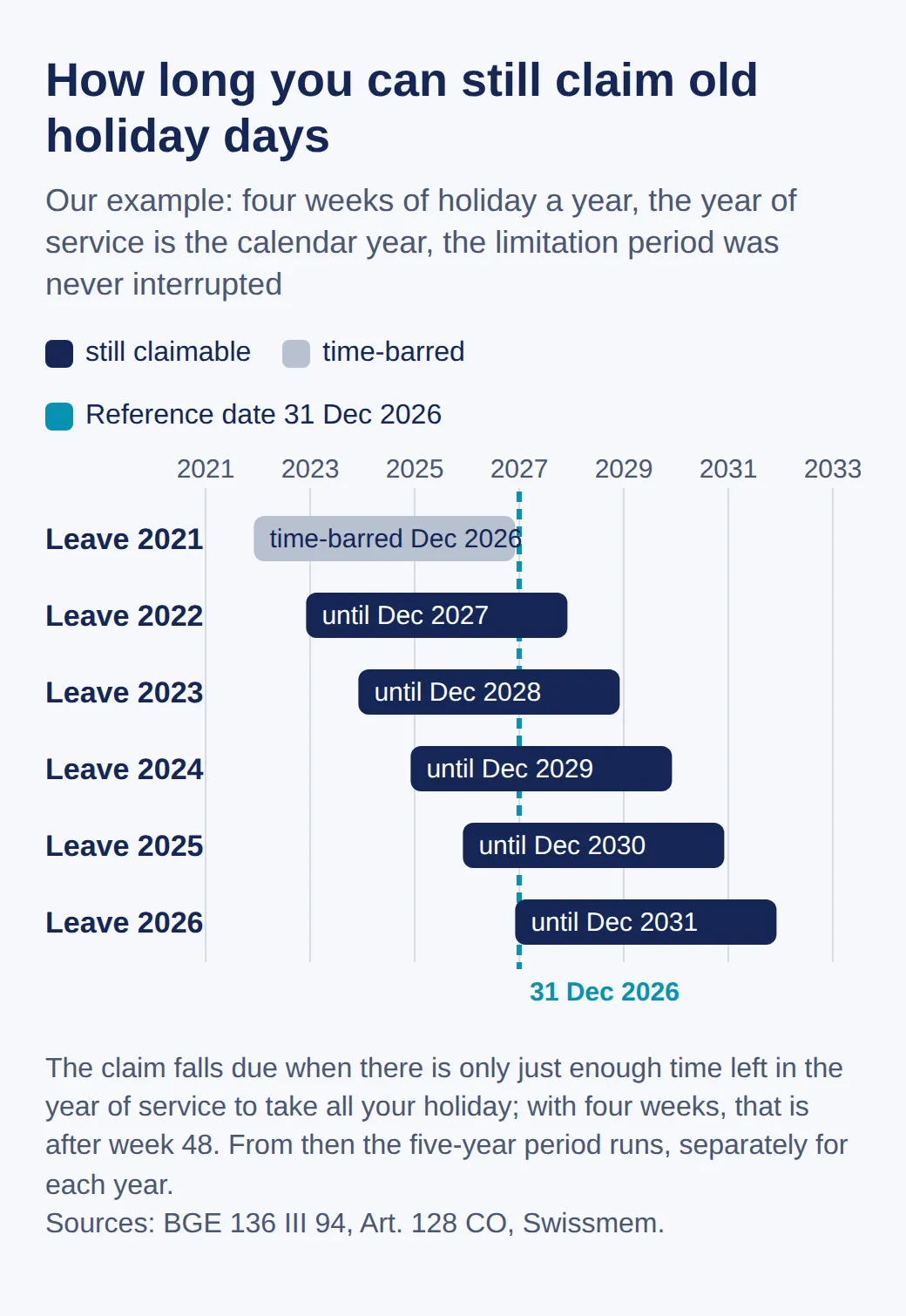
For the turn of the year, this means: in this example, untaken holiday from 2021 becomes time-barred in early December 2026, while holiday from 2022 can still be claimed for another year. SECO, in its FAQ on holidays (in German), counts a little more simply, from the end of the year in which the holiday should have been granted. The difference is a few weeks. To be on the safe side, work with the earlier date.
There is one way to reset the clock. The limitation period is interrupted if the debtor, here your employer, acknowledges the claim (Art. 135 CO). Swissmem goes further: if the employer informs you of the remaining balance at the end of the year or carries it over into the new year of service, in the time-tracking system or on the payslip, for example, this creates a new claim and the five years start again. We have not found a court ruling that confirms this view. But a balance confirmed in writing can never hurt you.
Time-barred days are also lost when you leave. If you change jobs at the end of the year, you get no money for holiday that is already time-barred. For such days, no right to a payout arises at all, the Federal Supreme Court held in BGE 131 III 451 (in German).
That leaves the question of who plans the days. If your employer sets the timing, it also has a say in whether you get to take them at all.
Who decides when you take your holiday?
Your employer has the last word, but must take your wishes into account as far as the business allows (Art. 329c para. 2 CO). At least two weeks of holiday a year must be taken in one block. SECO is more specific: for parents of school-age children, the employer must take school holidays into account, and holidays should generally be fixed at least three months in advance.
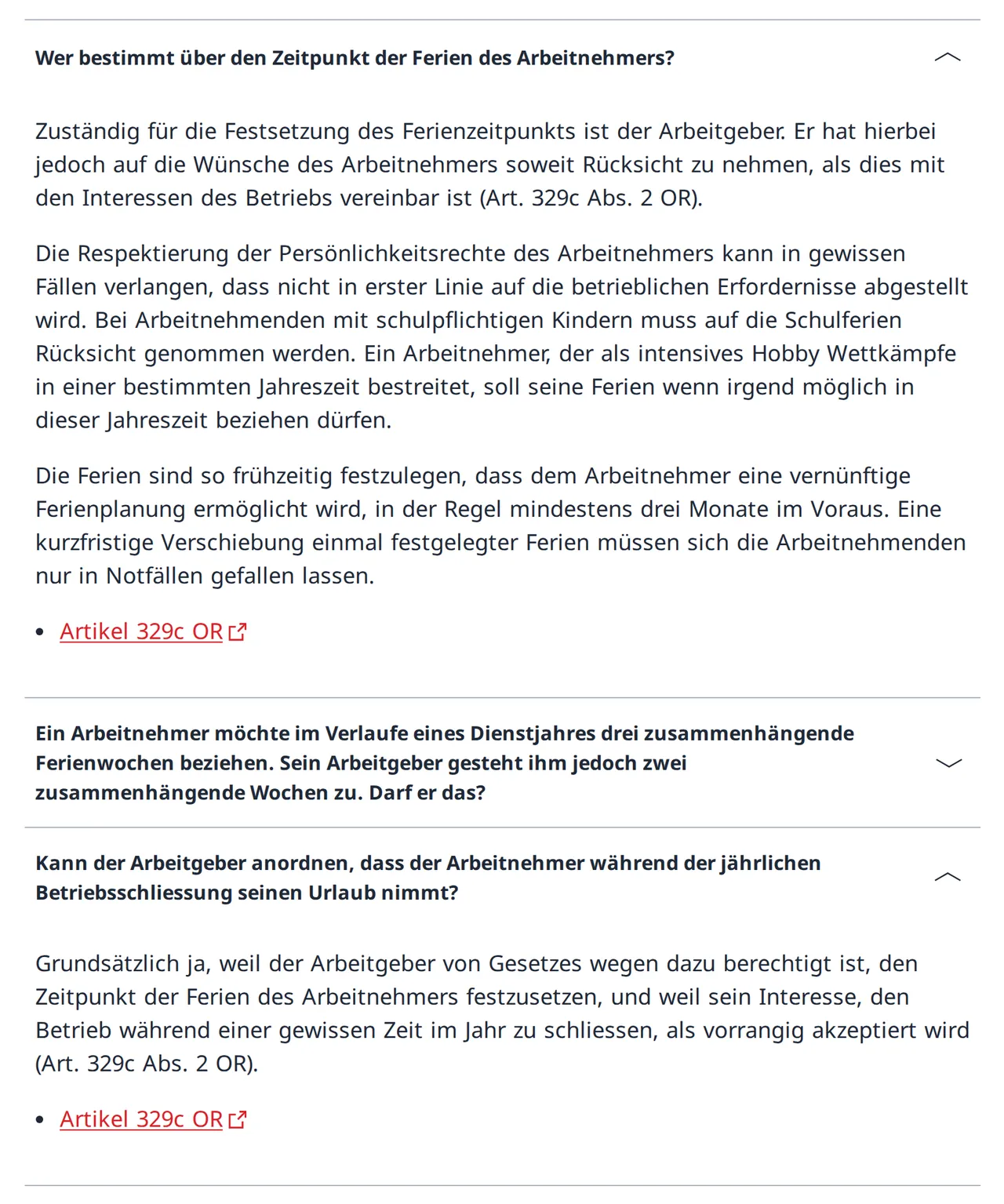
The same guideline applies when you are told to use up leftover holiday: your employer may assign you the remaining days, but generally not at the end of November for December. And once a holiday week has been fixed, your employer may only move it at short notice in an emergency. The trade union Syna (in German) says an employer that orders holiday unilaterally must give two to three months' notice, which is in the same range.
For you, it works the other way round: if you have built up a lot of days, put in your dates in writing early in the year. If your employer turns down every date, that is its responsibility, as the Federal Supreme Court held in the country inn case. Your employer has the clearest say over your holiday when it closes down entirely.
Company shutdown over Christmas and New Year
An employer may in principle require you to take holiday during an annual company shutdown. SECO's reasoning is that the employer's interest in closing the business for a certain time each year takes priority. Here too, notice matters. In a fact sheet on bridge days over the festive season (in German), Swissmem advises its members to announce company holidays at the start of the year if possible, and at least three months in advance.
Public holidays that fall within the shutdown do not cost you a day of leave. The Basel-Stadt Office of Economy and Labour (in German) states that such days do not count as holiday taken. Which days are public holidays is up to each canton, so check how many real working days the shutdown covers where you work.
It gets trickier if you do not have enough days, for example because you only started in the autumn. Swissmem names the usual ways out: hours worked in advance and spread over the year (Vorholzeit), or existing overtime. If neither is available, you and your employer can agree to take some of next year's holiday early. Agree means you do not have to say yes. If you would rather work, offer your work in writing. If your employer does not accept it, it generally remains obliged to pay your salary under Article 324 CO, and you do not have to make up the time.
If you have holiday over the festive season and would rather have the money, you run into a stricter rule.
No payout while you are still employed
During your employment, holiday may not be replaced by money or other benefits (Art. 329d para. 2 CO). That applies even if you and your employer both agree. Holiday is there for you to rest, and that purpose cannot be sold.
How strictly the courts apply this is shown by an order of the labour court at the Horgen District Court of 28 January 2026 (in German). An employee had sued in December 2025 for holiday pay for 25 working days, around CHF 6,930 gross, for holiday from 2024 and 2025. She had been given notice in October, but her employment ran until the end of January 2026. The court refused to hear the claim at all. As long as the holiday can still be taken as time off, no right to money arises. Whether she was owed anything at all would only become clear on 31 January. The court charged no costs and pointed out that she could sue again after leaving.
In practice there is one exception, for part-time work with hours that vary a lot, typically paid by the hour. There, holiday pay may be paid out with every salary, but only if the contract states it as an amount or a percentage and every payslip shows it as a separate amount (BGE 129 III 493, in German). According to SECO, the phrase "holiday included in the hourly wage" is not enough. Without the separate line, the employer risks paying for the holiday a second time. Basel-Stadt gives these supplements:
| Holiday per year | Supplement on the wage |
|---|---|
| 4 weeks | 8.33% |
| 5 weeks | 10.64% |
| 6 weeks | 13.04% |
For everyone else, money only comes when the job ends. Even then not automatically, because first comes the question of whether you have to take the days during your notice period.
Leftover holiday during the notice period
After notice has been given, any outstanding holiday should still be taken if possible. You can ask for this yourself: according to SECO's FAQ on dismissal (in German), the employer may only refuse in a business emergency.
The opposite case is more disputed: your employer sends you on holiday, but you would rather have the balance paid out. If you handed in your notice yourself, you can usually be expected to take the days. If your employer gave notice, your job search comes first. You are entitled to the time off you need for it in any case (Art. 329 para. 3 CO). Whether you still have to take your holiday depends on how the length of the notice period compares with the number of days you have left. Even during the notice period, your employer may not order holiday from one day to the next.
A case from Solothurn shows how tight this can get (judgment 4A_11/2011, in German). An employee on probation was given notice on 23 April 2010 to leave on 30 April, seven days' notice. The company released him from work and told him to take his five holiday days that week. The cantonal High Court still awarded him CHF 969.30 for the holiday: he had started looking for work at once and had a new job lined up just two weeks after the notice, so rest was out of the question. The Federal Supreme Court let that stand.
If you fall ill during your notice period, the sick days do not count as holiday, and the notice period can be extended. We explain exactly how that works in our post on protection periods during notice. Holiday disputes are most common when your employer does without your work altogether.
Garden leave: when your holiday is used up
If you are on garden leave, meaning you are released from work during your notice period but still paid, outstanding holiday generally counts as taken during that free time, but not necessarily all of it. The Zurich courts (in German) sum it up like this: holiday must be taken during garden leave, and if that is not possible for good reasons, such as an intensive job search, it must be paid out.
The Federal Supreme Court developed the principle in the case of a caretaker at a retirement home (BGE 128 III 271, in German). He was on garden leave from March 1998, had 40 days of holiday left and started a new job on 1 July. No instruction to take the holiday was needed, the court wrote, because the duty of loyalty still applies during garden leave. But there is no fixed rule. What counts is how the length of the garden leave compares with the number of holiday days left. From March to June, he had enough time to take the 40 days alongside his job search. He got no money for them.
A judgment from 2020 shows what that comparison looks like in figures (4A_319/2019, in French). A marble mason in Geneva had been put on garden leave as soon as he was given notice. Because of an illness, the end of his employment was pushed back, and the rest of his notice period fell in September and October 2016, 42 working days in all. He still had 23.44 days of holiday left.
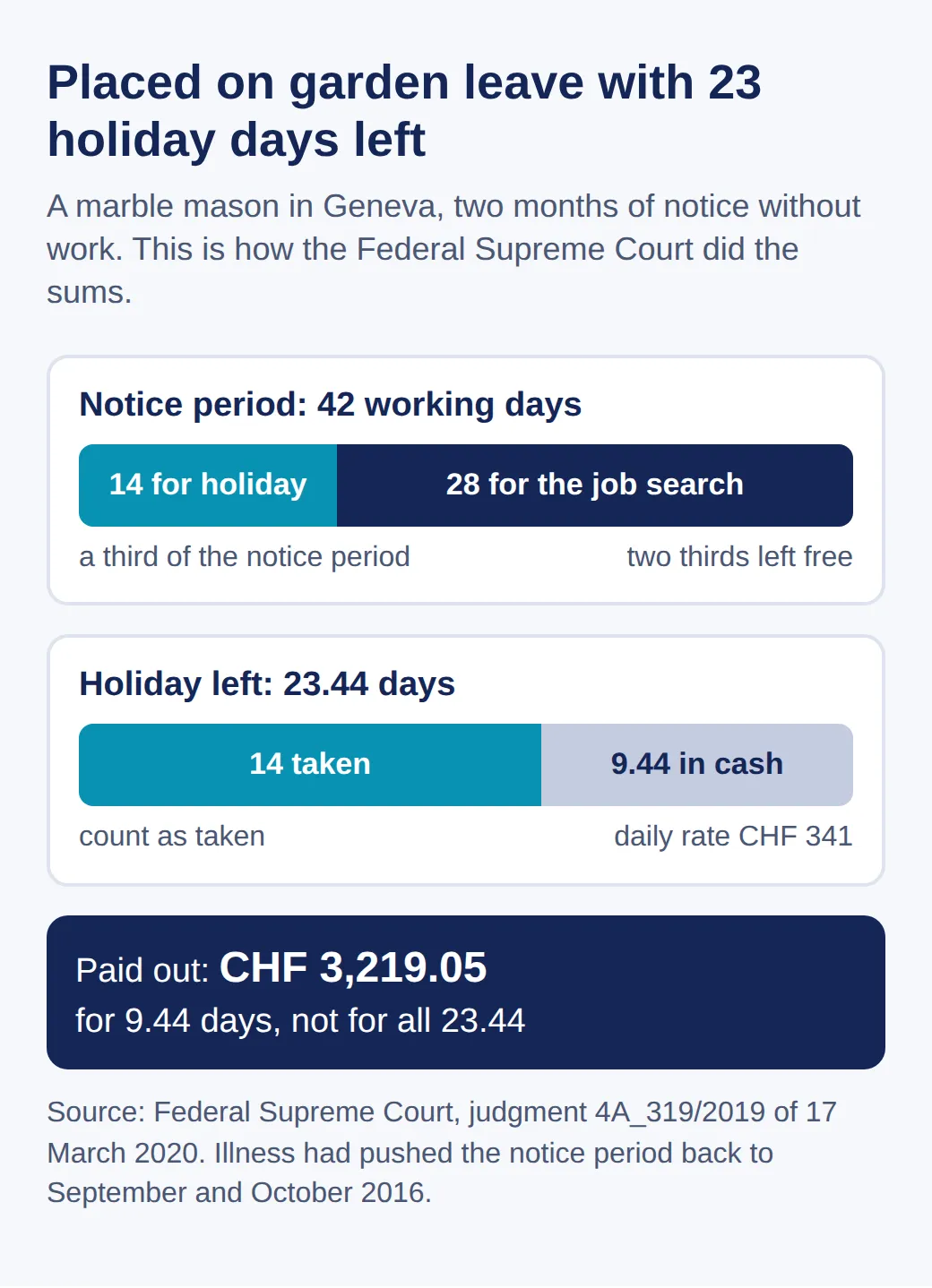
The court considered it reasonable to use a third of those working days for holiday, so 14 days. The employer had to pay out the remaining 9.44 days, CHF 3,219.05. As a rule of thumb, the judgment names a quarter to a third of the notice period. Two points from it help you too: the marble mason did not have to prove that he had actually been looking for work. And the months he was ill did not count as holiday, because illness is not rest.
Whatever is left at the end turns into money. How much can be worked out quite precisely.
What is paid out on your last day
When your employment ends, all claims fall due (Art. 339 CO), including those for untaken holiday. For the last, incomplete year of service, you are entitled to a share in proportion to how long you worked that year (Art. 329a para. 3 CO). If you have four weeks of holiday, a year of service starting in January and work until the end of September, that comes to nine twelfths of 20 days, so 15 days.
You are paid the full salary for those days (Art. 329d para. 1 CO). The Zurich Labour Court explains in its fact sheet on calculating holiday pay (in German) how to get to the daily rate: with a five-day week, a year has 260 or 261 working days; divided by 12, that makes 21.66 or 21.75 working days a month. If a 13th-month salary has been agreed, a matching share belongs in the calculation, according to Basel-Stadt.
A worked example of our own: you earn CHF 6,500 gross a month, paid 13 times a year, and have 7 holiday days left when you leave. Per month, that is 6,500 × 13 ÷ 12 = CHF 7,041.67; divided by 21.75, it gives a daily rate of CHF 323.75. For 7 days, that makes CHF 2,266.25 gross, from which the usual social security contributions are deducted.
Check your final pay statement for both: the number of days, broken down by year, and the daily rate. Dismissal without notice has its own rules, which we explain in our post on summary dismissal. Overtime, which often sits in the same balance, is not covered by holiday law; more on that in our post on overtime and extra hours.
What to do before the turn of the year
Start by looking at your balance, broken down by year. If any days date from 2021 or earlier, they are time-barred or close to it by the Federal Supreme Court's reckoning, unless your employer acknowledged the balance in the meantime. Ask for written confirmation of what you have left; it takes one email:
Dear [Name]
According to the time-tracking system, I will have [number] holiday days left at the end of the year, [number] of them from [year]. Could you please confirm this balance in writing? For the remaining days, I would like to propose the following dates: [dates].
Kind regards [Name]
Put in your dates early so your employer can plan. It generally has to fix holidays three months in advance itself, and the same lead time works well for you. And if a job change is coming up: a balance paid out when you leave is welcome; a week that has become time-barred is not. If you are looking for a new job, you can find current full-time jobs across Switzerland in our overview.
Common questions
- Can my employer in Switzerland cut my holiday after long sick leave?
- Only after a grace period. If you are kept from working through no fault of your own for no more than one month in total in a year of service, your employer may not cut anything. After that, it may deduct one twelfth for every further full month; with four weeks of holiday, the canton of Basel-Stadt puts that at 1.67 days a month. Up to two months of absence because of pregnancy may not lead to any cut at all.
- Does a public holiday during my time off count as a day of leave?
- No. If a public holiday falls during your holiday, it is not deducted from your holiday balance. If you work part-time and would have had that weekday off anyway, you do not get a replacement day for it, the Basel-Stadt Office of Economy and Labour points out.
- How many holiday days do I get if I work part-time in Switzerland?
- The same number of weeks, but fewer days. If you work 40 percent on two days a week and have four weeks of holiday, you get 8 holiday days a year. The example comes from the canton of Basel-Stadt. The same rules on time limits and payouts apply as for full-time staff.
- Do I get my holiday days back if I fall ill on holiday?
- Yes, if the illness or accident really stops you from resting. A mild cold is not enough. Tell your employer straight away and get a doctor's certificate confirming you were unable to enjoy your holiday. If you are already ill before your holiday starts, you can ask for it to be moved.
- Can I work for another company while I am on holiday?
- Be careful. If you do paid work for someone else during your holiday and this harms your employer's legitimate interests, your employer may refuse your holiday pay and reclaim any holiday pay already paid. That is laid down in Article 329d paragraph 3 of the Code of Obligations. Holidays are there for you to rest.
More posts
All posts
Changing jobs in Switzerland: moving your pension fund money
New job on 1 January? What to tell your old pension fund, how to read the exit statement and where your vested benefits go if there is a gap.

Sick pay in Switzerland: Bern, Zurich and Basel scales
How long your salary is paid when you are ill in Switzerland: the Bern, Zurich and Basel scales, 80% sickness benefits and the medical certificate.

Arbeitszeugnis: how to read and fix a Swiss work certificate
What the wording in a Swiss work certificate (Arbeitszeugnis) means, why there are no secret codes and how to get it corrected. With rulings up to 2026.