Summary dismissal in Switzerland: reasons, deadlines, rights

If you were dismissed
A summary dismissal ends your job at once, even if it was unjustified. It only holds after a particularly serious incident, for lesser breaches only after a warning, and the company has to act within a few days. Without good cause, it owes you your pay to the end of the notice period plus compensation of up to six months' salary.
A Federal Supreme Court ruling from April 2026 shows how expensive a wrong call can be for a company (4A_56/2026). An e-commerce manager in Zug had handed in her own notice, effective the end of 2022, and already had a new job lined up. Eight days later the company dismissed her without notice for bringing in freelancers without permission. Before that, four people had questioned her for about two hours and threatened to call the police, and the day after the dismissal the company's lawyer wrote to her new employer. The trouble was that the co-CEO had known about the freelancers. The company had to pay her wages for November and December, CHF 11,632.50, plus five months' salary in compensation, CHF 35,500. We go through the topic from your side, with the rulings that show where courts draw the line.
Your job ends at once, even without good reason
A summary dismissal ends the employment the same day, in law and in fact, even if it was unjustified. SECO says so in its directive on unemployment benefits (in German, marginal number C210). No court will later put you back in your job. All that is left to argue about is money.
The law sets no particular form for a summary dismissal. But you have the right to ask for the reasons in writing (Art. 337 para. 1 CO), and you should do so straight away. If you were dismissed orally, the Zurich courts (in German) also advise a written protest.
The courts provide a template for this. In it, you do not offer to keep working. Instead you say that you are looking for a new job and will hold the company liable for your lost pay. A few lines are enough:
Registered mail
[Place, date]
Summary dismissal of [date]
Dear Sir or Madam
You dismissed me with immediate effect on [date]. I dispute that there was good cause and ask you to give me the reasons in writing under Art. 337 para. 1 CO.
I claim my pay up to the end of the regular notice period. I reserve the right to claim compensation under Art. 337c para. 3 CO. Please also issue me a work certificate.
Yours faithfully
[Signature]
Whether this gets you anywhere comes down mainly to one question: is the reason the company gives good enough?
What courts accept as good cause
There is good cause when the company cannot, in good faith, reasonably be expected to keep you on until the end of the notice period. The Federal Supreme Court requires a particularly serious breach that is objectively capable of destroying trust and actually did destroy it, as in the case of a butler from the canton of Lucerne (4A_151/2025). Whether an incident is enough is for the court to decide at its discretion, looking at your position and responsibility, how long you have been employed and the nature of the incident.
How long the job would have lasted anyway also counts (BGE 142 III 579). The shorter that remaining time, the more serious the incident has to be. So if notice has already been given in the normal way, courts look closely. A company in Zug had given its managing director ordinary notice in February 2020, effective the end of August. In April came a "warning of summary dismissal" (Abmahnung zur fristlosen Kündigung), and five working days later the summary dismissal. The Zug courts had the impression that, having given him notice, the company wanted to be rid of him as fast as possible, and the Federal Supreme Court did not object to that (4A_546/2023).
An older case shows what is enough without any warning at all (BGE 130 III 28). A salesman had secretly set up his director's private email account to forward a copy of every message to his own account. Whether he had read the private emails could not be proven. For the courts that made no difference: the diversion alone destroyed trust. A criminal offence against the company is usually good cause (BGE 137 III 303). On the other hand, the case law says that not even every criminal act at work is enough, and for private matters the bar is higher still. A part-time employee of a fiduciary firm in the canton of Zurich was dismissed because she was having an affair with the husband of the managing director, who was also the sole shareholder. The Federal Supreme Court held that this was no breach of contract and declared the dismissal unjustified (BGE 129 III 380).
Two things are never good cause. If you are ill or have had an accident through no fault of your own, you cannot be dismissed without notice for it (Art. 337 para. 3 CO). And poor business is the company's risk, not yours.
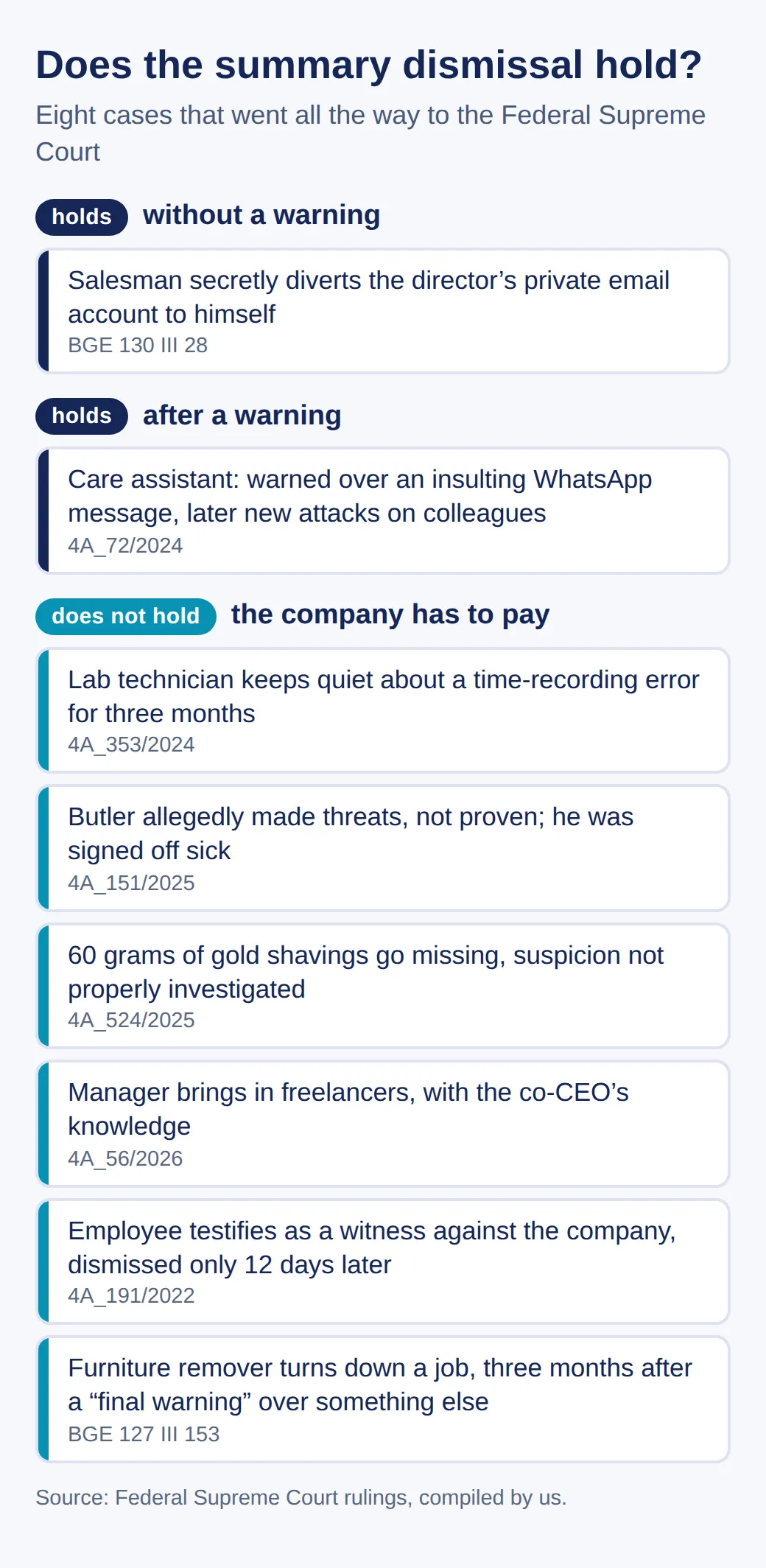
The two dismissals that held rested on a clear breach of trust or on a warning that was ignored.
Why a warning usually has to come first
A less serious breach only justifies a summary dismissal if it happens again despite a warning. A care assistant at a Geneva care home shows what that looks like (4A_72/2024). In March 2020 he sent a colleague an insulting WhatsApp message calling her a snake. In May the home's management gave him a written warning: one more incident and the contract would be ended. In January 2021 he grabbed a colleague by her ponytail, and in February he told colleagues he would deal with a resident with cognitive impairments «personnellement et en dernier», personally and last. The home gave him ordinary notice. After the meeting he went through the floors looking for the colleagues who had reported him. One care assistant came out of the conversation in tears, and several staff locked themselves in a room until the police arrived. The summary dismissal he received the same day held all the way to the Federal Supreme Court, even though he had already been given notice and released from his duties.
A warning is no blank cheque for the company, though. A furniture remover in Geneva was given a "final warning" in October 1999 for helping his former boss with an art delivery on a day off. Three months later he refused to take over a removal job in Zurich for a colleague and was dismissed without notice. The Geneva courts found the dismissal unjustified despite the warning, and the Federal Supreme Court agreed (BGE 127 III 153). The refusal had nothing to do with the conduct he had been warned about, and a warning for something quite different does not allow summary dismissal for the slightest slip. According to the legal commentary cited in the ruling, a warning has two jobs: it names the behaviour that is the problem, and it spells out a consequence. It does not have to say "without notice", but it must be clear that more is at stake than ordinary notice.
If you think a warning is wrong, dispute it in writing and keep your reply. If it comes to a dispute, it is evidence. And a warning, too, has to come promptly: the Zug managing director received his "warning of summary dismissal" over an incident from October 2019, but the company could not show when it had first learned of it. That brings us to the question of time.
How quickly does the company have to act?
Quickly. The case law treats two to three working days as enough time to think it over and get legal advice (BGE 138 I 113). It may take a little longer if a body such as a board of directors has to decide or employee representatives have to be consulted. A company that waits longer gives the impression, in the Federal Supreme Court's words, that it can live with the job continuing until its regular end, and it loses the right to dismiss without notice (4A_191/2022).
That case, from Ticino, shows how the days are counted. On 13 March 2019 a manager gave evidence as a witness in a lawsuit brought by two former employees, contradicting her company's version. Three days later she sent the judge documents backing up her statement. The company learned of this on 21 March and dismissed her without notice on 25 March. The company considered that to be in time. The courts counted from the witness statement, which was the real trigger, and arrived at twelve days. Too late. The employee was awarded the wages she had claimed plus three months' salary in compensation.
The company is also bound by the reasons it gives. Reasons the company already knew when it dismissed you cannot be added later. It may only add what it neither knew nor could have known at the time, and events after the dismissal never count (4A_56/2026). That is why it pays to ask for the written reasons at once. Whatever is stated there, the company then has to prove.
Suspicion is only enough after a careful investigation
The company has to prove the incidents it relies on, and to the point where the court is convinced. An assumption is not enough. The butler from the canton of Lucerne had worked since 2016 as caretaker, chauffeur and butler on a country estate. From 20 March 2021 he was signed off sick at 100 percent, and two days later came the summary dismissal: he had allegedly blocked the lift with his foot and threatened his boss. The boss could not prove it, and even admitted to having laughed at the butler after the incident. The labour court awarded him a total of CHF 49,548.20 net, and the Federal Supreme Court upheld that in June 2025.
There is one exception: suspicion of a serious crime. If the suspicion is substantial and the company investigates it at once, as thoroughly as can be expected of it, it may dismiss without notice, and the dismissal holds even if the employee later turns out to be innocent. A case at a Geneva watch components supplier shows how demanding this duty to investigate is (4A_524/2025). In June 2021 a supervisor found three bags, each holding 20 grams of gold shavings, in a drawer, and the company put them back to see who would collect them. On the video a machine setter walks to the cupboard, bends down and is out of the picture for about twenty seconds; two days later the bags were gone. The company reported him to the police, the police picked him up at work, and the dismissal letter was written before he had been questioned. The company never followed up on the fact that the exit check on the evening in question had found nothing, and it never heard his side. The criminal court later acquitted him. He was awarded his wages to the end of September 2021, his share of the 13th monthly salary, his holidays and CHF 10,000 in compensation, more than one month's salary.
So write down that same day what happened, who was there and what was said, and don't sign any record that is not accurate. How much money is at stake is settled by a single article.
What you can claim when the reason is not enough
If the dismissal was unjustified, you are entitled to three things, set out in the three paragraphs of Article 337c CO.
First, you get what you would have earned had the company given you ordinary notice. What counts is your notice period: unless your contract says otherwise, one month in the first year of service, two months up to the ninth year and three after that, each to the end of a month (Art. 335c CO). On a fixed-term contract, the agreed end date counts. Your share of the 13th monthly salary and your holidays up to that date are included. The butler from Lucerne also added the protected period for his illness, by which an ordinary notice would have been extended. We explain how these protected periods work in our post on protected periods against dismissal.
Second, what you earn elsewhere during that time, what you save because the job has ended and what you intentionally failed to earn is deducted. That can be expensive, as a coach in Valais found out (4A_90/2024). He earned CHF 20,000 a month, his fixed-term contract ran until the end of June 2019, and he was dismissed without notice in September 2018. After that he applied for one job in September and none at all from October to January. The court found that with steady applications he would have had a job after five months, and cut his claim for lost pay from CHF 181,755.75 to CHF 94,422.40 gross. The courts also cut one of the four months from the Zug managing director's claim, because as a highly qualified professional he would have found a new job sooner. It is the company that has to prove this, but your own records of applications are the most important evidence, for you or against you.
Third, the court can award compensation of up to six months' salary. It is meant to punish the company and to compensate you for the harm to your personality rights. As a rule it is owed, and it is only refused in exceptional circumstances (4A_353/2024). The amount depends above all on how reprehensibly the company acted, how hard you were hit and how much you contributed yourself.
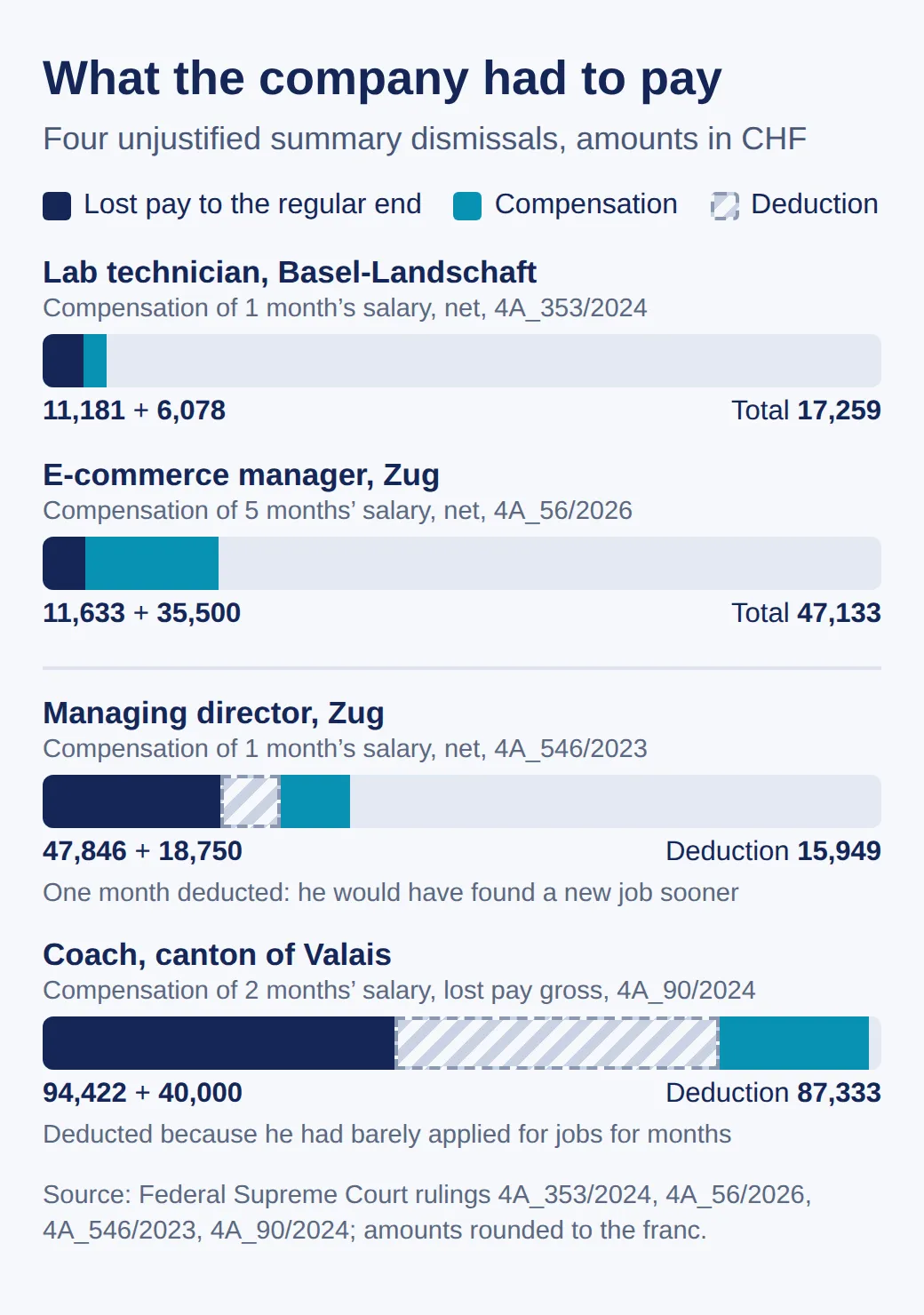
Your own misconduct does not necessarily wipe out the compensation either. In the case of the lab technician from Basel-Landschaft, nobody had adjusted his target hours after his employment percentage was raised. He worked less on full pay and said nothing for three months after noticing the error. A breach of his duty of loyalty, the courts found, but not one that made keeping him on until the regular end unreasonable, especially as time recording was the company's job. He was awarded CHF 11,181.10 in lost pay and one month's salary in compensation.
Two rules protect you here. While you are employed and for one month afterwards, you cannot waive claims under mandatory law (Art. 341 CO), and lost pay under Article 337c paragraph 1 is one of them. A receipt for full and final settlement (Saldoquittung) that the company puts in front of you on the day of the dismissal has no effect to that extent, as SECO notes in an example in its directive. You still shouldn't sign it. And unlike with an abusive dismissal, you don't have to lodge an objection by a particular date. You cannot get compensation for an abusive dismissal on top, as the two cannot be added together (BGE 121 III 64). The rules on abusive dismissal concern ordinary dismissal with notice.
If you cannot reach an agreement, the first step is the conciliation authority (Art. 197 CPC). In employment disputes up to CHF 30,000, no court costs are charged either there or in court (Art. 113 and 114 CPC). Sometimes, though, it is the other way round, and you are the one who cannot stay.
Quitting without notice: when you may leave at once
The same good cause and the same strict standards apply to you as to the company. If the issue is unpaid wages, the Zurich courts (in German) advise a more cautious first step: send a reminder for your pay. If it still does not arrive, you may stop working without losing your right to your wages (BGE 120 II 209). The job continues in the meantime, and so does your pay.
A clear case came from Neuchâtel (BGE 133 III 657). A domestic helper worked for a family for almost a year and was paid a total of CHF 1,438.45 in that time. The cantonal court held that leaving at once was justified, and by the time the case reached the Federal Supreme Court that was no longer in dispute. Quitting with good cause like this gets you full damages, meaning the pay you would have earned up to the regular end (Art. 337b CO). The penalty of up to six months' salary does not apply in this case, though, only damages for non-material harm if the company has violated your personality rights (BGE 137 III 303). In the ruling that confirms this rule, the captain of a football club was allowed to leave at once after the club had permanently banished him from the first team over an exchange of words with the coach at half-time. If your company becomes insolvent, you can demand that it provide security for your future wage claims within a reasonable period. If it doesn't, you may leave without notice (Art. 337a CO).
Without good cause it gets expensive. If you walk out without notice, the company can claim a quarter of your monthly salary plus any further damage. If it does not set the amount off against your wages, it has to start debt collection or sue within 30 days, or the flat-rate claim lapses (Art. 337d CO). And the unemployment insurance fund looks closely at why you left.
How unemployment insurance treats it
If you lose your job through your own fault, you get no daily allowance for a number of days (Art. 30 of the Unemployment Insurance Act, in German). Unemployment counts as your own fault in particular when your behaviour gave the company cause to dismiss you (Art. 44 of the Unemployment Insurance Ordinance, in German). How long depends on the degree of fault: 1–15 days for minor fault, 16–30 for medium and 31–60 for serious fault (Art. 45 of the Ordinance, in German).
In SECO's suspension scale, which the unemployment insurance funds follow, a justified summary dismissal on an open-ended contract counts as serious fault, as does handing in your own notice without a firm job offer elsewhere or agreeing to end the contract by mutual consent. According to SECO, for serious fault the fund starts from the middle of the range, 45 suspension days, and adjusts up or down from there. Because five daily allowances make one week (Art. 21 of the Act), 45 suspension days are about nine weeks without money. And they are deducted from your maximum number of daily allowances.
The fund may not penalise you on the company's word alone. It has to weigh both versions, and your behaviour has to be clearly established (directive, marginal numbers D20 and D76). If you challenge the dismissal before the labour court, the fund will still impose a suspension where there are strong indications, but it revisits that after the judgment, whatever the outcome. If you object to the suspension itself, it waits for the judgment (C244 and C245). If you handed in your own notice, the penalty does not apply if, because of good cause under Article 337 CO, you could not reasonably be expected to stay (D27). The standard for that is strict, and health reasons need a medical certificate.
One point that can help you in this situation is in Article 29 of the Act. For the time up to the end of your notice period, the company is in principle responsible. But if there are well-founded doubts that you will get the money, the fund pays daily allowances and takes over your claim against the company to that extent. SECO names summary dismissals in particular as a source of such doubts, for example when the company cannot be expected to pay within one or two months (C221). The compensation of up to six months' salary does not pass to the fund; it stays yours (C212). This does not apply to days before you registered (C233).
The first days after the dismissal
On the day of the dismissal, write down what happened and send the company your protest by registered mail, asking for the reasons in writing. That day or the next, register with the regional employment centre (RAV) so you don't lose any days. Don't sign a receipt for full and final settlement or a termination agreement before you have had advice. A trade union or your legal protection insurance, if you have it, can assess your chances.
Then look for a new job and keep a record of it, with the date, the company and the reply. The RAV requires this anyway, and in court it protects your claim for lost pay, as the case of the coach in Valais shows. A temporary job can bridge the gap until something permanent comes along. And ask for your work certificate, which you are entitled to even after a summary dismissal. How to read it and get it corrected is in our post on the wording in a work certificate.
Common questions
- Can my employer dismiss me on the spot verbally or by text message?
- Yes. The law sets no form for a summary dismissal, so it can be given orally. But the company must give its reasons in writing as soon as you ask for them. After an oral dismissal, the Zurich courts recommend a written protest, so it is clear later on that you disputed the reason.
- Can I be dismissed without notice during the probation period?
- Yes, Article 337 CO applies at any time. Because the notice period during probation is only seven days unless agreed otherwise, the lost pay you can claim after an unjustified summary dismissal is small. For the unemployment insurance fund, a justified summary dismissal during probation still counts as serious fault.
- What happens to my holidays and 13th monthly salary after a summary dismissal?
- If the dismissal was unjustified, both are part of the pay you are owed up to the end of the regular notice period. In the Geneva case of the gold shavings, the courts awarded the employee his wages to the end of September plus his share of the 13th monthly salary and his untaken holidays. Include these items in your claim.
- Can an apprentice be dismissed without notice?
- An apprenticeship contract can also be ended with immediate effect for good cause. The law names further cases, for example when the apprentice lacks the physical or mental aptitude the training requires. In that case the apprentice must be heard first, and for minors their legal representative too.
- Am I entitled to a work certificate after being dismissed without notice?
- Yes, you can ask for a work certificate at any time, including after a summary dismissal. If the company refuses or the content is wrong, the court can set the wording. In the Zug case of the e-commerce manager, it ordered the company to issue a certificate with precisely specified text.
More posts
All posts
Swiss probation period: when it ends, what illness changes
Probation period in Switzerland: one to three months, seven days' notice, no protection while sick. How illness extends it and the rules for fixed-term jobs.

Unfair dismissal in Switzerland: deadlines and compensation
When a dismissal in Switzerland is abusive, the two deadlines you must meet and how much compensation the Federal Supreme Court actually awards.

Unused holiday in Switzerland: does it expire at year end?
Unused holiday in Switzerland does not expire on 31 December; it becomes time-barred after five years. Rules for company shutdowns, notice and garden leave.