Bonus in Switzerland: when you are entitled to one

Before bonus season
You are entitled to a bonus if your contract names an amount or a fixed formula, if your employer has paid it three years in a row without a reservation, or if it is so large next to a modest salary that it is really salary. Anything else is a voluntary gratuity. If you resign before payday, you only get a share of it if that was agreed.
The law itself names the two usual dates: Christmas and the end of the financial year. That is why many employers pay with the December salary or in spring, once the annual accounts are closed. If you plan to resign before one of these rounds, fear a cut or simply want to know what you can count on, the answer lies in your contract, the bonus rules and the letters of the past few years. We show how the Federal Supreme Court reads these documents, with real cases and thresholds worked out from the latest wage figures of the Federal Statistical Office (FSO).
A third get a bonus, and the amounts vary widely
Bonuses are common in Switzerland, but far from universal. According to the Swiss Earnings Structure Survey 2024 by the FSO, 32.6 percent of employees received a bonus, on average CHF 11,967 a year. The FSO defines a bonus as an irregular annual special payment on top of the base salary. A 13th-month salary does not count; 75.9 percent of employees received one.
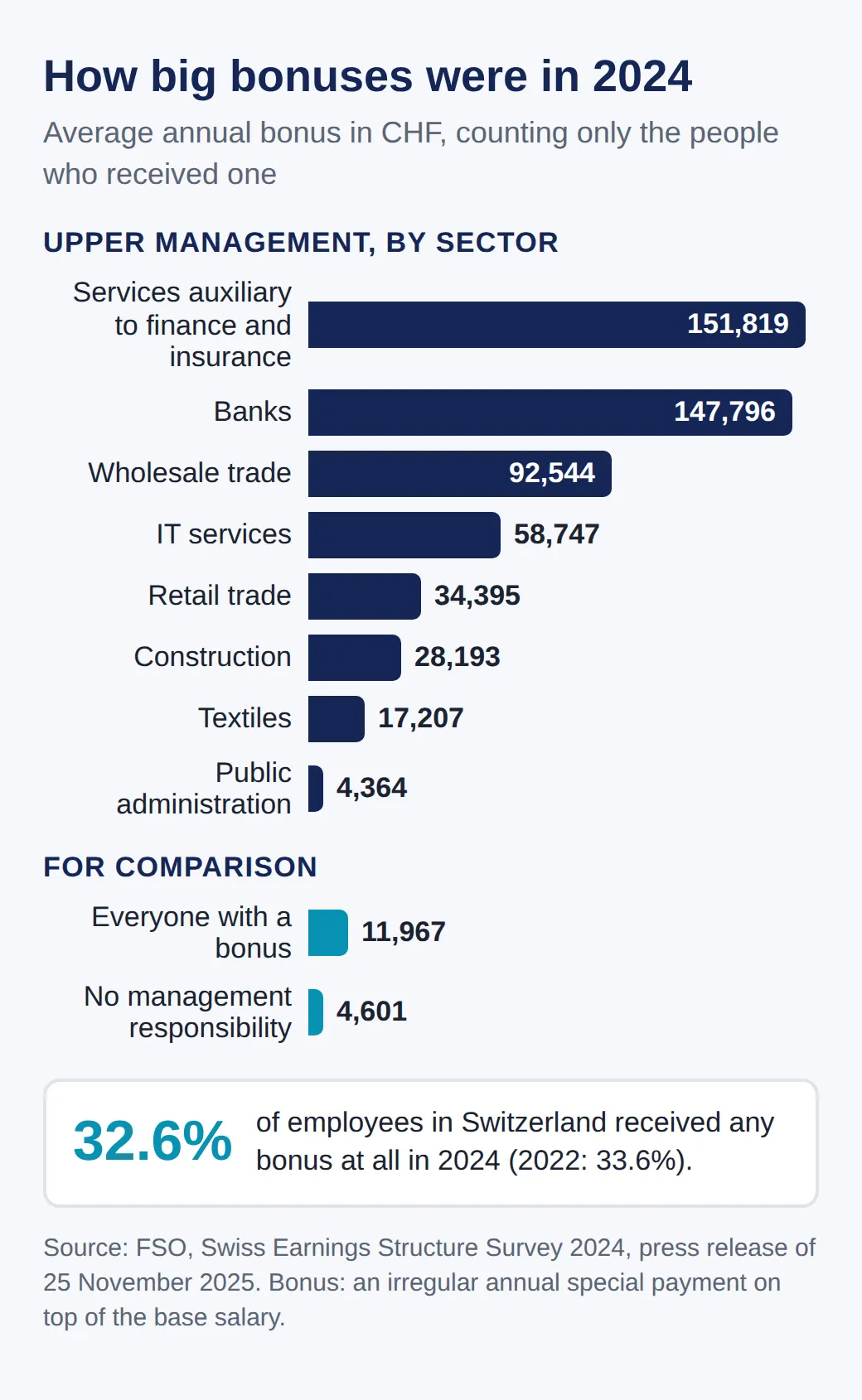
The spread is huge. In upper management at banks, the average bonus was CHF 147,796; in public administration it was CHF 4,364. People without management responsibility received CHF 4,601 on average. For most employees, then, a few thousand francs are at stake; for some, six-figure sums. These very differences matter later, when the question is whether a bonus can still be voluntary. But first comes the question that decides everything else.
Salary or gratuity: the question behind every bonus
The word "bonus" as such has no legal meaning of its own in the Code of Obligations (CO). A court therefore puts it into one of two categories: salary under Article 322 CO, or a gratuity under Article 322d CO, called Gratifikation in German. The English version of the Code describes it as a bonus paid "on particular occasions", to which you are only entitled "where it is contractually stipulated".
The Federal Supreme Court draws the line like this. If the bonus is fixed in the contract or can be calculated by fixed rules, it is salary and it is owed. If the employer keeps some leeway, at least over the amount, it is a gratuity. The employer already has that leeway when its personal assessment of your performance counts alongside the business results. An amount fixed in advance cannot be a gratuity, the court held in judgment 4A_364/2024 of February 2025 (in German). A fixed 13th-month salary is therefore salary, whatever it is called.
Within gratuities, the court makes one further distinction in judgment 4A_280/2020 (in French). That gives three cases:
| Case | Are you entitled? | Leaving before payday |
|---|---|---|
| Variable salary (amount or formula fixed) | Yes, at the calculated amount | A share for the time worked |
| Gratuity you are entitled to (agreed or by custom) | Yes, but the employer has a say in the amount | A share only if agreed |
| Voluntary gratuity | No, unless it is too large to be a mere extra | A share only if agreed |
Which case applies to you is rarely spelled out in a single sentence. Usually you have to read the contract, the bonus rules and the yearly bonus letters together.
What your contract says about your bonus
Look for three things: whether an amount or a formula is named, whether the employer reserves its discretion, and what happens when you leave. Four clauses the Federal Supreme Court has ruled on show how differently that can turn out.
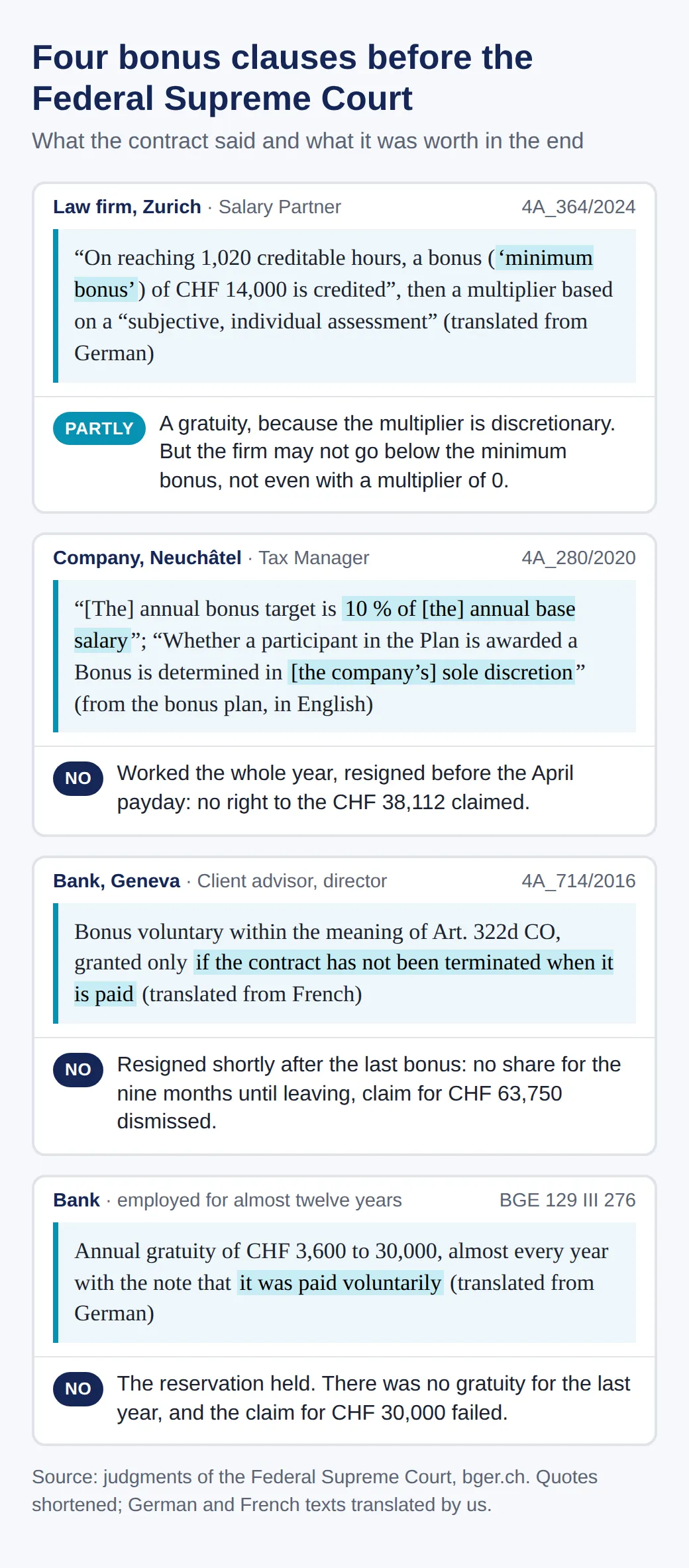
The most instructive case is the latest one. A lawyer worked as a salary partner at a Zurich law firm from 2018 to 2020, on a base salary of CHF 9,700 a month. His bonus rose in step with the hours clients paid for: CHF 14,000 at 1,020 hours, and another CHF 14,000 for every further 100 hours. The partners then multiplied the result by a factor based on their "subjective, individual assessment". That factor turned the whole bonus into a gratuity, the court decided. But the firm could not set it to zero, as it later tried to do. An employer that calls CHF 14,000 a "minimum bonus" in the contract may not go below it; otherwise the word would be misleading.
For you, this means a bonus with a formula is not automatically salary. As soon as the contract mentions "discretion", "assessment by management" or "voluntary", it is usually a gratuity. A minimum amount that is expressly promised, however, stays owed. If your bonus depends only on profit or turnover, for example as a fixed percentage, you have a share in the business results. Your employer must then give you the information you need and let you see the accounts, as far as you need them to check the calculation (Article 322a CO).
If your contract says nothing at all, or your employer simply pays every year, a different rule comes into play.
Three years without a reservation: when habit becomes a right
If your employer pays a gratuity at least three years in a row without pointing out that it is voluntary, it counts as tacitly agreed. That is settled case law, most recently confirmed in judgment 4A_280/2020. It makes no difference whether the amount was the same each year. If the amounts varied, though, the employer keeps some leeway over how much it pays.
So the reservation is what matters, and it is stronger than many people think. In the case behind BGE 129 III 276 (in German), an employee had worked at a bank for almost twelve years, and the dispute went through the Basel courts. He received a gratuity every year, CHF 3,600 in the first year and CHF 30,000 in 1999. For 2000, his last year, he got nothing and sued. He lost: with every payment but one, the bank had noted that it was made voluntarily. A single forgotten note does not create a right.
Nor does the reservation have to be repeated every year if it is already in the contract. A tax manager in Neuchâtel was hired on a starting base salary of CHF 140,000 with a bonus target of 10 percent. He argued that the company had paid the bonus for years without any further reminder. That did not help him, because the bonus plan itself left both whether and how much to the company's discretion. The three-year rule does not apply when the contract reserves both.
The Federal Supreme Court allows two exceptions. A reservation does not count if it is mere boilerplate and the employer shows by its conduct that it feels bound to pay. And after decades of payments, a right can arise despite the reservation, but only if the employer never used it, even in years of poor business or weak performance. You have to prove either one, and that rarely succeeds.
So dig out the bonus letters of the past few years. If none of them says "voluntary", "without prejudice" or something similar (in German letters, freiwillig or ohne Präjudiz), and neither does the contract or the bonus rules, you have a good argument after three payments. If you find the reservation, one last question remains: whether the bonus is too large to still be voluntary.
Is a large bonus on a small salary really salary?
It can be. Under the case law, a gratuity may only be an extra on top of the salary. No employment contract should be built so that you live mainly on a voluntary payment. If the voluntary part grows too large, the court treats it wholly or partly as salary, even if the employer called it voluntary.
How large is too large depends on how much you earn. In BGE 141 III 407 and judgment 4A_714/2016 (both in French), the Federal Supreme Court set three tiers and tied them to the Swiss median wage in the private sector. That is the wage in the middle: half of employees earn more, half earn less. According to the FSO table, it was CHF 6,722 a month for a full-time job in 2024. Using the court's method with twelve monthly salaries, that gives these thresholds:
- Modest salary, up to the median itself, so up to about CHF 80,700 a year: even a bonus well below the base salary can be salary.
- Middle to high salary, above that up to the line for very high incomes: the bonus generally has to be as high as the annual salary or higher, and paid regularly.
- Very high income, from five times the median, so CHF 403,320 for base salary and bonus together: a voluntary bonus always stays voluntary.
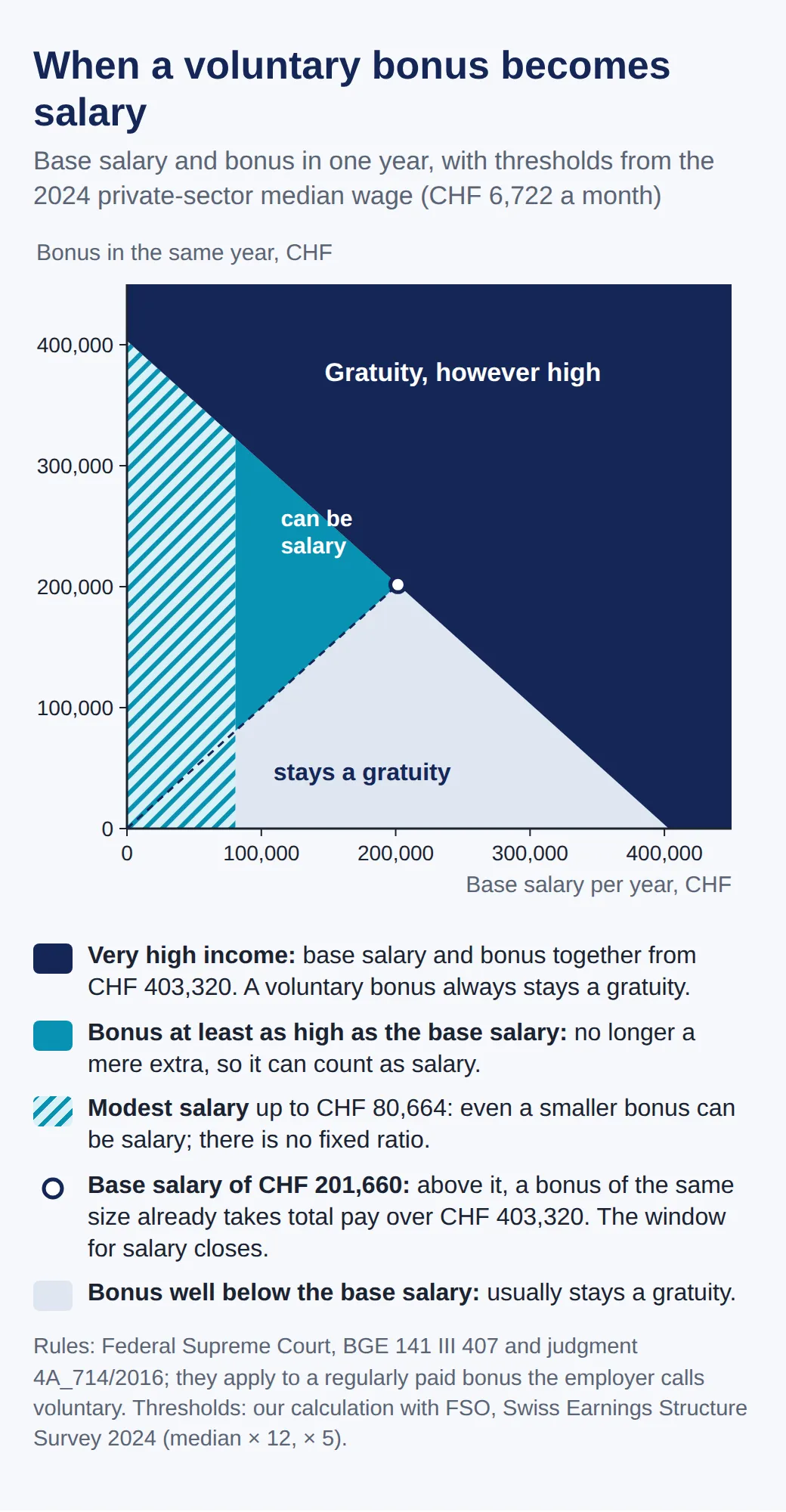
For the lowest tier the court sets no fixed ratio; it decides case by case. For the middle tier it is strict. A client advisor at a Geneva bank earned between CHF 100,000 and 165,000 and received bonuses of between 16.94 and 60.60 percent of his base salary. That was not enough: the bonus remained an extra and therefore voluntary. The comparison is always between one year's base salary and the bonus paid out in that same year, even if the bonus is based on the previous year's figures.
The chart shows a consequence that is easy to miss. From a base salary of CHF 201,660, a bonus of the same size already takes total pay above CHF 403,320. If you earn that much, you can in practice no longer rely on the rule that a bonus at least as high as the salary counts as salary. Which brings us to top salaries.
The cut-off for top earners: five times the median wage
According to the Federal Supreme Court, people who earn a great deal do not need special protection. From five times the median wage, freedom of contract therefore applies, and a voluntary bonus stays voluntary, however large it is compared with the base salary. What counts is everything you actually received from your employer in the year in question: base salary plus the bonuses paid out in that year.
The case in which the court introduced this cut-off in 2015 concerned a managing director at a bank. He resigned in March 2009 with effect from the end of June. In those six months he received CHF 150,000 in salary and, after the bank had clawed part of it back, CHF 212,071 in bonus. The court projected the 2009 median wage at CHF 5,900 a month and arrived at a threshold of CHF 354,000 a year, or CHF 177,000 for six months. At CHF 362,071, he was clearly above it. The bank did not have to pay the further CHF 150,000 or so that the lower court had awarded him.
The following year the court confirmed the cut-off in BGE 142 III 381 (in German). A senior private banker in Zurich had received CHF 239,220 in base salary in the last year of his employment and two bonus payments totalling CHF 244,480, CHF 483,700 in all. The threshold was CHF 367,725. He had sued for around CHF 266,000 for his last year and got nothing. It did not matter which financial year the payments were meant for, only when they were paid.
The same method applies to the bonus rounds ahead. Because the FSO only surveys the median wage every two years, the court projected it with the wage index for the years in between. The nominal wage index rose by 1.8 percent in 2025. That gives us a threshold of around CHF 410,600 for 2025; for 2024 it is CHF 403,320. There are no figures for 2026 yet. If your base salary and bonus together are well below that, the cut-off is not an issue. If you are close to it, do the sums carefully, because here a few thousand francs make the difference between having a claim and having none.
Resigning before payday: do you get a share?
With a gratuity, only if that was agreed. Article 322d paragraph 2 CO says so: if your employment ends before the occasion for the payment, you are entitled to a pro rata share "where the contract so provides". Without such an agreement, the bonus for the current year is lost.
Many contracts go further and pay a bonus only if the employment is not under notice on payday. According to BGE 141 III 407 this clause is customary in banking, and with a gratuity the Federal Supreme Court accepts it. The tax manager from Neuchâtel worked the whole financial year until the end of January 2018, but had handed in his notice in November for that date. The bonus would have been due in April, by which time he had left, and he did not get the CHF 38,112 he sued for. The same went for the client advisor at the Geneva bank. He resigned at the end of March 2014 with effect from the end of September, a few days after receiving his bonus of CHF 80,000 for the previous year. He kept that one. For the nine months of 2014 he got nothing.
It is quite different if the bonus is salary. Then Article 322d paragraph 2 does not apply, and the employer must pay it pro rata for the time you were employed, even without a special agreement. The Federal Supreme Court says so in judgment 4A_714/2016. That share falls due when your employment ends (Article 339 CO). A share in profit or turnover only falls due once the year's results are established, at the latest six months after the end of the financial year.
There is also a limit for the employer. If it dismisses you solely to prevent a bonus from arising, the dismissal is abusive (Article 336 paragraph 1 letter c CO). That will not bring the bonus back, but it can earn you compensation. Which deadlines you must meet for that is explained in our article on unfair dismissal.
If you want to move on yourself, the practical consequence is clear: read the exit clause before you resign. If it says the bonus is only paid when the contract is not under notice, wait until after payday to hand in your notice, if your notice period and the new job allow it.
What to do before bonus season
Lay four documents side by side: your employment contract, the bonus rules or bonus plan in the version that applies, the bonus letters of the past three years and your payslips. Mark every amount, every formula and every word like "voluntary", "discretion" or "not under notice" (in a German contract: freiwillig, Ermessen, ungekündigt). Then work out how large your bonus was compared with the base salary of the same year, and where your total pay stands against the thresholds above.
If that shows you have a claim and your employer pays nothing or too little, ask for the amount in writing. A short letter is enough:
Dear Ms [Name]
Under section [number] of my employment contract of [date] and the bonus rules [title, version], I am entitled to a bonus of [amount or formula] on reaching [target]. I reached this target in the [year] financial year, as [evidence] shows.
Please pay me the bonus of CHF [amount] by [date] and confirm the calculation in writing.
Kind regards [Name]
Keep a copy. If your employer does not reply, the next step is the conciliation authority, as we describe in our article on the work certificate. You have time: claims arising from employment only become time-barred after five years (Article 128 CO).
And if you are weighing up a new job, ask for the bonus rules before you sign. A bonus with a minimum amount or a fixed formula is worth more than a higher "bonus target" at the employer's sole discretion, and an exit clause can cost you a whole year's bonus.
Common questions
- Are AHV contributions deducted from a bonus in Switzerland?
- Yes. Under the AHV ordinance, gratuities and loyalty and performance bonuses count as salary for old-age and survivors' insurance, so your employer deducts AHV contributions from them just as from your base salary. The same applies to monetary benefits from employee shares. Whether the bonus is salary or a gratuity in employment law makes no difference here.
- Does my employer have to pay everyone the same bonus?
- No. With a voluntary gratuity, the employer may treat some people better than others. In 2002 the Federal Supreme Court turned down a bank employee who pointed out that colleagues had received a gratuity when they left. Favouring some employees does not in itself discriminate against the rest.
- What happens to unvested bonus shares when I leave my job?
- Usually the same as with a voluntary cash bonus. In BGE 139 III 155, shares from a bonus plan vested at 20 percent a year over five years, and the rest was forfeited on early departure. Because the bank allocated the bonus at its own discretion, it counted as a gratuity, and the employee did not get the shares that had not yet vested.
- How long do I have to claim an unpaid bonus in Switzerland?
- Five years. Claims arising from employment become time-barred after five years under Article 128 of the Code of Obligations. The period starts when the claim falls due, which for a bonus means the agreed payday. If your employment ends earlier, a bonus that is owed generally falls due on the day you leave.
More posts
All posts
Unused holiday in Switzerland: does it expire at year end?
Unused holiday in Switzerland does not expire on 31 December; it becomes time-barred after five years. Rules for company shutdowns, notice and garden leave.

Summary dismissal in Switzerland: reasons, deadlines, rights
Fired without notice in Switzerland? When a summary dismissal holds, when a warning must come first, what you can claim and what unemployment insurance does.

Changing jobs in Switzerland: moving your pension fund money
New job on 1 January? What to tell your old pension fund, how to read the exit statement and where your vested benefits go if there is a gap.